Table of Contents
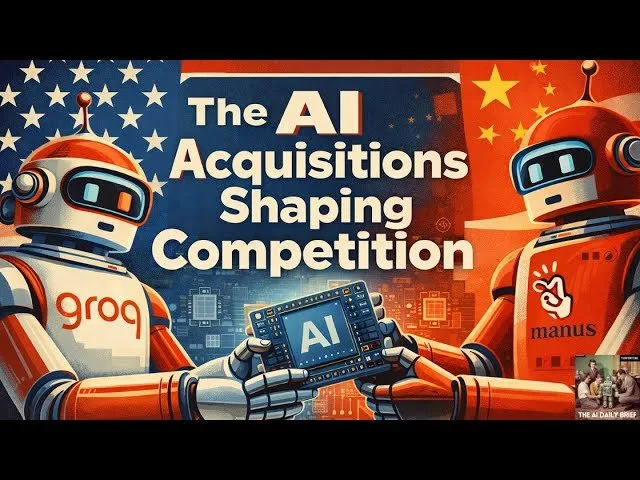
The 2026 technology landscape has opened with a definitive shift in strategy among Silicon Valley’s giants, marked by Meta’s acquisition of AI agent startup Manus for over $2 billion and Nvidia’s massive $20 billion licensing agreement with chipmaker Groq. These high-profile deals, finalized during the holiday break, signal a pivot from general model training toward consumer-facing autonomous agents and the high-speed inference hardware required to run them.
Key Points
- Meta acquires Manus: Meta has purchased the general-purpose agent startup Manus for more than $2 billion, aiming to integrate autonomous task execution into its ecosystem of 3 billion users.
- Nvidia secures Groq talent and IP: In a $20 billion licensing deal effectively functioning as an acquisition, Nvidia has absorbed Groq’s key executives and technology to bolster its high-speed inference capabilities.
- Shift to "Agentic" workflows: The Manus deal highlights a move beyond chatbots to "agents" that execute complex workflows, such as writing and running code to solve problems autonomously.
- Inference over Training: Nvidia’s move suggests a strategic diversification into the inference market, utilizing Groq’s distinct architecture to reduce latency for real-time AI applications.
Meta Bets Big on the Agentic Future
In a move that validates the rising dominance of autonomous AI agents, Meta has acquired Manus, a company that reportedly grew from zero to $100 million in revenue in just eight months. Unlike traditional Large Language Models (LLMs) that generate text, Manus utilizes what experts call "capability overhang" to scaffold agents capable of executing multi-step tasks. This acquisition places Meta directly in competition for the "application layer" of AI.
According to former Scale leader and current Meta Chief AI Officer Alexandr Wang, the acquisition is designed to leverage Manus's ability to navigate complex digital environments. Tech analyst Rahar Jark notes that this represents a fundamental shift in product philosophy.
"Meta has just opened the floodgate for the AI agentic application layer. Manus is more than just an LLM wrapper... instead of just talking about a problem, Manus writes a Python script on the fly to solve it, executes that script in a secure sandbox, and looks at the result."
Strategic Implications for Commerce
The integration of Manus is expected to drive Meta’s ambitions in enterprise and e-commerce. By embedding agentic capabilities into platforms like WhatsApp or Meta Ray-Ban smart glasses, the company aims to move beyond serving as a communication tool to becoming an active assistant in commercial transactions.
Matt Turk of First Mark argues that consumer intent is migrating away from traditional apps toward autonomous agents. For Meta, owning the agent means retaining the user interface for internet commerce. As analyst Shaun Chahan observed, the value lay not just in the technology, but in the proven market fit:
"Meta didn't pay $2 billion for Manus' technology. They paid for 8 months of distribution proof... The agent war won't be won in benchmarks. It will be won in the apps users refuse to leave. Distribution is the new moat."
The deal also involved complex geopolitical maneuvering. Originally founded in China before relocating to Singapore, Manus faced scrutiny regarding its origins. Meta has stated that there will be no continuing Chinese ownership following the transaction, and operations in China will cease, effectively severing the geopolitical ties to clear regulatory hurdles.
Nvidia Dominates the Inference Stack
Parallel to Meta’s software play, Nvidia has solidified its hardware dominance through a $20 billion arrangement with Groq. While technically structured as a non-exclusive licensing deal, industry insiders characterize it as a strategic acquisition. Nvidia gains access to Groq’s proprietary technology and key personnel, including founder Jonathan Ross, a former Google executive known for inventing the TPU (Tensor Processing Unit).
The deal addresses a specific vulnerability in Nvidia’s portfolio: high-speed inference. While Nvidia’s GPUs are the gold standard for training AI models, they are often constrained by memory bandwidth during the inference phase (generating responses). Groq’s architecture, which utilizes fast SRAM rather than the High Bandwidth Memory (HBM) used in GPUs, offers significantly lower latency—a critical requirement for the real-time agents Meta and others are building.
UBS analysts maintained a "buy" rating on Nvidia following the news, highlighting the strategic fit:
"[The deal could] bolster Nvidia's ability to service high-speed inference applications, an area where GPUs are not ideally suited because of all the off-chip high bandwidth memory. This would also be one of the fastest growing parts of the inference market."
The Inference-Training Cycle
This acquisition suggests Nvidia is preparing for a future where inference volume vastly outstrips training volume. By offering specialized, lower-margin chips for running models (inference) alongside their high-margin chips for building models (training), Nvidia creates a virtuous cycle. As Jonathan Ross, now joining Nvidia, explained regarding the market dynamics:
"If we were to deploy a lot of much lower cost inference chips... the demand for training would increase because the more inference you have, the more training you need and vice versa."
Market Outlook for 2026
These dual acquisitions set the tone for the coming year: the battleground is shifting from who has the smartest model to who can deploy the most useful agents and who controls the infrastructure they run on.
For Meta, the challenge will be integrating Manus’s "doing" capabilities into a seamless user experience for billions of consumers without alienating its user base. For Nvidia, the integration of Groq’s team allows them to defend against vertical integration by cloud providers like Google and Amazon, ensuring they remain the default hardware provider for both creating and running intelligence.
As the industry moves deeper into 2026, stakeholders should expect further consolidation as major tech incumbents rush to secure the components of the "agentic" stack—both the software that performs the labor and the silicon that powers the speed.