Table of Contents
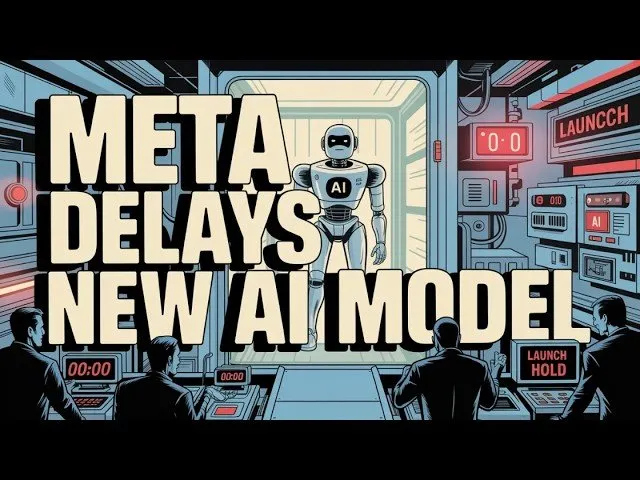
Meta has indefinitely delayed the release of its latest frontier artificial intelligence model, codenamed Avocado, following internal benchmarks that revealed performance shortfalls. The decision marks a significant setback for the company’s AI ambitions, as industry competitors continue to sharpen their own capabilities and internal leadership turnover impacts major players across the sector.
Key Points
- Meta's Avocado model, previously expected for a spring release, is delayed due to underperformance in critical reasoning, coding, and writing benchmarks.
- xAI continues to face internal churn, with two more co-founders departing, bringing the total to six departures this year.
- Cursor is reportedly seeking a $50 billion valuation as it shifts strategy toward training its own proprietary models.
- Medical adoption of AI has surged, with 81% of physicians now utilizing the technology, primarily for administrative tasks and document summarization.
Meta's Development Hurdles and Market Positioning
Meta’s delay of Avocado underscores the immense difficulty of maintaining a competitive pace in the fast-moving AI landscape. Internal reports indicate that the model failed to match the performance of high-tier competitors, specifically struggling against the latest iterations from Google Gemini. Despite the setback, Meta leadership remains publicly optimistic about the company's trajectory, emphasizing that the current delay serves to ensure quality over quantity.
"Our next model will be good, but more importantly, show the rapid trajectory we're on and then we'll steadily push the frontier over the course of the year as we continue to release new models. We're excited for people to see what we've been cooking very soon," Meta stated in a formal release.
Industry observers note that the competitive landscape has effectively become a three-way race between major labs, with firms like xAI also grappling with internal stability. xAI, led by Elon Musk, recently lost two additional co-founders—Zihang Dai and Guodong Zhang—marking a significant brain drain for the startup. Musk has characterized the ongoing organizational changes as a necessary reconstruction, comparing the process to the early, turbulent days of Tesla.
Infrastructure and Enterprise Integration
As model labs struggle with product cycles, the enterprise sector is seeking more concrete implementation strategies. Anthropic, for instance, has engaged in discussions with private equity firm Blackstone regarding a potential consulting venture. While these talks have stalled due to geopolitical tensions, the intent remains clear: corporations are desperate for specialized guidance on deploying Large Language Models (LLMs) effectively.
The urgency for integration is particularly evident in the medical field. According to a new report from the American Medical Association, AI usage among doctors has more than doubled since 2023. However, the data suggests that adoption is currently focused on "augmented intelligence"—tools that assist with note-taking, discharge instructions, and research—rather than automated clinical diagnosis, which accounts for only 17% of reported use cases.
The Future of Token-Based Economics
Looking ahead, the industry is bracing for a shift in business models. OpenAI CEO Sam Altman recently signaled that the future of AI economics will center on the sale of "tokens" as a utility, similar to electricity or water consumption. Altman warned that the industry faces a "painful adjustment" period as societies grapple with the shift from an economy based on human labor scarcity to one characterized by the abundance of machine intelligence.
For now, companies like Cursor are doubling down on their independence. By pursuing a $50 billion valuation, Cursor aims to move beyond reliance on external model providers, signaling a broader market trend where software companies are increasingly eager to integrate vertical training into their own infrastructure to avoid the limitations of third-party API dependencies.