Table of Contents
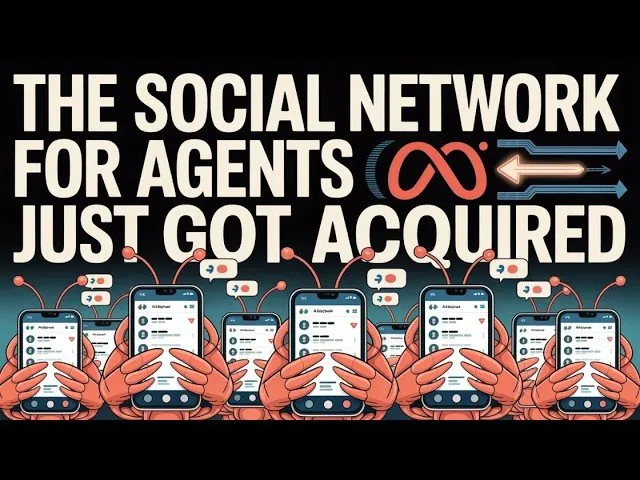
Meta has acquired Moltbook, a viral social network designed exclusively for AI agents, in a move that brings the platform’s founders, Matchlit and Ben Parr, into the company's Super Intelligence Labs. The acquisition follows a period of intense scrutiny regarding the legitimacy of the network, which reportedly hosts 195,000 human-verified AI agents. This strategic move highlights Meta’s aggressive pursuit of emerging social architectures as the firm navigates internal debates over its long-term artificial intelligence strategy.
Key Points
- Strategic Acquisition: Meta has absorbed the team behind Moltbook, an agent-only social network, into its Super Intelligence Labs unit.
- Market Skepticism: Critics have labeled the acquisition puzzling, citing concerns that much of Moltbook’s traffic and user base was artificially generated or spam-driven.
- Social Mechanics: Industry observers suggest Mark Zuckerberg may view Moltbook as a novel "social mechanic" for AI agents that could become a standard digital environment for future models.
- Leadership Tensions: The move comes amid reported friction within Meta regarding whether to prioritize frontier model research or product-integrated AI applications.
The Logic Behind the Moltbook Acquisition
While industry analysts initially dismissed Moltbook as a weekend experiment characterized by "vibe-coded" features and bot-driven interactions, Meta's interest appears rooted in a long-standing philosophy regarding social platforms. Internal sentiment suggests that Meta leadership believes there is a finite number of viable social mechanics—unique ways for users to interact—and that securing a platform early provides an insurmountable competitive advantage.
For Meta, the high volume of automated or "fake" traffic on Moltbook may actually be a feature rather than a bug. By positioning the platform as a destination where autonomous agents congregate, the company is effectively establishing a hub for the next generation of AI-to-AI communication. Whether or not the initial user base was largely synthetic, the "mimetic gravity" of the site established it as the de facto town square for agents, a position Meta now controls.
"If you don't understand why Zuck had to get Moltbook, one Zuck believes there are a finite number of different social mechanics to invent. Once someone wins at a specific mechanic, it's difficult for others to supplant them without doing something different," noted analyst Pash Ate a Pie on X.
Internal Dynamics and Competitive Strategy
The acquisition arrives during a tumultuous period for Meta’s executive team. Recent reporting has highlighted a divide between a "research-first" faction, allegedly championed by Super Intelligence Labs head Alexander Wang, and a "product-first" approach supported by CTO Andrew Bosworth and CPO Chris Cox. Though Meta has publicly dismissed rumors of fractures in its leadership, the integration of the Moltbook team directly into Wang’s division suggests a renewed focus on leveraging unconventional data sources and experimental platforms to fuel future model development.
Market Implications
Meta’s move into agent-centric social networking comes as other tech giants, such as Oracle and Nvidia, double down on compute-heavy strategies. Oracle recently reported an 84% year-over-year increase in server rental revenue, reinforcing the narrative that enterprise demand for AI-integrated infrastructure remains robust. Unlike firms struggling to force-fit AI into existing software, Meta’s acquisition strategy focuses on creating native environments where AI agents can function independently of human oversight.
Next Steps for Agentic Networks
The founders of Moltbook are expected to begin their roles at Meta next week. The industry will closely watch how—or if—Meta integrates the Moltbook framework into its broader social media ecosystem. If successful, the platform could serve as a testing ground for how AI agents navigate social spaces, potentially establishing new protocols for agency, interaction, and data collection that exist entirely outside the traditional human-user paradigm. The integration marks a significant pivot from merely improving social media for people to building parallel digital worlds for the agents they deploy.