Table of Contents
When we imagine the history of Europe, our minds often drift to the stone castles of England, the vineyards of France, or the ruins of Rome. Eastern Europe, by contrast, is frequently written off in historical narratives as a gray, static backdrop—or worse, boring. This perception could not be further from the truth. The formation of Medieval Eastern Europe was a "wild east" saga, a Battle Royale of migrating tribes, emerging empires, and distinct social structures that attempted—and ultimately failed—to form a world civilization on the scale of the West, China, or Islam.
To understand the modern geopolitical landscape, from the war in Ukraine to the tensions in the Balkans, we must look back to the concept of ethnogenesis—the national formation of these peoples. This was a region defined by vast forests, river superhighways, and a vacuum of power left by the collapse of the Huns and the migration of Germanic tribes. It is a story of how the Slavs, the Vikings, the Mongols, and the Byzantines collided to create a fractured, yet deeply fascinating, civilization.
Key Takeaways
- Geography dictated destiny: Unlike the Romanized West, Eastern Europe was a sparsely populated "Wild East" of infinite forests and steppes, requiring societies to build social structures from scratch.
- The Slavic expansion: The Slavs filled the power vacuum left by the Huns and Germanic migrations, becoming the dominant ethnic group through tenacity rather than organized conquest.
- The Great Schism of 1000 AD: The region fractured along religious lines, with Poland and Hungary adopting Western Catholicism, while Russia and the Balkans turned toward Byzantine Orthodoxy.
- The tragedy of serfdom: While Western Europe moved toward capitalism, Eastern Europe’s nobility exerted total control over the peasantry, instituting a form of serfdom akin to slavery that stifled economic development.
- The Mongol pivot: The Mongol invasion severed Russia from its European roots, redirecting its cultural and political trajectory toward autocracy and isolation.
The "Wild East": Geography and the Slavic Vacuum
To grasp the scale of Medieval Eastern Europe, one must adjust their mental map. The Romans viewed the world beyond the Mediterranean as increasingly savage the further one traveled. By the time one reached the Slavic lands, they were effectively off the map of "civilization."
A Landscape Like Modern Canada
The geography of the region was a formidable barrier to development. This was not a land of roads and cities, but of dense, endless forestry.
"It's important to see the way Eastern Europe was back then to the way Canada is today... if you drive across any stretch of Canada besides central Ontario, you'll just see infinite forest that goes on forever with periodic settlement."
This terrain meant that civilization could not simply be inherited from Rome; it had to be carved out of the wilderness. The region was a revolving door of migrations. Originally inhabited by Germanic tribes, the landscape was cleared by the Huns, a nomadic superpower that pushed the Germans west into the Roman Empire. When the Hunnic empire collapsed, it left a massive demographic void.
The Rise of the Slavs
Into this void stepped the Slavs. Historically, they were the "dark horse" of the Migration Period. Unlike the charismatic Germanic warriors or the organized Arab conquests, the Slavs were initially a primitive, decentralized people living around the Pripyat Marshes of northern Ukraine.
They filled the empty map rapidly, not through grand military strategy, but through migration and population density. They moved west into modern-day Germany, south into the Balkans, and east toward Russia. They were often the foot soldiers or subjects of other nomadic confederacies—like the Avars or Bulgars—but they possessed a resilience that allowed them to outlast their masters and become the permanent demographic bedrock of Eastern Europe.
Rivers, Vikings, and the Birth of the Rus
If the forests were the barriers of Eastern Europe, the rivers were its arteries. The Danube, the Dnieper, and the Volga served as the primary trade routes connecting the frozen north to the wealthy markets of Byzantium and the Islamic Caliphate.
The Viking Connection
Statehood in Russia and Ukraine did not originate solely from the Slavs, but from the north. The Vikings, known locally as the Varangians or the Rus, utilized the river systems to engage in a lucrative trade network involving fur, amber, and slaves.
The legend goes that the disorganized Slavic tribes invited the Viking Rurik to rule them and bring order. While likely a simplification, the reality is that the Vikings established a series of fortified trade posts that coalesced into the Kievan Rus. This was a society that, by the 11th century, was one of the wealthiest and freest in Europe. Cities like Novgorod and Kiev boasted parliaments, rule of law, and robust trade connections, challenging the notion that Russia was destined for autocracy from the start.
The Khazar Interlude
Before the dominance of the Rus, the southern steppes were controlled by the Khazars, a Turkic people who famously converted to Judaism to maintain neutrality between the warring Christians and Muslims. They represented a "nearly civilized" outgrowth on the steppe, with bureaucracy and trade, until they were eventually dismantled by the expanding power of the Viking-Rus.
The Religious Fracture: 1000 AD
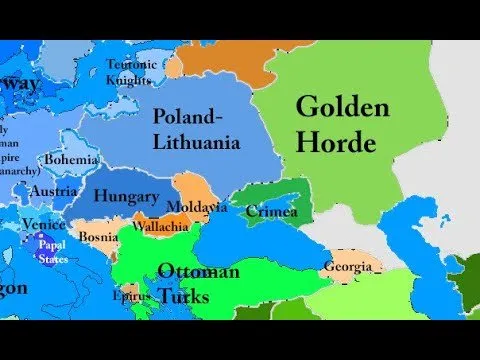
Around the year 1000 AD, the map of Eastern Europe solidified into distinct kingdoms, a development that mirrored state formation across Eurasia. However, this period also cemented the cultural divide that persists to this day.
The Catholic West vs. The Orthodox East
The region faced a choice between two civilizations: the Frankish/Catholic West and the Byzantine/Orthodox South. This decision determined the alphabet, the architecture, and the political soul of each nation.
- Poland and Hungary: Adopted Roman Catholicism. This integrated them into Western cultural spheres, Latin literacy, and feudal structures. Poland, in particular, became a bastion of Western values in the East.
- The Rus and Bulgaria: Adopted Eastern Orthodoxy from Constantinople. This brought the Cyrillic alphabet (developed by Byzantine monks) and a model of church-state relations where the patriarch was often subordinate to the ruler.
This religious split meant that even genetically similar populations—like the Poles and the Russians, or the Croats and the Serbs—developed entirely different civilizational identities.
The Tragedy of Potential: Poland, Bohemia, and Serfdom
One of the great "what ifs" of history lies in the development of Central-Eastern Europe. Nations like Bohemia (modern Czechia) and Poland-Lithuania showed immense promise as centers of liberty and innovation.
Bohemian Innovation
Bohemia served as a unique intersection of Germanic and Slavic cultures. It was an intellectual powerhouse, home to early scientific breakthroughs and the Hussite movement—a proto-Protestant rebellion that occurred nearly a century before Martin Luther. The Hussites successfully used innovative tactics, like wagon forts and firearms, to repel German crusaders, proving that the region was technically and socially advanced.
The Polish Paradox
Poland-Lithuania eventually merged to become the largest state in Europe. It was a paradox: a republic of nobles with a figurehead king. The Polish "Golden Liberty" gave the nobility (the Szlachta) unprecedented rights, including the infamous liberum veto, where a single member of parliament could halt any legislation.
"Poland's constitution was so democratic that it gave the leader no power... neighboring governments would just bribe one of these councilmen [so] that nothing was accomplished."
While this protected freedom for the elite, it paralyzed the state, eventually leading to Poland's partition by its authoritarian neighbors.
The Curse of "Second Serfdom"
The true tragedy of the region was the shift in labor relations. While Western Europe moved toward free labor and cities, Eastern Europe responded to the demand for grain by enslaving its population. This "Second Serfdom" was far harsher than its Western medieval counterpart, resembling chattel slavery. It empowered the nobility but hollowed out the middle class, leaving the region largely agrarian and underdeveloped compared to the industrializing West.
The Mongol Storm and the Reshaping of Russia
If the Vikings built the scaffolding of Russia, the Mongols tore it down and rebuilt it in their own image. The Mongol invasion in the 13th century was a supernova event that devastated the Kievan Rus.
The Rise of Moscow
The Mongols destroyed the old centers of power like Kiev. In the aftermath, a small, peripheral trading post named Moscow rose to prominence by acting as the tax collector for the Mongol Khans. Muscovy centralized power by ruthlessly suppressing rival Slavic states, including the destruction of the democratic republic of Novgorod.
This period severed Russia’s connection to the rest of Europe for centuries. By the time Russia threw off the "Tatar Yoke" under Ivan the Great, it had developed a political culture deeply influenced by Mongol autocracy—centralized, militaristic, and distinct from the feudal contracts of the West.
The Balkan Mosaic
South of the Danube, the Balkans followed a different, more fractured trajectory. The geography here is mountainous and compartmentalized, acting as a natural fortress for distinct micro-identities.
Byzantine Social Engineering
The Byzantine Empire, seeking to manage the Slavic influx, established independent Orthodox churches for different groups. This was a brilliant short-term strategy for control but had long-term consequences. By tying religious identity to local geography, the Byzantines inadvertently planted the seeds of modern nationalism. When the overarching empires (Byzantine, then Ottoman) eventually receded, these distinct church-based identities hardened into the fierce ethnic nationalisms of Serbs, Bulgarians, and Greeks.
The Ottoman Conquest
Following the decline of Byzantium, the Ottoman Turks conquered the region, freezing its social development in many ways. The Balkans became a borderland, a militarized frontier between Islam and Christendom. This legacy of imperial conquest—where elite cultures (Ottoman or Austrian) ruled over a mosaic of peasant nationalities—created the complex and often volatile ethnic map we recognize today.
Conclusion: A Civilization Interrupted
Medieval Eastern Europe was not merely a buffer zone between East and West; it was a region of immense potential that was repeatedly reshaped by external storms. It possessed the raw materials for a world-class civilization: the democratic instincts of Novgorod and Poland, the intellectual vibrancy of Bohemia, and the vast resources of the Ukrainian steppe.
However, the pressures of invasion—from the Mongols in the East and the pressure of Germanic expansion in the West—combined with the internal trap of serfdom, prevented this potential from fully flourishing. The history of Eastern Europe is a story of a civilization that developed a "Western" software on "Eastern" hardware, creating a unique, often tragic, but enduring identity that continues to shape our world.


![Bitcoin: An Unfortunate Pattern [Update]](/content/images/size/w1304/format/webp/2026/03/bitcoin-unfortunate-pattern-update.jpg)