Table of Contents
If you look at a photograph of yourself from ten years ago, you might cringe at your fashion choices or marvel at how different your worldview was. We readily acknowledge that we are not the same people we were in the past. Yet, when asked who we will be in ten years, we tend to believe we are "finished products." We assume our current preferences, values, and personalities will remain static.
Cognitive scientist Maya Shankar calls this the End of History Illusion. It is a psychological quirk that convinces us the present moment is the final destination of our personal evolution. However, research—and life experience—demonstrates that we are constantly in flux. Whether through unexpected career pivots, personal loss, or shifting ambitions, change is the only constant.
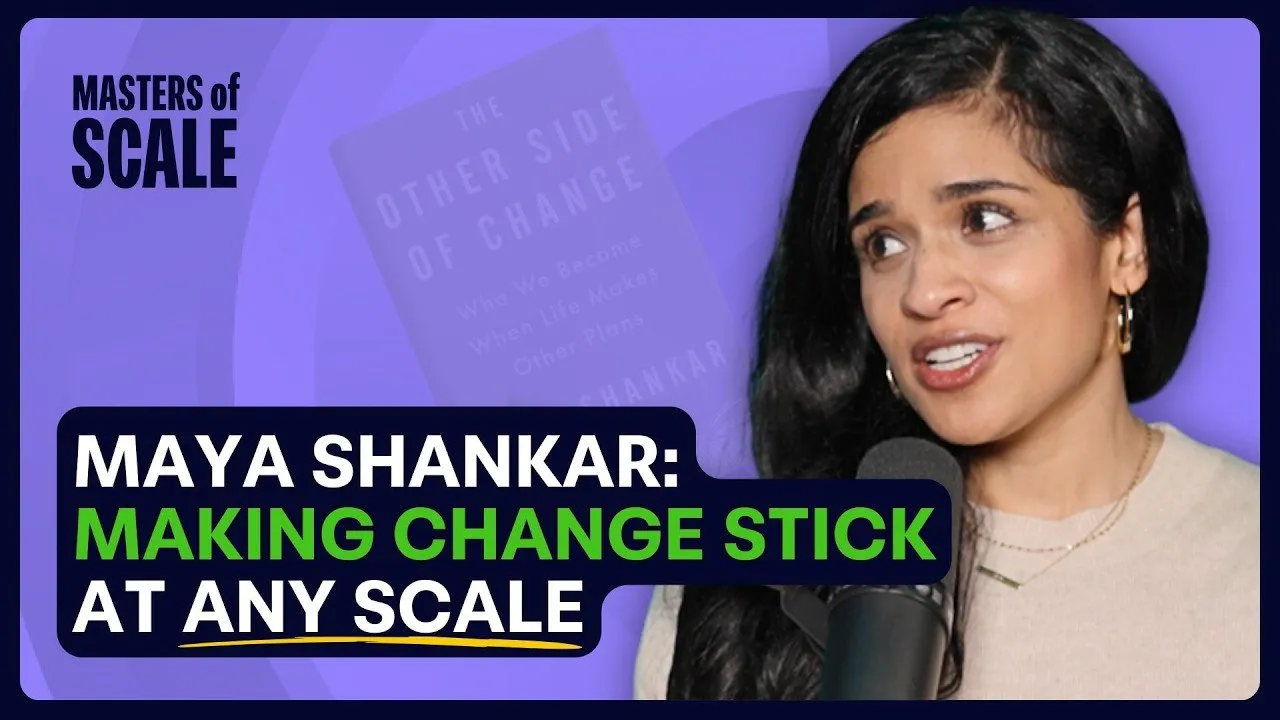
In a conversation on Masters of Scale, Shankar explores how behavioral science can help us navigate these turbulent shifts. From her time as a violinist to her work in the Obama White House and at Google, Shankar provides a blueprint for not just enduring change, but using it to unlock a more resilient version of ourselves.
Key Takeaways
- The End of History Illusion: We accurately recognize past growth but significantly underestimate how much we will change in the future.
- Future-Proofing Identity: To build resilience, define your identity by why you do things (the underlying value), not just what you do (the specific role).
- The Power of Defaults: In both public policy and personal habits, removing friction (opt-out vs. opt-in) dramatically increases success rates.
- Solving the Middle Problem: Motivation is nonlinear; breaking long-term goals into micro-milestones prevents the slump that often occurs halfway through a project.
- Moral Beauty as Fuel: Witnessing goodness and resilience in others (moral elevation) can expand our own sense of possibility during difficult transitions.
Understanding the End of History Illusion
The human brain has a peculiar relationship with time. We view our past selves with detachment, often forging psychological distance between who we are today and who we used to be. Conversely, we view our future selves as merely older versions of our current selves. This cognitive bias, known as the End of History Illusion, can be dangerous because it leads to rigid planning.
"It’s this funny quirk in our brains where we believe that the present moment reflects who we are going to be for the rest of our lives. We forget that we are constantly changing."
Accepting that you are a work in progress allows for greater adaptability. When big changes happen—whether forced by circumstance or chosen—they often inspire lasting internal shifts. Shankar notes that while people rarely wish for tragedy or job loss, they often express gratitude for the person they became on the other side of that experience. To navigate this, one must audit themselves over time, asking difficult questions about shifting values and beliefs.
Future-Proofing Your Identity
One of the most painful aspects of major life changes is the loss of identity. Shankar experienced this firsthand as a violin prodigy. Accepted to Juilliard at nine and studying under Itzhak Perlman as a teenager, her entire existence was defined by the violin. A hand injury at age 15 ended her career abruptly.
The grief she experienced wasn't just about the music; it was a loss of self. However, looking back, Shankar realized that while she lost the instrument, she hadn't lost the underlying drive.
Anchor in the "Why," Not the "What"
Shankar suggests that we can make our identities more resilient by digging deeper into our motivations. For her, the violin was a vehicle for human connection. Once she identified connection as her core driver, she could find new vehicles for it—eventually discovering cognitive science and public policy.
If you define yourself solely by your job title (e.g., "I am a software engineer"), a layoff creates an identity crisis. If you define yourself by your traits (e.g., "I am a problem solver who builds systems"), you retain your identity regardless of your employment status.
Applying Behavioral Science to Systemic Change
Shankar’s transition from music to science led her to the Obama White House, where she founded the Social and Behavioral Sciences Team. Her work demonstrated that understanding human behavior is just as critical for organizations as it is for individuals.
The Architecture of Choice
Shankar’s team utilized behavioral economics to solve large-scale problems with small, low-cost interventions. Two notable examples illustrate the power of "nudges":
- School Lunch Program: Despite millions of children being eligible for free lunches, stigma and paperwork barriers kept enrollment low. By shifting the program from "opt-in" to "opt-out" (automatic enrollment), the government fed 12.5 million more children.
- Veteran Benefits: A program helping veterans transition to civilian life saw low uptake. By changing one word in the email notification—reminding veterans they had earned the benefit rather than just being eligible for it—access increased by 9%. This leveraged the "endowment effect," where we value things more when we feel we own or have earned them.
For leaders in large, sclerotic organizations, Shankar advises acting as a "policy entrepreneur." Align your innovative ideas with the existing goals of your stakeholders. Frame behavioral insights not as a tangential experiment, but as a tool to help colleagues achieve their metrics faster and more efficiently.
Strategies for Navigating Professional Turbulence
Whether facing a layoff or pivoting to a new industry, the psychological toll of career change is heavy. Shankar offers specific, science-backed tactics to maintain momentum.
Identity Priming through Micro-Habits
When starting something new, the gap between your current state and your goal can be paralyzing. Shankar advises ignoring the massive end goal in favor of the smallest possible unit of progress.
"The difference between writing zero minutes a day and writing one minute a day is that in the one minute world you're a writer. And when you prime that identity, it's self-reinforcing."
By committing to the identity immediately through small actions, you build a virtuous cycle. You don't need to finish the book to be a writer; you just need to write today.
Overcoming the "Middle Problem"
Motivation is not linear. We experience a boost at the start of a project and a boost near the finish line, but we suffer from a slump in the middle. To combat this, Shankar suggests breaking long timelines into shorter intervals. Instead of a yearly goal, set weekly goals. This shortens the "middle" period effectively, keeping motivation higher by creating more finish lines.
The Peak-End Rule
Nobel Laureate Daniel Kahneman discovered that we do not remember experiences by taking an average of every moment. Instead, we remember the peak (the most intense moment) and the end. You can hack this cognitive bias to make difficult changes more palatable.
If you are doing a difficult task, like rewriting a resume or a hard workout, ensure the very last activity is pleasant. End a workout with a relaxing stretch; end a writing session by outlining an easy paragraph for tomorrow. Improving the "end" changes how your brain encodes the memory of the entire experience, making you more likely to return to it.
Resilience Through Gratitude and Awe
Change often brings grief. Shankar’s personal journey through surrogacy losses highlights the difficulty of maintaining perspective when one area of life is crumbling. She recommends two distinct emotional practices to stay grounded.
Self-Affirmation Theory
When one aspect of your identity is threatened (e.g., fertility struggles or job loss), it is easy to feel that all is lost. Self-affirmation involves listing the parts of your identity that remain intact.
Listing things you are grateful for—relationships, hobbies, physical health—reminds you that your life is multi-dimensional. It doesn’t cure the sadness, but it anchors you. As Shankar notes, it provides a "softer landing" by proving that your entire self-worth is not tied to the single thing that is currently breaking.
The Function of Awe and Moral Beauty
Finally, Shankar discusses the concept of awe, specifically "moral beauty"—the feeling we get when witnessing kindness, courage, or resilience in others. This feeling, known as moral elevation, physically changes our brain state, dampening self-focus and connecting us to the collective.
Witnessing moral beauty in others can crack open our imagination regarding our own potential. Shankar shares the story of Dwayne, a prisoner who became a poet and lawyer after witnessing the discipline and grace of a fellow inmate. When we feel stuck in a current version of ourselves, observing the growth of others can reveal "hoped-for selves" we hadn't yet dared to imagine.
Conclusion
We cannot stop the flow of time or the changes it brings. However, by understanding the cognitive machinery behind how we process change—from the End of History Illusion to the Peak-End Rule—we can navigate transitions with more agency. Whether through future-proofing our identity or finding awe in the resilience of others, science offers us the tools to ensure that who we become on the other side of change is a person we are proud to be.