Table of Contents
The numbers surrounding enterprise AI adoption tell a stark, conflicting story. On one hand, consumer adoption has been exponential, with reports indicating that over 60% of consumers now use Generative AI weekly. On the other, the enterprise reality is far grimmer. A recent MIT report suggests that only 5% of Generative AI deployments are making it to production in any meaningful form, while Gartner predicts that 40% of enterprise projects will likely be canceled by 2027.
There is a massive gap—a "chasm"—between model performance and actual business value. While foundational models have improved by 40-60% in public benchmarks over the last two years, the enterprise is stuck in pilot purgatory. The issue isn't the technology itself, but the infrastructure, data readiness, and deployment strategies required to make it reliable.
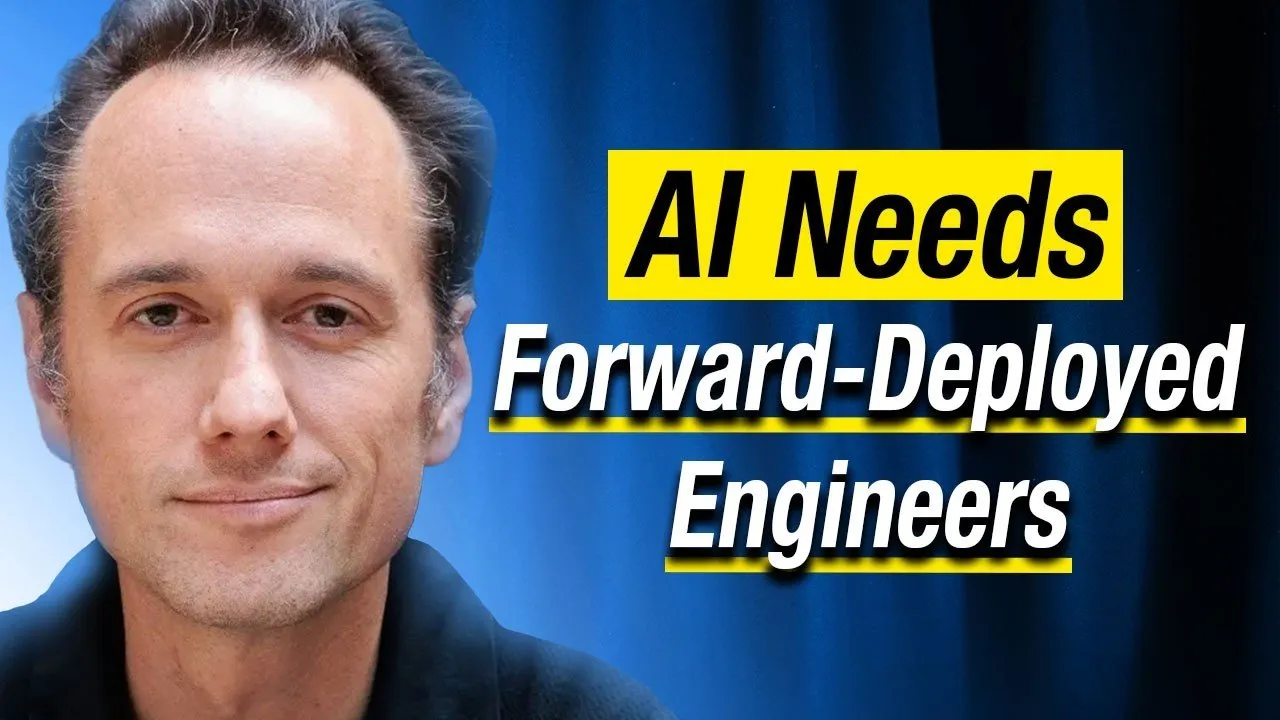
In a recent discussion with Matt Fitzpatrick, CEO of Invisible, we explored why internal AI builds are failing, why the SaaS model is breaking under the weight of Generative AI, and why the industry’s future relies heavily on Forward-Deployed Engineers (FDEs) and specialized human intelligence.
Key Takeaways
- Internal builds struggle: Externally driven AI builds are currently 2x as effective as internal team builds due to a lack of discipline and talent density within traditional enterprise structures.
- The SaaS model is evolving: "Out-of-the-box" software doesn't work for non-deterministic AI. The future model combines technology with Forward-Deployed Engineers (FDEs) to ensure workflow integration.
- Synthetic data has limits: While useful for base truths (like math), synthetic data cannot replace human feedback (RLHF) for complex, multi-step reasoning, cultural nuance, or high-stakes fields like law and medicine.
- Strategy is overrated; agility is key: In an industry where technology shifts every three months, long-term strategic planning is less valuable than building institutional memory and rapid iteration cycles.
- Pay-for-performance is the new standard: To combat skepticism, vendors must move away from seat-based licensing to models where customers only pay once the solution is proven to work.
The "Science Project" Problem in Enterprise AI
Why is there such a disparity between the hype of AI and the reality of enterprise deployment? The primary culprit is the approach. For the last decade, the corporate technology strategy was simple: buy software. The IT department purchased applications, and that was the extent of their "build."
Generative AI flipped this dynamic. Suddenly, internal teams were handed massive budgets and told to build proprietary solutions from first principles. The result has been a proliferation of "science projects"—initiatives that are technically interesting but operationally disastrous.
Fitzpatrick shared a telling example of an e-commerce retailer that spent $25 million building a proprietary agent to handle returns.
"They basically analyzed a mix of speed of call resolution and sentiment. The problem with that is, what if the agent hallucinates and says, 'Here's $2 million'? That actually gets resolved quickly and the person's happy... A couple of months later they shut it down and moved back to a deterministic flow."
Internal vs. External Builds
The data suggests that externally driven builds are twice as effective as internal ones. This isn't just about technical capability; it is about discipline. When an enterprise hires a vendor, there are clear timelines, ROI metrics, and milestones. If the vendor fails, they are fired. Internal teams, however, often lack this rigorous "deliver or die" pressure, leading to bloated timelines and vague success metrics.
Furthermore, the talent pool capable of executing these complex integrations is finite. The vast majority of top-tier AI engineers are concentrated in startups and major tech firms, not traditional enterprise IT departments. Expecting a traditional bank or retailer to build state-of-the-art AI infrastructure from scratch is often a setup for failure.
The Death of "Out-of-the-Box" and the Rise of FDEs
For the last 20 years, the dominant software paradigm was SaaS (Software as a Service). You bought a login, and the software worked. However, Fitzpatrick argues that "out-of-the-box" software has always been somewhat of a lie, usually requiring significant configuration. With Generative AI, this model breaks completely.
AI is non-deterministic. You cannot simply plug a Large Language Model (LLM) into a complex enterprise workflow—like claims processing or medical scheduling—and expect it to function perfectly without customization. This necessitates a shift toward Forward-Deployed Engineers (FDEs).
What Forward-Deployed Engineering Actually Means
Popularized by Palantir, the FDE model is often misunderstood as standard consulting or customer support. True forward-deployed engineering involves embedding small, high-powered technical teams (often just 1-2 people) into the client's environment to customize the core platform for specific workflows.
Unlike the traditional systems integrator model (e.g., Accenture), which might take years to layer disparate apps together, the modern FDE approach is about speed. The goal is to configure modular platforms—data ingestion, agent building, and process automation—into a hyper-personalized solution within 60 to 90 days.
This shift forces a change in economics. The high margins of SaaS were based on low-touch delivery. AI requires high-touch delivery to get started. However, the long-term value comes from a "system of agility" where the software is deeply embedded in the customer's operations.
Why Synthetic Data Can’t Replace Humans
A prevalent narrative in Silicon Valley is that synthetic data (data generated by AI to train AI) will eventually render human feedback obsolete. While synthetic data is highly effective for "ground truth" scenarios like mathematics or coding, where an answer is objectively right or wrong, it hits a wall with complex reasoning.
When training models for tasks involving cultural nuance, multi-step reasoning, or specialized knowledge, human expertise remains the gold standard.
"If you think about computational biology in Hindi versus French versus English with a southern accent... that paradigm is actually incredibly hard to train on. For a multi-stage reasoning test that requires a PhD in multiple different languages, human feedback is going to be important in that for the next decade."
The Evolution of Data Labeling
Five years ago, the data labeling industry was characterized by simple "cat vs. dog" image identification. Today, it operates more like a high-end digital assembly line. Platforms now must source experts capable of validating 17th-century French architecture or analyzing complex legal briefs on 24 hours' notice.
This demand for "specialized data" suggests that we are moving away from commoditized labeling toward a market for high-value expert cognition. The companies that will win are those that can effectively verify and manage this scarce human talent, ensuring that the data feeding the models is statistically validated and precise.
Rethinking Strategy in a Fast-Moving Market
In traditional industries, strategy is often plotted out in five-year cycles. In the AI sector, where the technological landscape shifts fundamentally every three months, rigid strategy is a liability.
Fitzpatrick notes that strategy in AI is "overrated" compared to execution and institutional memory. A voice agent developed today might be rendered obsolete by a new foundational model release next quarter. Therefore, successful AI companies—and enterprises adopting AI—must build interoperable frameworks rather than static solutions.
The focus should be on:
- Core beliefs: What will remain true for 10 years? (e.g., the need for high-quality human data, the need for workflow integration).
- Iterative adoption: Allocating 30-40% of resources to iterate constantly based on new technology releases.
- Talent density: Hiring "all-around athletes" who can pivot across roles, rather than hiring for narrow, static job descriptions.
The Economics of Trust
Perhaps the most critical shift needed for enterprise AI adoption is the move toward risk reversal. Because so many AI projects have failed, skepticism is at an all-time high. CFOs are no longer willing to sign large contracts for unproven technology.
The solution is a move toward proof-based economics. Instead of charging for FDEs upfront or demanding heavy licensing fees before deployment, vendors must prove the technology works first.
"We don't actually sell anything. We meet a customer, we say we will do it for free for 8 weeks and prove to you that works... The minute you had to bring in FDEs in a SaaS context, your economics broke instantly, right? But I think that’s the only way to get the enterprise working."
This approach is capital intensive and risky for the vendor, but it aligns incentives. It forces the technology provider to deliver operational ROI—cost savings, resolution times, efficiency gains—rather than just delivering software. In a market saturated with "vaporware," operational truth is the ultimate differentiator.
Conclusion
We are currently in the "first inning" of enterprise AI. The initial wave of excitement has crashed against the rocks of data fragmentation and operational complexity. However, the path forward is becoming clear. It requires a departure from the "buy and hope" SaaS model toward a partnership model rooted in engineering discipline, human-in-the-loop validation, and proven ROI.
While the headlines focus on the size of the models, the real revolution is happening in the trenches—where specialized human experts and forward-deployed engineers are turning raw potential into reliable business systems.