
Table of Contents
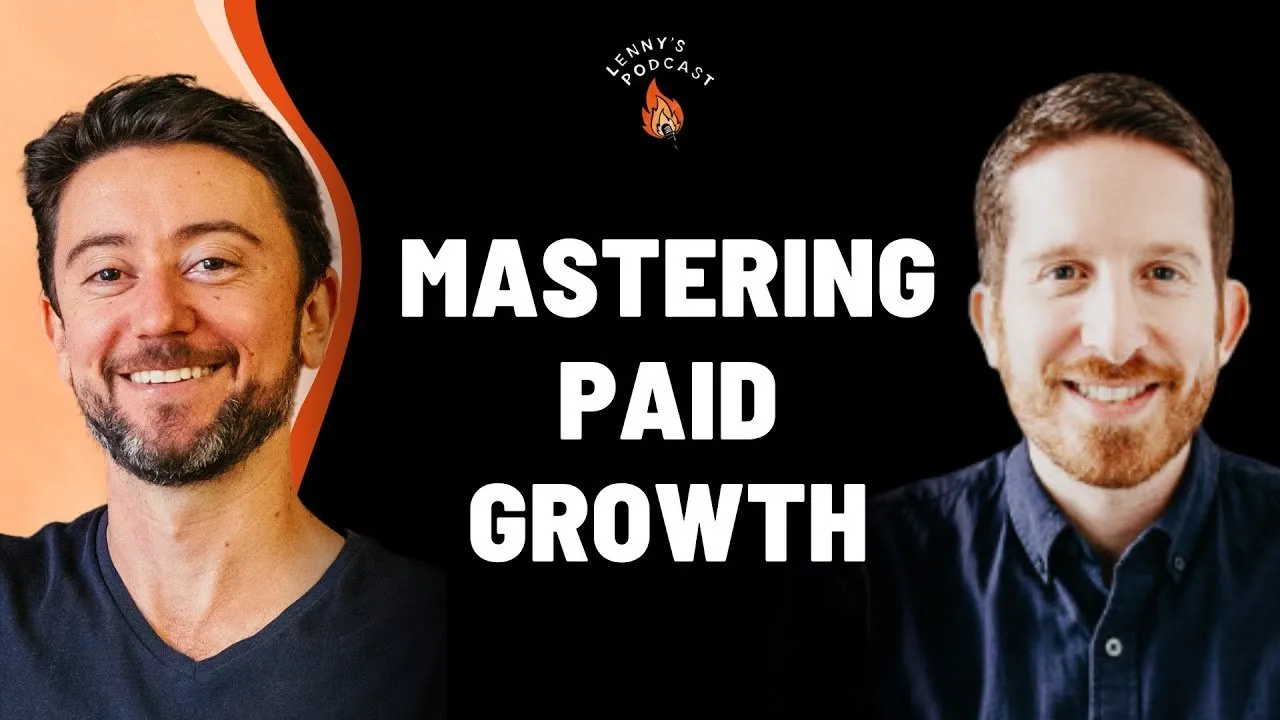
Paid acquisition can feel like a double-edged sword. On one hand, it's an incredible lever for growth, allowing companies to acquire users with measurable ROI. On the other, it's often described as a drug—once you start, you can get hooked, creating a dependency that feels unhealthy. Navigating this complex world requires expertise, especially as privacy shifts and AI advancements rewrite the rulebook. We've synthesized a masterclass from Jonathan Becker, a legend in Performance Marketing who has managed over $3.5 billion in ad spend for giants like Uber, Asana, and Square, to provide a clear roadmap for mastering paid growth today.
Key Takeaways
- Creative is the New Frontier: As platforms automate bidding and targeting, the biggest opportunity for optimization now lies in rigorous creative testing and iteration. Your ad assets are your most powerful lever.
- AI is a Force Multiplier, Not a Replacement: Artificial intelligence is shifting the role of marketers from manual "trench work" to high-level strategy. It's used for generating ad copy, creating visual mock-ups, and validating models, allowing teams to do more with less.
- Attribution Requires a Blended Approach: The era of relying on a single source of truth like last-click attribution is over. A modern approach involves a combination of methods, including statistical analysis like Media Mix Modeling (MMM), customer surveys, and in-platform data.
- Diversification is Non-Negotiable: Relying on a single paid channel is like putting your life savings into one stock. A healthy marketing mix that includes organic channels like SEO and email alongside a diversified paid strategy is crucial for sustainable growth.
- Success Starts with In-House Expertise: An agency can't work in a vacuum. The most successful partnerships occur when a company has a knowledgeable in-house point person who understands the business and can collaborate effectively with an external team.
The Modern Landscape of Performance Marketing
Once upon a time, paid growth was seen as a simple machine: put money in, get customers out. But the landscape has evolved dramatically. Jonathan Becker, who began his career in SEO before pivoting to paid search, notes that the appeal of paid channels was their tangible, measurable nature. However, this very tangibility can lead to an over-reliance that puts businesses at risk.
The "Drug" of Paid Growth and the Case for Diversification
Is paid growth a dangerous dependency? Only if it's your sole engine for growth. Becker uses a powerful analogy: advising someone to put their life savings into a single stock would be irresponsible due to market volatility. Similarly, pouring your entire marketing budget into one channel, like Facebook ads, exposes your business to the whims of algorithm changes, rising costs, and shifting market conditions.
The antidote is diversification. A responsible channel mix spreads risk and creates a more resilient growth model. The first rule of Performance Marketing, according to Becker, is not to forget about offline and organic marketing. Channels like email, SEO, and even direct mail work beautifully alongside paid acquisition. The crash-and-burn scenarios often happen when brands scale rapidly on a single loophole or channel, only to see their entire business crumble when that channel's conditions change.
When is Paid Growth the Right Channel?
So, what makes a company a good fit for paid growth? It depends on the stage. For early-stage companies, the key prerequisite is product-market fit. If your product resonates with an audience through organic channels—whether it's a strong email list, SEO traffic, or word-of-mouth—it's highly likely paid acquisition will work as an amplifier. Paid channels can't fix a product problem.
For later-stage companies, the question shifts from "does it work?" to "at what scale can it work?" Success here depends on internal resources:
- Creative Resources: Do you have a team that can create and test ad assets in a feedback loop with performance data?
- Marketing Professionals: Is there an in-house team that speaks the language of paid acquisition and can collaborate with an agency?
- Technical Resources: If tracking and attribution are broken, can your team implement the necessary fixes?
Ultimately, patience is key. There are no overnight turnarounds in Performance Marketing. It's a difficult, ever-changing discipline that takes time to optimize for any business.
Why Creative is the New Competitive Edge
Over the last decade, platforms like Google and Meta have automated many of the technical levers that marketers used to pull manually, such as bidding and audience targeting. While this has simplified campaign management, it has also leveled the playing field. The one area that remains a significant differentiator—and is not yet fully automated—is creative.
From Silos to Synthesis
A common pitfall is the disconnect between brand marketing and performance marketing teams. Brand designers often hand over a folder of polished, generic assets without understanding the context of the paid acquisition funnel. A successful creative strategy requires a more integrated approach, thinking of the customer journey as a conversation.
The ad creative should change as the user moves from awareness (top of the funnel) to consideration and conversion (bottom of the funnel). Showing the same ad repeatedly leads to "banner blindness" and inefficiency. The goal is to create a beginning, middle, and end to the conversation, guiding the user with tailored messaging at each stage.
A Scientific Approach to Creative Testing
The key to unlocking performance is rigorous, structured testing. To do this effectively, you must isolate variables. For example, in a Meta ad set targeting a single audience, you might run two nearly identical ads where only one element is different—the headline, the image, or the call-to-action button.
This allows you to determine precisely what change drove a better result. Metrics like click-through rate (CTR) or "impressions until conversion" help normalize the data, even if the platform serves one ad more than the other. These learnings create a powerful feedback loop: data informs the creative team which elements are working, allowing them to iterate and continually improve performance.
...it turns out that when this copy is used at this stage of the funnel it converts fifty percent more frequently than this other copy.
A few years ago, Becker’s team discovered that unpolished, user-generated content (UGC) filmed on a phone massively outperformed highly produced brand assets. The authenticity of a real person sharing their experience resonated far more deeply. In another instance, a furniture company saw its return on ad spend (ROAS) double or triple after a simple, playful change: adding a dog to the photos of their couches.
Demystifying Attribution in a Post-Privacy World
Attribution is the process of determining which actions, campaigns, or channels should get credit for a conversion. It's the central question every marketer tries to answer. As retail magnate John Wanamaker famously said over a century ago:
Half my marketing dollars are wasted; the trouble is I don't know which half.
This challenge persists today, complicated by recent privacy changes like Apple's iOS 14.5 update and the deprecation of third-party cookies. These shifts have made traditional cookie-based attribution models less reliable.
The Evolution of Attribution Models
For years, the industry relied on models like:
- Last-Click: The final touchpoint before a conversion gets 100% of the credit. This model is simple but often overvalues bottom-of-funnel channels like branded search.
- First-Click: The first touchpoint a user has with a brand gets all the credit. This highlights top-of-funnel discovery channels but ignores the rest of the journey.
- Multi-Touch: Credit is distributed across multiple touchpoints in the customer journey, using various weighting methods.
The problem is that these models became less accurate as platforms lost access to user-level tracking data. The data that powered Facebook's attribution, in particular, became less complete, making it harder to validate which campaigns were truly driving revenue.
The Modern Approach: A Triangulation of Evidence
There is no single source of truth for attribution anymore. Anyone who claims to have one is not being accurate. The modern approach is an ongoing investigation that uses multiple methods to validate results. This includes:
- In-Platform Data: Using the conversion data provided by Google, Meta, and other ad platforms as one signal.
- Statistical Modeling: Using techniques like Media Mix Modeling (MMM), a form of regression analysis that determines the causal relationship between ad spend and revenue. Tools like Recast are making this sophisticated analysis more accessible.
- Customer Surveys: Simply asking customers "How did you hear about us?" at checkout or through post-purchase surveys can provide invaluable, directionally correct data.
The goal is to look for evidence from multiple angles to validate whether your campaigns are working. Sometimes, even the most sophisticated models reveal that a channel is not performing, and that itself is a valuable finding.
How AI is Revolutionizing Paid Growth Operations
While generative AI feels new, artificial intelligence has been shaping performance marketing for over a decade. Ad platforms have long used AI to automate bidding and targeting. The primary effect has been a displacement of human effort from manual execution to high-level strategy—focusing on modeling, validation, and creative levers.
Today, conversational AI and image generation tools are accelerating this shift in practical ways:
- Ad Copy Generation: Tools like ChatGPT can produce dozens of copy variations for testing in a fraction of the time it would take a human, helping teams overcome creative blocks and scale testing efforts.
- Creative Concepting: Image generators like DALL-E and Midjourney can turn abstract ideas into tangible mock-ups in minutes. This allows for faster iteration and better alignment between creative teams and clients.
...these like rough drafts that you might show...to a client to say like do we like this more... that's AI generated.
This technology democratizes creativity. Someone without artistic skill can now visualize their ideas, share them, and refine them in real-time. Rather than taking jobs, these tools are making teams more productive, allowing them to focus on the strategic questions that machines can't yet answer.
Building Your Paid Growth Engine: Team vs. Agency
One of the most common questions for startups is whether to hire an in-house team or work with an agency. Becker's surprising answer is that it's rarely an "either/or" choice. The most effective model is a partnership.
Why You Need Both
Agencies cannot operate effectively without a dedicated, knowledgeable in-house point of contact. Reporting to a busy CEO who can't provide timely approvals or strategic context is a recipe for failure. You need someone in-house who is focused on growth.
The relationship changes based on the company's stage. Early on, an agency helps a small in-house team scale faster by bringing in specialized expertise and resources for experimentation. At a later stage, an agency acts as a strategic partner, helping a sophisticated internal team manage complexity, build advanced attribution models, and maintain a large, high-performing machine.
What to Look For in Your First Hire
When making your first performance marketing hire, prioritize ingenuity and a strong technical aptitude. Look for candidates who can solve problems across tracking, attribution, and data visualization. Backgrounds in fields like physics, mathematics, finance, or engineering are often strong indicators of the necessary problem-solving and analytical skills.
Experience is important, but aptitude can be even more so. Becker looks for two key things in interviews. First, can they think on their feet? He asks logic questions like, "How many windows are there in New York City?" to assess their problem-solving process, not to get the right answer. Second, how do they handle pressure? Their composure in an unexpected situation is a leading indicator of how they'll perform in a challenging client-facing scenario.
Conclusion
Mastering paid growth in the current environment is less about finding secret hacks and more about building a durable, strategic system. It requires a diversified approach to channels, a relentless focus on creative testing, and a sophisticated, multi-pronged strategy for attribution. AI is not a threat but a powerful ally, empowering marketers to shift their focus from manual tasks to high-impact strategic work. Whether you're building an in-house team or partnering with an agency, success hinges on a deep understanding of your business economics and the courage to adapt in a constantly changing industry.



)