Table of Contents
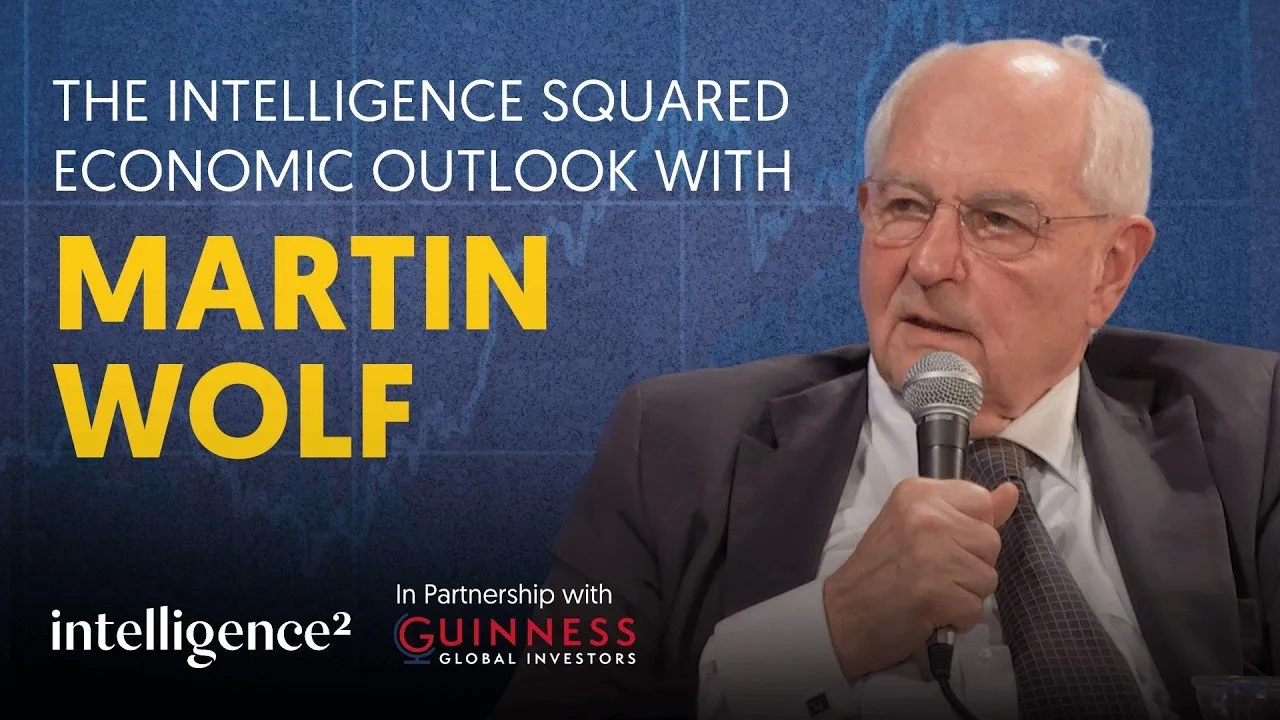
As 2026 opens with significant geopolitical tremors, from shifts in NATO alliances to the seizure of leaders in South America, the global economy is once again facing a severe test of resilience. At a recent Intelligence Squared event, Financial Times chief economics commentator Martin Wolf joined Johnny Diamond to dissect the current state of global affairs. Their conversation spanned the precarious nature of British politics, the unpredictability of the American administration, and the profound impact of artificial intelligence. Wolf offered a rigorous analysis of why the current "small-c" conservative approach of the UK government may be insufficient to weather the coming storms and what the rise of populism means for the future of democratic capitalism.
Key Takeaways
- The UK’s Fiscal Vulnerability: Britain faces high debt-to-GDP ratios and a chronic current account deficit, making it sensitive to any perceived move toward populist or irresponsible fiscal policy.
- The End of American Predictability: The U.S. administration has abandoned fundamental principles of action, favoring a transactional approach that makes long-term global planning difficult.
- The Anatomy of Populism: Populism is a style of politics defined by anti-elitism, where leaders demand absolute trust and limitless power to "fix" systems allegedly rigged by corrupt elites.
- The AI Investment Boom: While AI promises massive productivity gains, the current surge in data center investment carries the risk of a bubble similar to the dot-com era or the 19th-century railway boom.
- Demographic Pressures: The "explosive" debt path in the UK and the population explosion in Africa represent two of the most significant long-term challenges for the global order.
The Fragility of the UK’s Political Economy
The British government is currently operating under a cloud of political uncertainty. While Keir Starmer’s administration has attempted to maintain a sense of fiscal orthodoxy, Martin Wolf suggests that the credibility of such leadership is often binary rather than a spectrum.
"You can't insist you're credible. You either are credible or you're not."
The current government is characterized by a "small-c" conservatism, largely driven by a Treasury and a Bank of England that have imposed strict orthodox limits on spending. This approach, while designed to soothe markets, risks alienating a public that has seen stagnant living standards for nearly two decades. Britain is currently a chronic deficit country, meaning its investment is financed from abroad. If a future government shifts toward redistributive policies without a clear funding plan, it could trigger disruptions in debt markets, forcing the Bank of England to raise interest rates and creating a significant economic mess.
The Growth Problem
The underlying issue remains the weak rate of economic growth. The last 20 years have seen the slowest rise in living standards in the UK since the early 19th century. Managing public spending is vastly easier when the economy is growing; when it stagnates, social problems inevitably rise. This stagnation creates a vicious circle where the tax burden must rise to meet the needs of an aging population, which in turn further suppresses household income and growth.
The Trump Administration and Global Volatility
The United States is no longer seen as a predictable or principled actor on the world stage. Instead, policy appears to shift based on the immediate perceptions and interests of the administration. This has led to a landscape where relations with China might be more stable than relations with traditional NATO allies. While initial fears of catastrophic tariffs were somewhat softened by a "chickening out" principle, the long-term impact on world trade remains negative.
The Dollar and the "Digital Twin"
Despite the politicization of the dollar and attempts at diversification by countries like China, the U.S. currency retains the advantages of the incumbent. One of the more innovative strategies emerging from the U.S. Treasury is the concept of a digital twin for the dollar through stablecoins. By backing these digital assets with U.S. Treasury liabilities, the administration could potentially fund its yawning deficits by allowing individuals worldwide to hold digital dollars directly.
Defining the Populist Threat
Populism is frequently used as a lazy label, but Wolf defines it as a specific style of politics with deep historical roots. Drawing on Platonic theory, he notes that the demagogue’s art is to frame the world as a conflict between "ordinary people" and "predatory, corrupt elites."
"The essential art of the demagogue is to say... predatory, corrupt, vicious elites are exploiting you."
This style of politics demands that constraints on power—such as the rule of law and independent judiciaries—be removed to allow the leader to "solve" the people's problems. Whether from the left or the right, populist economics tends to ignore fiscal and monetary constraints. Historical data suggests that over a 15-year period, right-wing populism typically leads to a 10% drop in GDP per capita, while left-wing populism results in a 15% decline, largely due to the erosion of property rights and institutions.
AI: The Next Industrial Revolution or Another Bubble?
Artificial Intelligence is the most transformative technology of the current era, but it brings as much anxiety as it does excitement. The current massive investment in data centers is reminiscent of the internet boom of the 1990s. While the technology itself is transformative, the sustainability of current stock prices is questionable. If the investment boom bursts, the world could see a significant slowdown in demand that monetary policy may be unable to offset.
Productivity vs. Job Displacement
The optimistic view is that AI will restore productivity growth to levels not seen in decades, allowing for non-inflationary expansion. However, the risk of massive job disruption is real. Unlike previous technological shifts where new jobs were created relatively quickly, the transition period for AI could last decades. Governments currently have very little idea how to handle the social consequences of such a shift.
The Demographic Reality of the 21st Century
The global demographic landscape is shifting dramatically. While rich nations and China face shrinking workforces, Africa’s population is set to explode. By 2050, the population of Africa will equal that of the entire developed world plus China combined. This creates immense pressure for economic development and migration. If the West does not have a clear strategy for African development, the migration pressures will become unmanageable.
In the UK, the demographic challenge is equally stark. With an aging society and stagnant growth, the debt path is becoming explosive. Solutions like lifting the pension age or reforming the triple lock are politically toxic, yet they may become inevitable. As Wolf notes, "stability destabilizes," and the current overconfidence in certain market sectors may be hiding significant fragilities.
Finding Hope in Historical Context
Despite the myriad challenges, there is a case for historical optimism. Looking back to 1946, few could have predicted the unparalleled economic boom that followed the Second World War. Between 1946 and today, world GDP per capita has increased fivefold—a feat never before seen in human history. While the current outlook may seem pessimistic to many, the capacity for human innovation and institutional resilience should not be underestimated. The 4% of the population who remain "very confident" in the future may yet be proven right, provided we can navigate the populist and fiscal traps of the coming decade.