Table of Contents
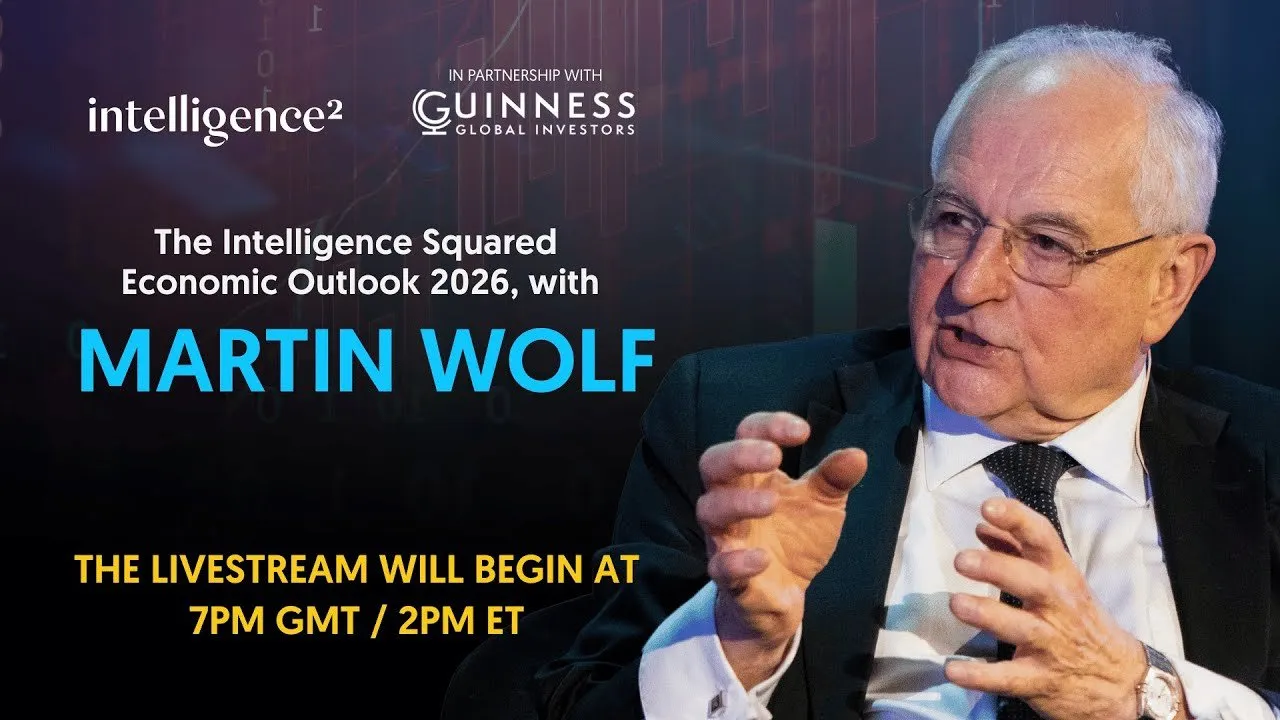
In a world increasingly defined by geopolitical volatility and rapid technological shifts, understanding the trajectory of the global economy requires looking beyond the daily headlines. In a recent detailed analysis for Intelligence Squared, Martin Wolf, the renowned chief economics commentator for the Financial Times, dissected the forces shaping our economic future as we look toward 2026 and beyond. From the resurgence of populism and the fragility of UK debt to the transformative power of AI, Wolf provides a sober yet nuanced roadmap for navigating an era where stability can no longer be taken for granted.
Key Takeaways
- The Era of Unpredictability: The United States has moved toward transactional, unpredictable policymaking, yet the US dollar remains dominant due to a lack of viable alternatives.
- The Cost of Populism: Economic analysis suggests that once entrenched, populist governments (both left and right) depress GDP by 10% to 15% over a 15-year period.
- UK Vulnerabilities: Britain faces a dangerous combination of high public debt, a chronic current account deficit, and low growth, making it highly susceptible to market shocks.
- The AI Dilemma: We are likely witnessing a classic investment bubble in AI infrastructure, but the long-term potential for a productivity revolution remains the best hope for escaping stagnation.
- Demographic Realities: Advanced economies are on an "explosive" debt path driven by aging populations, requiring politically difficult choices on taxation and retirement ages.
The New Geopolitical Reality: Predictability is Gone
The defining characteristic of the current global economic landscape is the erosion of predictability. Policy actions, particularly from major powers like the United States, are no longer bound by traditional principles or long-standing alliances. Instead, decision-making has become increasingly transactional, driven by immediate political benefits rather than long-term strategic coherence.
Despite this volatility, the predicted catastrophes regarding global trade and the US dollar have not fully materialized. While protectionist tariffs introduce friction, the US economy remains relatively insulated due to its low reliance on imports relative to GDP. Furthermore, the anticipated collapse of the dollar's dominance has been stalled by a simple reality: there is no alternative.
"It is a general principle that you shouldn't go to war with your creditors. The US has got away with it because the creditors see no alternative."
While diversification is happening—with China pushing the RMB and the EU bolstering the Euro—the US dollar retains the massive advantages of incumbency: the largest economy, the deepest financial sector, and universal familiarity. Wolf notes an intriguing development in this space: the rise of stablecoins. These digital assets, largely backed by US Treasury liabilities, effectively act as a digital platform for the dollar, allowing the US to continue funding its deficits by embedding its currency into the future of digital finance.
The "Taco Principle" of US Policy
Analyzing the erratic nature of recent US administrations, notably regarding trade and foreign policy, Wolf references the "Taco Principle." This concept suggests that while the rhetoric is often inflammatory and the threats severe, the final policy execution tends to be softened or walked back when economic realities bite. However, this creates a confidence problem. Markets and allies are constantly hedging against the risk that one day, the "fireworks" will not be contained.
The UK Economy: Fragility and Missed Opportunities
Closer to home, the United Kingdom finds itself in a precarious economic position. The post-2010 era has been characterized by what Wolf identifies as the slowest rise in living standards since the early 19th century. This stagnation creates a vicious cycle: low growth leads to social discontent, which pressures the government to spend more, resulting in a rising tax burden that further suppresses growth.
The UK’s vulnerability is structural. The nation runs a chronic current account deficit, meaning it relies on foreign capital to finance investment and government debt. With public debt now hovering near 100% of GDP—up from 40% prior to the financial crisis—the UK has little room for error.
"If you add a government that might look irresponsible or populist to our debt position, that raises significantly the chances of disruptions in debt markets."
The Science and Tech Advantage
Despite these headwinds, the UK possesses a unique and underutilized asset: its leadership in science, technology, and academia. Wolf argues that the UK is the only mid-sized country with a university system and intellectual tradition that rivals the United States. In an era where the US is increasingly politicizing its own scientific institutions, the UK has a "spectacular opportunity" to double down on biosciences and AI.
However, realizing this potential requires fiscal imagination. Rather than relying solely on its status as a financial hub—a sector that brings wealth but also volatility—Britain must build a more dynamic system for converting academic prowess into scalable business ventures.
The Economic Costs of Populism
The rise of populism is not merely a political phenomenon; it is a profound economic risk. Wolf defines populism not by its policy specifics, but by its style: a demagogic approach that frames politics as a battle between the "virtuous people" and "predatory elites," requiring leaders to demand limitless power to fix society's ills.
Research into the long-term effects of populist governance over the last century paints a grim picture. Once established, populist governments are difficult to dislodge, often lasting 15 years or more as they erode electoral institutions. The economic toll is quantifiable:
- Right-wing populism tends to reduce GDP per head by approximately 10% compared to non-populist peers.
- Left-wing populism is associated with a 15% reduction in GDP per head.
The disparity often stems from property rights. While right-wing populism is often corrupt and interventionist, it generally maintains basic property rights. Left-wing variations, historically seen in Latin America, frequently annul property rights entirely, leading to total economic collapse. Regardless of the flavor, populism thrives on the destruction of the complex, independent institutions—judiciaries, central banks, and civil services—that provide the stability necessary for long-term growth.
The Artificial Intelligence Boom: Bubble or Revolution?
The current explosion of investment in Artificial Intelligence draws striking parallels to the railway mania of the 19th century or the dot-com boom of the 1990s. Wolf suggests we are likely in a bubble phase. It is probable that stock valuations are unsustainable and that a significant portion of the current infrastructure investment—data centers and hardware—will eventually face a reckoning when business models fail to materialize immediately.
If this investment boom collapses, the world could face a significant demand shock. With monetary policy already stretched and debt levels high, governments would struggle to offset a crash with fiscal stimulus. This presents a "nightmare scenario" of a deep global slowdown.
The Productivity Hope
However, there is a distinct upside. If AI succeeds in doubling productivity growth, as some optimists predict, it could solve the very stagnation problems plaguing economies like the UK. Higher productivity would allow for non-inflationary wage growth and help monetize heavy public debt loads.
"They have absolutely no idea what's going to hit them. But to be fair, nobody does... My general assumption tends to be any digital tech revolution ends up being very destructive, but I hope I am wrong."
The labor market implications remain the great unknown. While economists traditionally argue that technology creates new jobs to replace old ones, the transition period for AI could last decades. During the Industrial Revolution, it took 30 to 40 years for wages to realign with productivity—a lifetime of disruption for workers.
Demographics and the Fiscal Cliff
Beneath the noise of geopolitics and tech bubbles lies a relentless mathematical reality: demographics. Most advanced economies, and increasingly developing ones like China and Brazil, are aging rapidly. In the UK, the Office for Budget Responsibility (OBR) forecasts an "explosive" debt path under current policies.
Wolf identifies only three ways to address this fiscal imbalance:
- Accept Higher Taxes: The tax burden will likely drift toward 50% of GDP, similar to Denmark.
- Radical Labor Reform: Governments must incentivize older populations to work longer, well past current retirement ages.
- Growth: Achieving significantly higher GDP growth to outpace debt accumulation.
The political toxicity of these choices—cutting pensions or raising taxes on working populations—means most governments are paralyzed. The most likely outcome is that structural reforms will only happen when a crisis forces the issue.
Conclusion
It is easy to look at the "two predatory superpowers" (the US and China), the fragility of European debt, and the disruption of AI and feel deep pessimism. Yet, history offers a counter-narrative. Looking back to 1946, the world faced a landscape of ruin, debt, and geopolitical uncertainty far worse than today. What followed was an era of unparalleled economic expansion where global GDP per head increased five-fold.
While the current risks are acute—particularly the potential for conflict with creditors or the mishandling of the AI transition—the global economy has repeatedly demonstrated a capacity for resilience that defies expert prediction. The path forward will be volatile, but the potential for renewal remains.

![Is The Bottom In For Bitcoin? [Here’s Your Signal]](/content/images/size/w1304/format/webp/2026/02/is-the-bottom-in-for-bitcoin.jpg)