Table of Contents
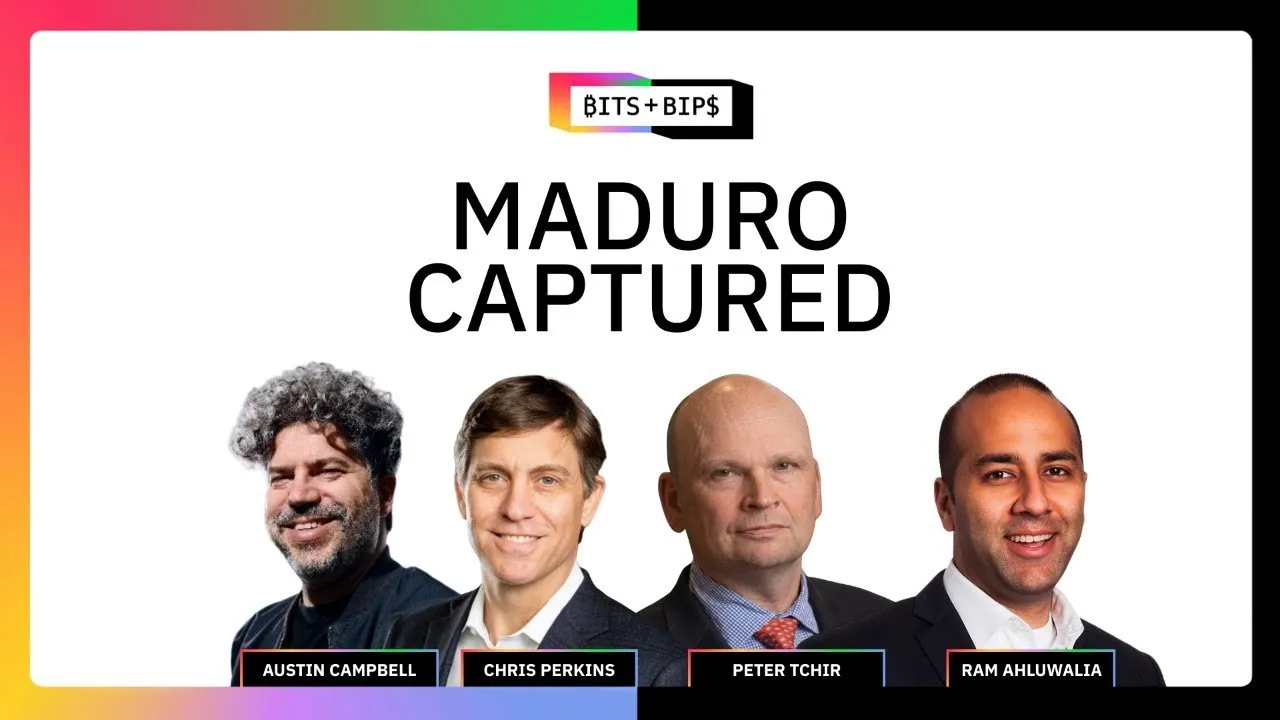
The global geopolitical landscape shifted overnight with the U.S. capture of Venezuelan President Nicolás Maduro. In the first 2026 edition of Bits and Bips, hosts Austin Campbell, Ram Ahluwalia, and Chris Perkins were joined by Peter Tchir, Head of Macro Strategy at Academy Securities, to dissect the immediate market reaction. What appears on the surface to be a singular military operation may actually signal a fundamental pivot in U.S. foreign policy, global energy markets, and the role of digital assets in statecraft.
The conversation revealed that markets are not merely reacting to a regime change in Venezuela, but are repricing risk based on a revitalized Monroe Doctrine and a shift toward "Production for Security." From the surge in Bitcoin to the implications for rare earth minerals, the extraction of Maduro serves as a bellwether for how the U.S. intends to project power and protect supply chains in a fracturing world.
Key Takeaways
- Crypto as the geopolitical early warning system: While traditional equity markets were closed during the weekend raid, Bitcoin and digital assets reacted in real-time, highlighting their utility as 24/7 risk management tools.
- The rise of "ProSec" (Production for Security): The panel argues that the era of ESG is evolving into a focus on security and survival, prioritizing domestic and hemispheric production of energy, chips, and critical minerals.
- A shift in military doctrine: The surgical nature of the operation—contrasted with the "boots on the ground" approach of the early 2000s—signals a more precise, less occupation-heavy U.S. strategy.
- The North-South Alliance: Investment theses are shifting away from East-West trade toward a North-South axis, favoring Latin American markets (Mexico, Brazil, Argentina) over Europe and Asia.
- Stablecoins as soft power: The vacuum left by the Maduro regime presents a massive opportunity for dollarization via stablecoins, cementing U.S. economic influence without traditional banking infrastructure.
The Market Verdict: High Beta and Animal Spirits
The immediate reaction to the operation was a decisive "risk-on" signal. Bitcoin rallied past $94,000, and crypto miners saw double-digit gains. The panel noted that this wasn't just a reaction to regional stability, but a broader acknowledgment that the U.S. administration is capable of executing complex objectives without getting bogged down in prolonged conflict.
"Crypto is awake. Traditional markets are asleep. We're not going to be able to go through too many more stresses like this before people say... 'I'm leaving traditional markets behind.'"
Ram Ahluwalia pointed out that high-beta assets—those most sensitive to market volatility and liquidity—are outperforming. This suggests that investors view the operation not as a destabilizing war, but as a move that reduces long-term geopolitical friction. By removing a key disruptive figure and potentially unlocking energy reserves, the market perceives a path toward lower inflation and sustained financing for capital-intensive sectors like AI.
From Defense to Offense: A New Military Doctrine
A central theme of the discussion was the operational method used. Unlike the drawn-out conflicts in Afghanistan or Iraq, this was a rapid, intelligence-driven extraction. Chris Perkins described this as the "Anti-Bay of Pigs," demonstrating capabilities that send a stark message to other adversaries, notably China and Russia.
The Deterrence Effect
The timing of the raid—coinciding with aggressive Chinese naval maneuvers around Taiwan—was likely no accident. By demonstrating the ability to dismantle a nation's air defenses and capture its head of state overnight with zero American casualties, the U.S. re-established a credible threat of force. This "surgical" approach reduces the fear of long-term entanglements that typically spook markets, replacing it with a narrative of precise power projection.
Reviving the Monroe Doctrine
Peter Tchir emphasized that this move solidifies a "North-South Alliance." The U.S. appears to be pivoting its focus to the Western Hemisphere, looking to stabilize Latin America to secure supply chains closer to home. This has profound implications for emerging market investors, who may need to distinguish sharply between Asian EMs (exposed to Chinese supply chain risks) and Latin American EMs (beneficiaries of U.S. "friend-shoring").
The Era of "ProSec": Production for Security
Perhaps the most significant macro shift identified by Peter Tchir is the transition from ESG (Environmental, Social, and Governance) to what he terms "ProSec," or Production for Security. In a world defined by great power competition, the hierarchy of needs has shifted.
"If you think about Maslow's hierarchy of needs... we realized your foundations crumbled. So... you got to go back to that base layer and produce those things: shelter, [energy, and materials]."
The Critical Minerals Race
While Venezuela is known for oil, the panel speculated that its unexploited rare earth and critical mineral reserves might be the true long-term prize. China currently holds significant leverage over the U.S. regarding the processing and refining of these minerals. By securing a friendly government in Venezuela and deepening ties with Argentina and Mexico, the U.S. aims to break China's chokehold on the inputs required for chips, batteries, and advanced weaponry.
Energy Independence and AI
The "ProSec" thesis extends to domestic energy production. With the explosive energy demands of Artificial Intelligence and data centers, the U.S. is expected to aggressively pursue an "all of the above" energy strategy. This includes revitalizing nuclear power (specifically Small Modular Reactors or SMRs) and expanding solar capacity. The panel noted that affordability of electricity is swiftly becoming a primary political issue, forcing a pragmatic approach to regulation and generation.
Dollarization and the Crypto Standard
The economic stabilization of Venezuela presents a unique test case for digital assets. The local currency has been decimated by hyperinflation, and trust in centralized banking is low. Austin Campbell raised the prospect of dollarization occurring not through pallets of physical cash, but through U.S. dollar-backed stablecoins.
Tether is already the most popular stablecoin in Latin America, but a U.S.-backed transition could see a flood of regulated stablecoins entering the Venezuelan economy. This serves a dual purpose: it stabilizes the local economy immediately and entrenches the U.S. dollar as the medium of exchange, frustrating Chinese efforts to internationalize the Renminbi in the region.
Furthermore, there is speculation regarding the seizure of the previous regime's assets. If the U.S. government seizes Maduro's cryptocurrency holdings, it faces a choice: auction them off (as Germany did previously) or hold them. Given the current administration's stance, there is a strong possibility these assets could seed a strategic reserve or a sovereign wealth fund, further legitimizing Bitcoin as a nation-state asset class.
Conclusion: The Pre-War Investment Landscape
The consensus among the Bits and Bips panel is that the world has entered a "pre-war" environment. This does not necessarily imply inevitable World War III, but rather a mindset where efficiency, security, and supply chain resilience take precedence over globalized just-in-time economics.
For investors, this signals a rotation. Capital is likely to flow toward defense, domestic energy, and Latin American allies, while Europe may lag due to its energy dependence and lack of a cohesive security strategy. The capture of Maduro is not just a headline; it is a signal that the U.S. is aggressively reorganizing the global board, and markets are moving fast to align with this new reality.