Table of Contents
We are currently living through a historical transition that may be as significant as the Industrial Revolution or the fall of the Berlin Wall. While headlines are dominated by fears of job displacement and economic disruption, a deeper look reveals a different narrative: artificial intelligence has arrived precisely when humanity needs it most.
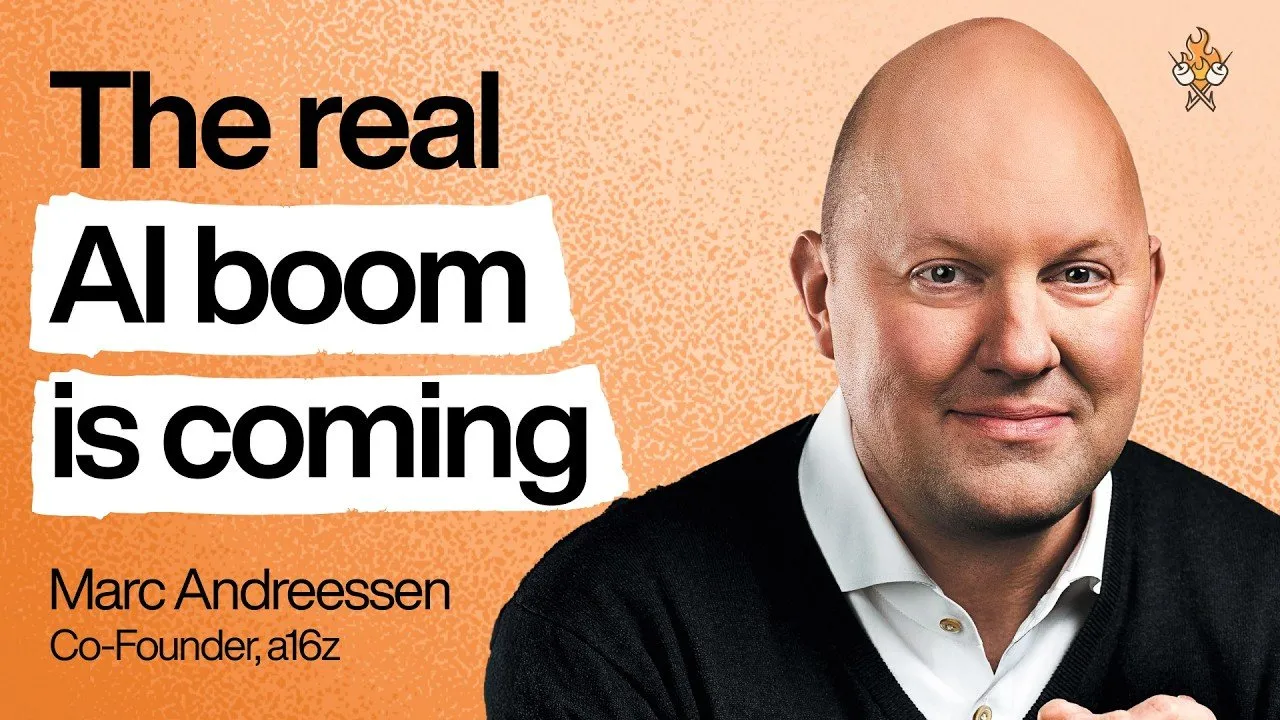
Marc Andreessen, co-founder of a16z and one of Silicon Valley’s most influential thinkers, argues that we are not facing a dystopian future of scarcity, but rather a potential era of unprecedented productivity. From the "Mexican standoff" between tech roles to the collapse of global demographics, the implications of the AI boom are far more complex—and optimistic—than the prevailing narrative suggests.
Key Takeaways
- The Demographic Crisis: AI is not a job-killer in the aggregate; it is an economic necessity. With global populations and birth rates in decline, we need AI and robotics to maintain economic growth and productivity.
- The "Mexican Standoff" of Skills: The lines between product managers, designers, and engineers are blurring. The future belongs to the "super-empowered individual" who can use AI to master multiple domains simultaneously.
- Sand into Thought: AI represents the "Philosopher’s Stone" of technology, converting the most abundant resource on earth (silicon/sand) into the rarest and most valuable resource (intelligence/thought).
- Agency Over Obedience: In an AI-native world, the most critical skill to teach children is agency—the ability to lead and build—rather than rule-following.
- Uncapped Intelligence: We are approaching a moment where intelligence is no longer capped by biological limits (IQ ~160), opening the door to scientific and creative breakthroughs we cannot yet imagine.
The Economic Necessity of AI
The prevailing anxiety surrounding artificial intelligence is that it will render human labor obsolete, leading to mass unemployment and economic despair. However, this fear ignores the macroeconomic reality of the last 50 years. Contrary to popular belief, we have been living in a regime of relatively slow technological change and productivity growth.
When you combine slow productivity with a global collapse in birth rates, the real threat isn't that robots will take our jobs—it is that there won't be enough workers to sustain the economy. In this context, the arrival of AI is not a disaster; it is a miraculous timing solution.
"The timing has worked out miraculously well. We're going to have AI and robots precisely when we actually need them. The remaining human workers are going to be at a premium, not at a discount."
If AI succeeds in driving massive productivity growth, the economic mechanism is straightforward: more output requires less input. This leads to a collapse in prices for goods and services. When the cost of healthcare, education, and housing falls due to technological efficiency, real wealth increases for everyone. A world of AI abundance is one where the social safety net is easier to fund and the standard of living rises, counteracting the deflationary pressures of a shrinking population.
The "Mexican Standoff" in Tech Roles
In the world of software development, a fascinating dynamic is emerging between the three core roles: product managers, engineers, and designers. Andreessen describes this as a "Mexican standoff."
Previously, these roles were distinct silos. Today, every engineer believes they can be a product manager and designer because they have AI tools to assist them. Conversely, designers and product managers believe they can code and build products independently using those same tools. They are all correct.
The Rise of the Super-Empowered Individual
This convergence does not necessarily mean these jobs disappear; rather, the tasks within the jobs change. The future belongs to the "super-empowered individual"—a worker who uses AI to become exponentially more productive.
This validates the career advice famously given by Scott Adams (creator of Dilbert): you don't need to be the absolute best at one thing. Instead, you should aim to be in the top 25% of two or three different fields. The additive effect of combining skills—such as a coder who understands design, or a writer who understands business—creates a specialized relevance that is impossible to automate.
"The additive effect of being good at two things is more than double. The additive effect of being good at three things is more than triple. You become a super relevant specialist in the combination of the domains."
In this new era, the most successful professionals will be those who refuse to be fungible. They will build a "T-shaped" or even "E-shaped" skill set, using AI to deepen their expertise in one area while broadly expanding their capabilities in others.
Redefining Education and Parenting for Agency
If the economy and the workplace are shifting fundamentally, how we educate the next generation must also change. The traditional education system was designed to teach obedience and rule-following—skills that are becoming less valuable in a world where AI can execute tasks based on rules perfectly.
The premium skill for the next generation is agency: the initiative to take charge, build new things, and solve novel problems. Andreessen, who homeschools his own children, emphasizes that AI serves as the ultimate tool for fostering this agency.
The Bloom Two Sigma Effect
Educational research has long shown that one-on-one tutoring is the most effective way to teach, capable of raising a student's performance by two standard deviations (the "Bloom Two Sigma" effect). Until now, this was economically unfeasible for most families. AI democratizes this aristocracy of education.
Every child now has access to an infinite, patient, and knowledgeable tutor. They can ask an AI to explain quantum physics, then ask it to "dumb it down," then ask to be quizzed. This allows children to pursue their curiosities down the rabbit hole, turning them from passive recipients of information into active seekers of knowledge.
The Evolution of Coding: From Syntax to Orchestration
There is a growing debate about whether learning to code is still necessary. If AI can write code, should humans bother learning Python or C++? Andreessen argues that while the tasks of coding are changing, the deep understanding of computer science remains vital.
Historically, the term "calculator" referred to a human job description—people who sat in rooms doing math by hand. When electronic calculators arrived, the job disappeared, but the task of calculation became infinitely faster and more complex. Similarly, coding is moving away from the manual writing of syntax toward the orchestration of AI agents.
- The New Workflow: A modern programmer might not write every line of code. Instead, they manage ten different "coding bots," reviewing their output, debugging their logic, and guiding the architecture.
- The Value of Depth: To be a great orchestrator, one must still understand the fundamentals. If you don't know how the machine works, you cannot effectively judge the output of the AI or debug it when it hallucinates.
The goal is not to let AI do the work so you can be mediocre; the goal is to use AI to become spectacularly great. The best programmers are reporting that they are not just 2x more productive, but 10x or 100x more productive.
The Philosopher’s Stone: Sand into Thought
To understand the magnitude of this technological moment, we can look back to the obsession of Isaac Newton and the alchemists: the Philosopher’s Stone. They sought a substance that could turn common lead into rare gold. They never succeeded.
Today, the semiconductor industry and AI researchers have achieved exactly that. We have taken silicon—sand, the most common substance on Earth—and processed it into computer chips that can generate intelligence.
"Now we have a technology that transfers the most common thing in the world which is sand converted into the most rare thing in the world which is thought."
This transformation suggests that intelligence, previously a constrained resource limited by biology, is becoming abundant. Human IQ biologically caps out around 160 (Einstein levels). We are building machines that face no such biological constraints.
The implications of uncapped intelligence are profound. We are likely to see AI models that not only match human reasoning but exceed it, potentially solving scientific stagnation in fields like physics, medicine, and energy. We are not just automating current tasks; we are unlocking the ability to solve problems that have previously been beyond human cognitive capacity.
Conclusion: An Indeterminate Optimism
Predicting the exact structure of the future—which companies will win, or which specific regulations will pass—is impossible. The system is too complex and adaptive. However, the trajectory points toward a world of "indeterminate optimism." We may not know exactly how things will get better, but the combination of human ingenuity and machine intelligence provides the tools to solve our grandest challenges.
For individuals, the path forward is clear: engage with the technology immediately. Do not be a passive observer. Spend time talking to AI, asking it to teach you, and using it to expand your capabilities. The boom hasn't even started yet, and the opportunity to define your role in this new world is available to anyone willing to learn.