Table of Contents
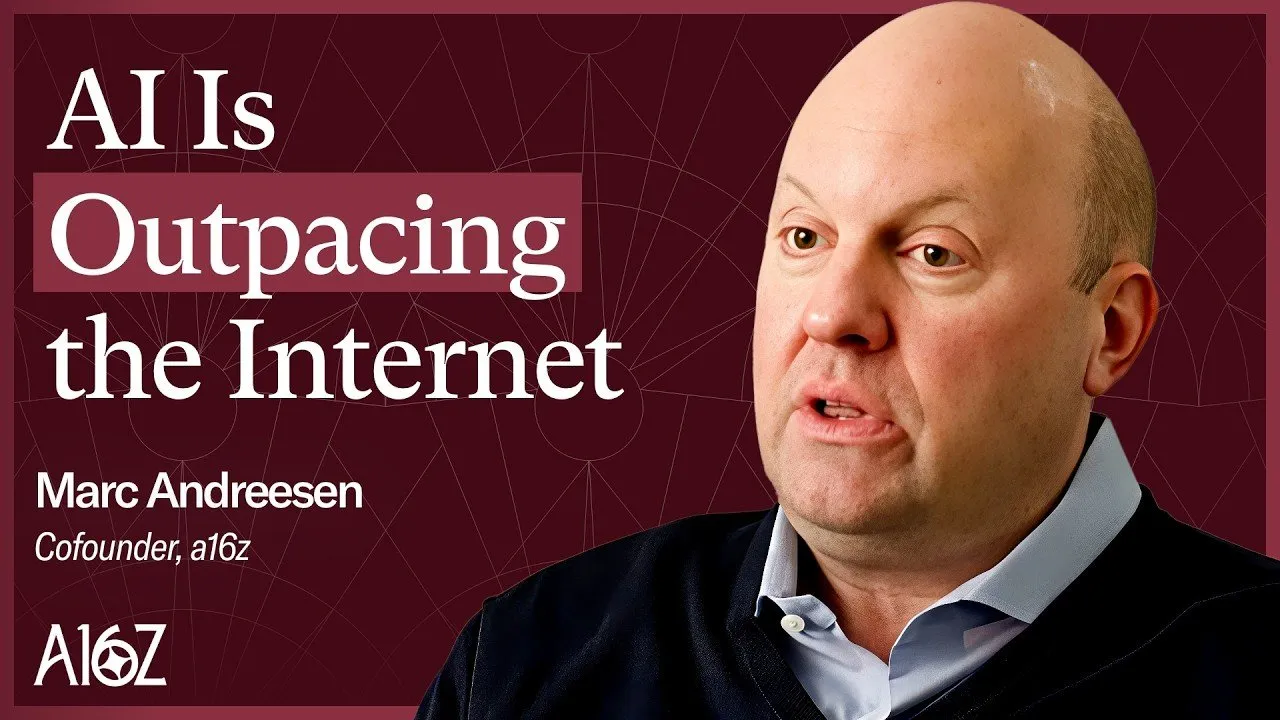
We are currently living through a technological shift that rivals the introduction of the steam engine, electricity, and the microprocessor. In a wide-ranging discussion on the state of the industry, Marc Andreessen, co-founder of Andreessen Horowitz (a16z), suggests that artificial intelligence is not merely another tech cycle—it is the definitive revolution of our lifetime. While the internet required decades of physical infrastructure build-out to reach global ubiquity, AI is riding the rails of existing connectivity to proliferate at unprecedented speeds. From the collapsing costs of compute to the geopolitical chess match between the U.S. and China, the landscape is shifting daily, presenting what Andreessen calls "trillion-dollar questions" rather than settled answers.
Key Takeaways
- The Magnitude of the Shift: AI represents the realization of an 80-year quest to build computers modeled after human cognition (neural networks) rather than calculating machines, a shift significantly larger than the internet revolution.
- Economic Deflation: The cost of AI "intelligence tokens" is falling faster than Moore’s Law, driving a hyper-deflationary cycle that is sparking massive elasticity in demand.
- The "God Model" vs. Small Models: The industry is bifurcating into massive, centralized super-intelligence models and highly efficient, localized small models that chase state-of-the-art capabilities within months of release.
- Geopolitical Stakes: The U.S. and China are locked in a "Cold War" style technology race, with Chinese open-source models like DeepSeek surprising the market with their efficiency and capability.
- Revealed Preferences: While public polling often reflects anxiety about AI, consumer behavior tells a different story: mass adoption, high usage, and deep integration into daily life.
1. The 80-Year Cycle: Realizing the Neural Network Dream
To understand the current explosion in AI capabilities, one must look back not just to the release of ChatGPT, but to the dawn of computing in the 1940s. The industry is currently correcting a divergence that began nearly a century ago between two distinct theories of computation.
The Path Not Taken
- The Great Divergence: In the 1930s and 40s, the pioneers of computing debated whether to build machines based on "adding machines" (calculating logic) or the human brain (neural networks). The industry ultimately chose the former, leading to the rigid, logic-based computing architecture of the last 80 years.
- The Neural Network Underground: Despite the dominance of the calculating machine model, a "rump movement" of researchers continued to explore neural networks and cybernetics in academia, facing decades of skepticism and "AI winters."
- The Crystallization Moment: The release of ChatGPT was the moment where 80 years of theoretical work finally crystallized into a working product, proving that the neural network approach was viable and scalable.
- Democratization of Access: Unlike the internet, which required laying fiber and building cell towers, AI is deploying instantly to 5 billion connected humans. It is the first major technological revolution that can be "downloaded."
- Rapid Evolution of Product Forms: The current chat-based interfaces are likely primitive compared to what will exist in five years; we are in the earliest innings of product design for this new intelligence.
- Surpassing Expectations: The rate of scientific discovery is flooring even seasoned investors, with new papers releasing capabilities on a daily basis that were previously thought impossible.
This is the biggest technological revolution of my life... clearly bigger than the internet.
2. The Economics of Intelligence: Pricing, Demand, and Chips
The business side of AI is defying traditional economic gravity. We are witnessing a unique market dynamic where the core input—intelligence—is becoming exponentially cheaper while simultaneously generating unprecedented revenue growth for companies that harness it.
Supply, Demand, and the Chip Glut
- Hyper-Deflation of Costs: The price of running AI inference is dropping significantly faster than Moore’s Law, creating a scenario where intelligence becomes effectively abundant.
- Elasticity of Demand: As prices collapse, demand is exploding. This elasticity suggests that the market for intelligence is far larger than previously anticipated.
- The Cycle of Shortage and Glut: While there are current shortages in GPUs and data center capacity, historical patterns suggest these will inevitably turn into gluts as massive capital investment floods the space.
- Pricing Power: Unlike the "race to the bottom" often seen in SaaS, consumer AI companies are successfully testing higher price points (e.g., $200/month tiers) by delivering massive value.
- Enterprise Value: For businesses, the value proposition is simple: if you can raise customer service scores or coding productivity by double-digit percentages, the ROI is immediate.
- Nvidia and the Competition: Nvidia’s massive profits act as a "Bat Signal" to the rest of the market, inviting fierce competition from AMD, hyperscalers (Google, Amazon), and state-sponsored Chinese initiatives to build alternative chips.
The price of AI is falling much faster than Moore's law.
3. Industry Architecture: "God Models" and the Rise of Small Models
A major debate is unfolding regarding the future structure of the AI industry. Will intelligence be centralized in massive, omniscient models, or will it be distributed across billions of local devices? Andreessen predicts a "pyramid" structure similar to the evolution of the PC industry.
The Chase Function
- The "God Model" Tier: There will likely remain a small handful of massive, centralized "supercomputer" models (like GPT-5 or 6) that provide the absolute peak of intelligence for the most complex tasks.
- The Compression Cycle: A consistent pattern has emerged where the capabilities of a leading-edge model are replicated by smaller, more efficient models within 6 to 12 months.
- Local Inference: Innovations like China's "Kimmy" or the reasoning capabilities of DeepSeek prove that high-level reasoning can eventually run on local hardware, such as a laptop or phone.
- Volume at the Bottom: While the smartest models sit at the top, the sheer volume of inference will likely happen on smaller, task-specific models embedded in devices, software, and everyday objects.
- Specialized Application Models: Leading application startups (e.g., Cursor) are moving beyond being "wrappers." They are using dozens of specialized models and training their own proprietary models to handle specific domain tasks better than generalist LLMs.
- No Permanent Moat: The speed at which startups like xAI and open-source projects catch up to incumbents suggests that maintaining a permanent lead solely through model architecture is incredibly difficult.
4. The Geopolitical Arena: The U.S. vs. China Cold War
AI has become the central theater of a new geopolitical contest. Unlike the US-Soviet dynamic, which was largely military, the US-China rivalry is deeply economic and intertwined. The race for AI supremacy is now a matter of national security and industrial survival.
The Two-Horse Race
- DeepSeek’s Surprise: The release of DeepSeek from a Chinese hedge fund (not a tech giant) shocked Washington and Silicon Valley, proving that China can compete on model architecture even with chip constraints.
- Open Source as a Strategy: China’s aggressive use of open source is viewed by some as "dumping" to commoditize the western software advantage, but it also accelerates global innovation and forces U.S. companies to stay competitive.
- The Chip Embargo impact: While U.S. sanctions have slowed China's access to cutting-edge GPUs, it has forced domestic Chinese innovation (e.g., Huawei) to accelerate, potentially creating a parallel robust ecosystem.
- Robotics and Physical Supply Chains: China maintains a distinct advantage in the physical manifestation of AI—robotics—due to its dominance in electromechanical supply chains.
- The Argument Against Complacency: The existence of a capable rival is arguably positive for U.S. policy, as it kills the argument for slowing down domestic development. We cannot afford to pause when the competitor is sprinting.
- Intertwined Economies: Unlike the USSR, China and the U.S. are economically co-dependent, creating a complex "frenemy" dynamic where total decoupling could lead to mutual economic collapse.
Once somebody proves that it's capable, it seems to not be that hard for other people to be able to catch up.
5. The Battle for Regulation: "Little Tech" and Open Source
As the technology accelerates, the regulatory landscape has shifted from federal inaction to a fragmented patchwork of state-level bills. Andreessen Horowitz has taken an active role in Washington to prevent what they view as catastrophic legislative errors.
Federalism Gone Wrong
- The Fragmentation Risk: We are currently tracking over 1,200 AI-related bills across 50 states. This threatens to create a regulatory environment where it is illegal to operate a national AI service due to conflicting local laws.
- The SB1047 Bullet Dodged: The veto of California’s SB1047 was a critical moment. The bill attempted to assign "downstream liability" to open-source developers, which would have effectively killed open-source innovation and academic research in the state.
- The European Warning: The EU’s "AI Act" serves as a cautionary tale. By regulating prematurely, Europe has largely sidelined itself from the AI boom, prompting even European founders to move to the U.S.
- Bipartisan Consensus: Surprisingly, the mood in D.C. has shifted toward a pro-innovation stance. Both parties increasingly understand that handicapping U.S. tech in a race against China is a strategic error.
- The "Little Tech" Agenda: A16Z is actively lobbying to protect the interests of startups ("Little Tech") against regulatory capture that often favors large incumbents who can afford high compliance costs.
- Open Source Liability: A core policy battle remains protecting the concept that developers of general-purpose tools should not be liable for how bad actors misuse them years later.
6. Societal Impact and Investment Strategy
Despite the noise regarding AI taking jobs or ruining society, the actual data on human behavior suggests a very different reality. Andreessen Horowitz is positioning its investment strategy to capitalize on this divergence between what people say and what they do.
The "Revealed Preferences" of Humanity
- Survey vs. Reality: If you poll Americans, they express fear and panic about AI. If you watch their behavior (revealed preferences), they are adopting AI tools at record rates to improve their work, health, and relationships.
- The Panic Cycle: History is littered with "end of times" panics regarding automation, from the Luddites to the 1960s "Triple Revolution" committee. In every instance, technology amplified human potential rather than replacing it.
- Betting on Contradictions: A16Z’s strategy involves betting on multiple, often contradictory outcomes (e.g., investing in both big proprietary models and open-source infrastructure) because the market is large enough for multiple winners.
- Controversy as a Filter: The firm’s public willingness to engage in controversial topics acts as a positive filter. Founders who want bold partners gravitate toward the firm, while those who prefer safety stay away.
- Value-Based Pricing: We are moving toward a world where software is priced based on outcomes (e.g., the value of a lawyer or doctor) rather than seats, potentially unlocking massive revenue streams for startups.
- Optimism on Adoption: Ultimately, AI will likely follow the path of the smartphone: initially feared or dismissed, but eventually becoming a tool so essential that we cannot imagine life without it.
Conclusion
We are standing at the precipice of a transformation that will likely redefine the global economy and the geopolitical balance of power. While the questions surrounding pricing models, open-source liability, and the ultimate architecture of the industry remain "trillion-dollar questions," the trajectory is clear.
The costs of intelligence are collapsing, capabilities are skyrocketing, and despite the inevitable panic cycles, humanity is adopting these tools with enthusiasm. For founders and investors, the key is to remain agile, betting on the continued expansion of what is possible rather than retreating into a defensive crouch. As Andreessen notes, the best way to predict the future is to aggressively fund the people building it.