Table of Contents
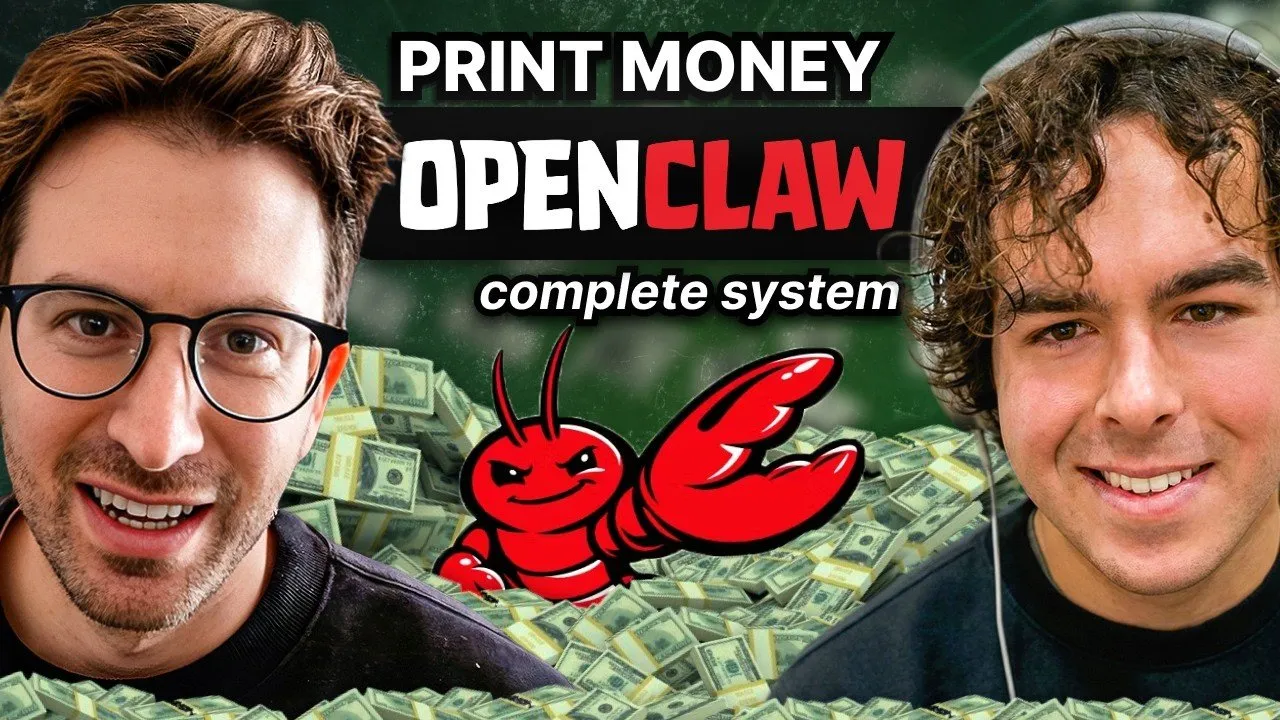
While the internet is flooded with viral clips of OpenClaw acting as a cute personal assistant or a digital novelty, a quieter, more profitable revolution is happening in the background. Savvy developers and entrepreneurs are moving beyond simple productivity hacks to deploy OpenClaw as a revenue-generating asset. By treating these AI instances not as chatbops but as digital employees capable of executing complex, vertical-specific workflows, builders are creating a new class of automation businesses. The opportunity lies not just in saving time, but in spinning up fleets of sub-agents to perform work that businesses are actively paying for today.
Key Takeaways
- Shift your mindset: Stop viewing OpenClaw as a personal assistant and start viewing it as a "computer use agent" capable of end-to-end business logic.
- The "Wedge" Strategy: To monetize, identify high-value, low-effort tasks within a specific vertical (like legacy CRM data entry) rather than trying to automate an entire business at once.
- Leverage Sub-Agents: Use a main OpenClaw instance as an orchestrator that spawns specialized sub-agents to handle parallel tasks, preventing your main "manager" from getting tied up with grunt work.
- The Upwork Arbitrage: Use freelance platforms to identify existing demand for "RPA" or manual data tasks, build a working OpenClaw demo using the job description, and win contracts by showing proof of work.
- Agents are the new SaaS: The future of software isn't selling a tool for humans to use; it is selling access to an agent that performs the outcome for them.
Moving Beyond the Personal Assistant
The viral demos of OpenClaw often showcase it navigating a browser or ordering food. While impressive, these use cases miss the massive economic potential of the technology. To monetize OpenClaw, you must pivot from personal convenience to business utility. The most successful implementations involve deploying OpenClaw into businesses to drive actual revenue outcomes or save significant operational costs.
Currently, we are seeing a surge in "concierge" services where developers manage OpenClaw instances for busy executives. However, the scalable money is in verticalized computer use agents. These are agents designed to navigate legacy software, interact with graphical user interfaces (GUIs) that lack clean APIs, and act as a universal bridge between disparate business systems.
The real power is in finding the thing that drives business outcomes, saves time for a business, finding that and building the automation around that.
A prime example of this is a promotional distributorship workflow. An agent can be trained to read incoming emails, navigate a supplier's website, download product specifications, parse that data, and upload it directly into a legacy CRM like Zoho. This transforms OpenClaw from a toy into a critical piece of infrastructure.
The "Wedge" Framework for Automation
When approaching a business or a potential revenue stream, you cannot automate everything at once. You need a "wedge"—a specific entry point that proves value immediately. This requires a design thinking approach to map out automation possibilities based on two metrics: Value Created vs. Effort/Cost.
Identifying Low-Hanging Fruit
Your goal is to find the quadrant of "High Value, Low Effort." These are often boring, repetitive tasks that require human vision or clicking because no API exists. Once you identify this wedge, you don't just ask OpenClaw to "figure it out." You map the workflow step-by-step.
Effective automation architects use tools like Figma or Mermaid code to visualize the process from tip to tail. By recording a human performing the task—perhaps using tools like Gemini or Granola to transcribe the process—you can feed that context into the agent. This allows you to build a robust pipeline where OpenClaw triggers a specialized Python script (a "Skill") rather than improvising every step.
Scaling with Sub-Agents and Virtual Machines
One of the most significant bottlenecks for early adopters is the "single-track" nature of an agent. If your OpenClaw instance is busy scraping a website, you cannot ask it to schedule a meeting. It is occupied. To solve this, you must treat your primary OpenClaw as a manager and utilize sub-agents.
Sub-agents act as specialized workers. You can spin up multiple virtual environments (using tools like Orgo or local clusters of Mac Minis) where each machine is dedicated to a specific task. For example, if you need to research 50 leads:
- The Orchestrator: Your main OpenClaw instance receives the command.
- The Delegation: It spawns five sub-agents in separate virtual environments.
- Parallelization: Each sub-agent processes 10 leads simultaneously.
- Consolidation: The orchestrator collects the results and presents the final report.
You’re giving an agent a computer... but the other half of the story is for it to be able to click around, actually operate a graphical user interface on legacy softwares.
This architecture transforms a single digital assistant into a scalable digital workforce. It allows for the parallelization of work, drastically reducing the time required to complete high-volume tasks.
The Upwork Strategy: Finding Immediate Revenue
If you do not have clients yet, the market is already telling you what it needs. Platforms like Upwork are filled with job postings for "RPA" (Robotic Process Automation), "Data Entry," or "Python Automation." These clients are essentially asking for OpenClaw without knowing it.
A tactical approach to winning these contracts involves permissionless development:
- Search for jobs with budgets between $500 and $5,000 that involve browser-based repetitive tasks.
- Take the job description and context provided in the posting.
- Spin up an OpenClaw instance and build a functional prototype of the solution immediately.
- Submit a proposal that includes a video or screenshot of the agent actually doing the work.
This arbitrage opportunity exists because the market perceives these tasks as requiring days of human labor or complex legacy coding. With OpenClaw, a savvy operator can build a solution in minutes. You are not just promising a solution; you are showing a finished product before the client has even interviewed other candidates.
The Future: Agents are the New SaaS
We are witnessing a fundamental shift in the software business model. Previously, entrepreneurs built SaaS (Software as a Service) tools and sold subscriptions to businesses, who then hired humans to operate that software. The next wave is Service as a Software.
In this model, you do not invite a user to a software interface; you invite them to a workspace populated by agents. A real estate agent, for example, shouldn't need to learn a complex new dashboard. They should be invited to a team of digital employees who already know how to scrape listings, qualify leads, and schedule viewings.
You’re not going to create software and invite them to the software. You’re going to create agents and you’re going to invite them to the agents.
This verticalization of computer use agents is where the "golden age" of individual entrepreneurship lies. By building specific assets—specialized agents for manufacturing, law, or logistics—developers are building the equivalent of a staffing agency, but with zero marginal cost of labor.
Conclusion
OpenClaw represents a "Chat GPT moment" for computer use. The barrier to entry for automating complex, visual computer tasks has collapsed. Whether you are a developer looking to build a startup or a freelancer looking to optimize workflows, the methodology is the same: identify a high-value manual process, map it out, and build a specialized agent to execute it.
The window of opportunity is open. The assets being built today—specialized scripts, agent workflows, and vertical-specific skills—will become the foundation of the next generation of software companies. It is time to stop treating these tools as novelties and start deploying them as the digital workforce of the future.