Table of Contents
Every January, millions of smart, motivated people make the same quiet mistake. It destroys their year before it even begins. It isn't a lack of laziness, and it certainly isn't a lack of discipline. The issue is far more predictable: relying on inspiration rather than structure.
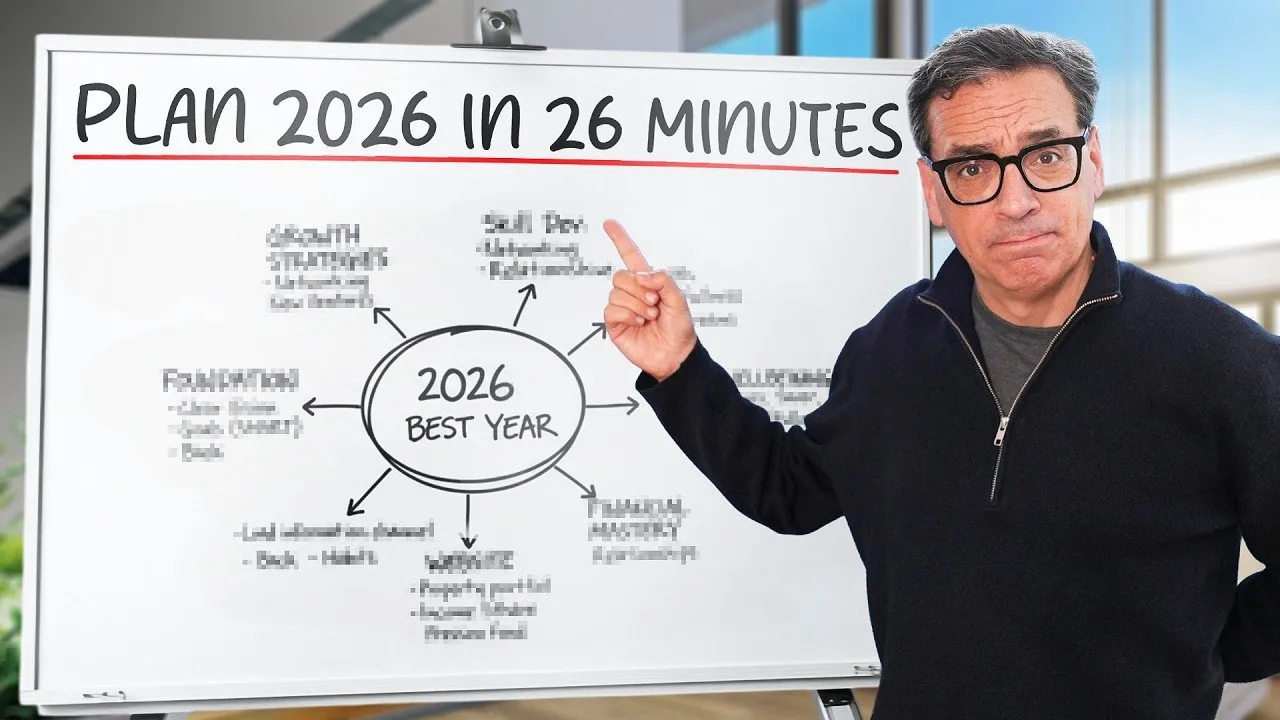
Those who truly thrive—from elite athletes to top executives—do not wait for motivation to strike. They build systems that make performance inevitable. If you want 2026 to be the year everything changes, you need a science-backed system designed to help you follow through. By implementing a framework based on clarity, structure, fuel, and connection, you can move from vague intentions to concrete results.
Key Takeaways
- Structure beats motivation: Willpower is a finite resource; environmental design and routines are sustainable.
- Look backward to move forward: actively processing regret and conducting "pre-mortems" prevents future failure.
- Protect your cognitive bandwidth: Simple habits like the 2-minute rule and protecting the first hour of the day preserve your IQ for deep work.
- Embrace discomfort: The neurological signal for learning feels like struggle; if you aren't failing 15% of the time, you aren't growing.
- Subtraction is powerful: To-do lists are common, but "to-don't" lists are often what create the space for excellence.
Act I: Build the Foundation with Clarity
Before you can accelerate, you must know exactly where you are starting and where you are going. This phase is about honesty and strategic foresight.
Run a Regret Review
Most advice suggests ignoring past failures. However, research indicates that regret, when handled correctly, is a powerful tool for instruction. The worst way to deal with regret is to ignore it; the best way is to use it as data.
Try this three-step process:
- Identify one specific regret: Look back at 2025. Don't choose a bundle of failures; pick the one that stings the most. Write it down on a piece of paper.
- Extract the lesson: On a second piece of paper, write down the lesson learned and a small, immediate plan to prevent it from recurring.
- Discard the emotion: Crumple up the first paper (the regret) and throw it away. Keep the second paper (the plan).
Regret isn't weakness, it's instruction. Use it to decide what matters most in the year ahead.
Conduct a Pre-Mortem
Everyone knows what a post-mortem is—an analysis of why a project died. A pre-mortem explains why something might die before it happens so you can save it. Jump mentally to December 31, 2026. Imagine your most important goal failed. Ask yourself: What went wrong? Did you lack accountability? Did you fail to schedule time? Once you list the causes of this imaginary failure, design your year to block those specific pitfalls.
Choose a Theme Word
Resolutions often fail because they are complex. Instead, choose a single word to serve as your compass for 2026. This acts as a "self-cue"—a psychological trigger to snap your attention back to your priorities.
If you have spent years planning, your word might be Ship. If you are burned out, it might be Restore. When you face a decision, simply ask if the choice aligns with your theme.
Operate in 90-Day Seasons
A year is dauntingly long. This often leads to the "middle-of-the-year slump." Instead of one 12-month marathon, treat 2026 as four 90-day sprints. Research on quarterly goal-setting shows that shorter feedback loops increase persistence. Every 90 days, conduct a reset: reflect on what worked, discard what didn't, and redirect your energy for the next season.
Act II: Design a Structure for Freedom
Once you have clarity, you need a daily architecture that keeps you on track when enthusiasm fades. This act focuses on optimizing your time and environment.
Protect the First Hour
The first hour of the day is when your brain is most impressionable. Unfortunately, most people surrender this time to other people's priorities by checking email or social media immediately. A University of London study found that multitasking early in the day can drop effective cognitive performance by the equivalent of 10 IQ points.
Guard this hour like an attack dog. Use it for deep, creative, or strategic work—anything that moves your life forward rather than responding to the world.
The 2-Minute Rule
Small tasks create invisible cognitive clutter. Derived from productivity consultant David Allen, the 2-minute rule is a "fog remover." If a task takes less than two minutes (sending a text, filing a document, hanging up a coat), do it immediately. Never schedule it. Never postpone it. This keeps your mental RAM clear for high-level thinking.
Mise-en-Place for Life
Chefs do not start cooking by searching for knives. They rely on mise-en-place—everything in its place. Preparation creates speed. Apply this to your life using implementation intentions:
- For exercise: Lay out your gym clothes the night before, placing them where you will step on them.
- For deep work: Clear your desk and open the relevant document before you go to sleep. Type one sentence so you have an easy starting point the next morning.
The Weekly Shutdown and Reset
To prevent work stress from bleeding into your weekend, establish a Shutdown Ritual on Friday. Review your tasks, plan your top three priorities for Monday, and verbally declare "Shutdown complete." This signals your brain that it is safe to stop ruminating.
Complement this with a Sunday Reset. Take 15 minutes to review your calendar for the upcoming week. Identify what needs to be canceled, protected, or prepared. This ensures you start Monday with intention rather than reaction.
Act III: Fuel Motivation with Psychology
Structure sets the stage, but you need fuel to keep moving. This requires upgrading your inner operating system to handle difficulty and progress.
The 85% Rule
We often think perfection is the goal, but machine learning research from UC San Diego suggests otherwise. Systems learn fastest when they are correct about 85% of the time. If you succeed 100% of the time, the task is too easy. If you fail constantly, it is too hard. Aim for the "sweet spot" where you are stretched but not snapped. This is where adaptation occurs.
Redefine Discomfort
When we feel awkward or frustrated, we usually interpret it as a sign to stop. We think, "I'm not good at this." However, research indicates that this feeling is actually the emotional signature of learning. Effort is the neurological cue for improvement. In 2026, when you feel friction, tell yourself: "This isn't failure. This is what getting better feels like."
Track Small Wins Daily
Harvard research on the "Progress Principle" shows that the single biggest motivator is making progress in meaningful work—no matter how small. Yet, we rarely track the positives.
Create a daily ritual: spend 60 seconds writing down three small wins from the day. It could be as simple as sending a difficult email or choosing a walk over scrolling. This creates a "progress loop," generating the positive emotion required to fuel the next day's effort.
The people who thrive don't rely on inspiration. They rely on structure.
Act IV: Connect and Renew
No one sustains excellence in isolation. You need a network that sharpens you and practices that restore you.
Build a Challenge Network
We all love compliments, but compliments do not improve performance. You need a "Challenge Network"—a small group of people who care enough to tell you the uncomfortable truth. Start "Feedback Fridays": send a piece of work to a trusted peer and ask, "What is one thing I can do to make this better?"
Curate Your Circle
Attitudes and habits are contagious—literally. Social contagion theory suggests behaviors spread up to three degrees within a network. Curate a core trio to surround yourself with:
- The Challenger: Pushes your thinking and prevents complacency.
- The Cheerleader: Helps you recover when you want to quit.
- The Coach: Someone a few steps ahead who can see patterns you miss.
Create a "To-Don't" List
Our brains are wired to solve problems by addition (doing more), but often the best solution is subtraction. Every quarter, identify tasks, meetings, or obligations that are no longer worth your time. Place them on a "To-Don't" list. Subtraction frees up the bandwidth necessary for excellence.
Gratitude as a Performance Tool
Finally, utilize the "26 Thank You Notes" challenge. Send one handwritten note every two weeks to someone who has helped, taught, or challenged you. Research validates that gratitude practices increase life satisfaction and reduce stress. It is a simple, analog habit that keeps you grounded and connected through the ups and downs of the year.
Conclusion
You now have 20 evidence-based techniques to design your best year. The goal is not to implement all of them simultaneously—that is a recipe for burnout. Instead, act like a curator. Select two or three ideas that resonate most with your current challenges and apply them rigorously.
Remember, a great year isn't something that happens to you. It is something you design, structure, and build, one day at a time.