Table of Contents
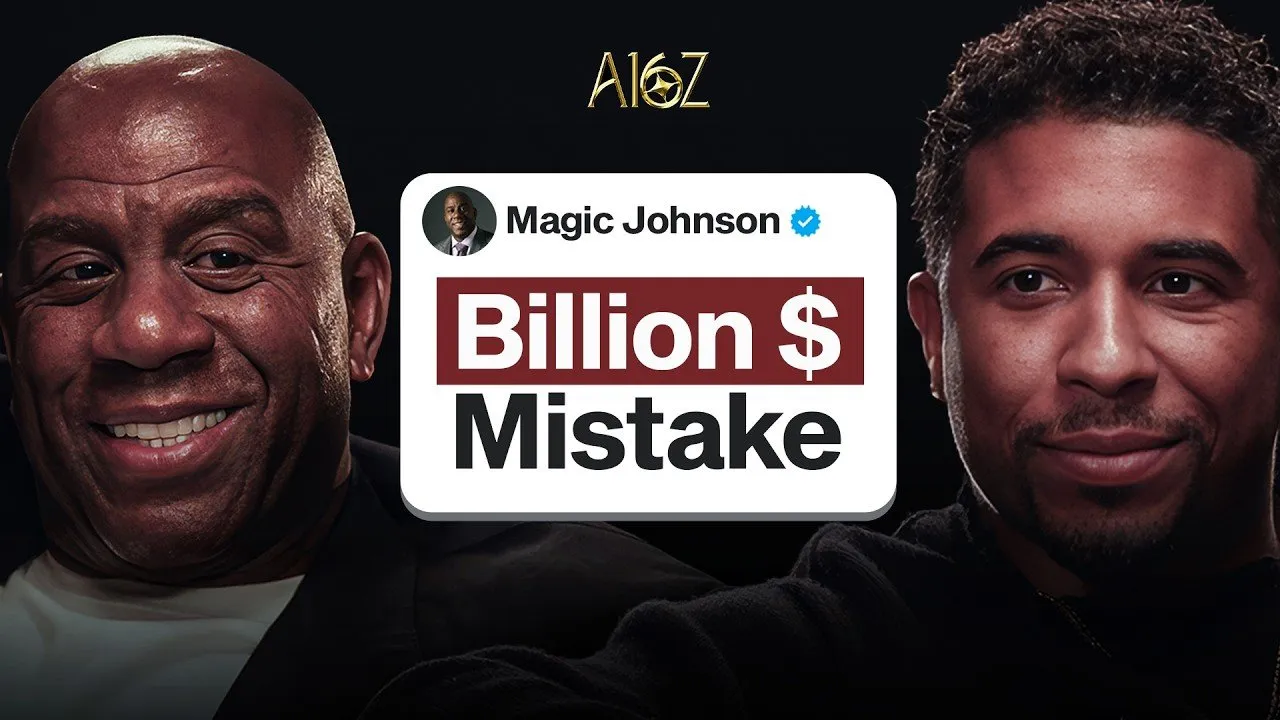
Few figures in history have successfully bridged the gap between elite athletics and high-level enterprise as effectively as Magic Johnson. While the world first knew him as the charismatic point guard leading the "Showtime" Lakers to five NBA championships, his second act as the CEO of Magic Johnson Enterprises has been perhaps even more impactful. In a candid conversation with Chris Lyons of Andreessen Horowitz (a16z), Johnson breaks down his evolution from a player seeking endorsements to a mogul demanding equity.
The transition wasn't accidental; it was the result of deliberate mentorship, a willingness to learn from failure, and a sharp eye for undervalued markets. From the $1 billion Nike mistake that reshaped his investment philosophy to his current ventures in Silicon Valley and sports ownership, Johnson’s journey offers a masterclass in portfolio diversification and the power of networking.
Key Takeaways
- Equity outperforms cash: Johnson’s missed opportunity with Nike taught him that long-term wealth is built through ownership and stock, not one-time endorsement checks.
- The power of "boring" businesses: While tech is flashy, Johnson built his foundation on tangible assets with high demand, such as movie theaters, food service, and infrastructure.
- Skin in the game is mandatory: True partnerships require personal financial risk; even Johnson’s mentors required him to write checks to prove his commitment.
- Fan experience drives valuation: In sports ownership, spending money on the stadium and player analytics is the primary driver of exponential asset appreciation.
- Build a team that can say "No": Success requires surrounding yourself with experts who are not friends, but business operators empowered to challenge your decisions.
The $1 Billion Lesson: Why Equity is King
Every great investor has a story about "the one that got away," and for Magic Johnson, that story is worth roughly $1 billion. In 1979, fresh out of college, Johnson was courted by shoe companies. Converse offered him cash, while Phil Knight of Nike, a younger and less liquid company at the time, offered him stock.
Johnson took the cash. It is a decision that, had he gone the other way, would be worth billions today. However, Johnson does not view this through a lens of regret, but rather as the foundational lesson that defined his future business strategy. It shifted his mindset from that of a laborer seeking a wage to an owner seeking a stake.
"I'm not a guy who goes backwards a lot. I move forward... What I have is what I'm supposed to have. The great thing is being 66 now, I'm not the same young guy I was then. So I can see deals different today."
This philosophy is now the standard advice he gives to the next generation of athletes, including LeBron James and Steph Curry. The goal is no longer just to be the face of a brand but to be on the cap table. Johnson emphasizes that modern deal-making for celebrities must focus on the benefits of equity versus simple endorsements, a shift that has created a new class of athlete-entrepreneurs.
Mentorship and the "Magazine Test"
Johnson’s business acumen was not innate; it was cultivated through aggressive networking and humility. His primary mentors included Lakers owner Dr. Jerry Buss and Hollywood super-agent Michael Ovitz. Johnson explicitly sought out Ovitz, knowing he needed to understand the mechanics of deal-making in Los Angeles.
The relationship didn't start easily. Ovitz initially dismissed Johnson, citing the poor track record of athletes in business. To prove his seriousness, Johnson was subjected to a test: Ovitz handed him a stack of business magazines and told him to return only after he had read and understood them. Johnson returned, passed the test, and gained access to a mentorship that would teach him the art of the "Rolodex."
The Value of Skin in the Game
Despite their close relationship, Dr. Jerry Buss taught Johnson a critical lesson about the difference between charity and business. When Johnson wanted to invest, Buss didn't simply gift him equity.
"Dr. Buss said, 'I love you as a son, but you got to write a check for a friend.' I said, 'Yes, sir.' And that's real... You have to put skin in the game. You got to be ready for that."
This requirement to invest his own capital ensured that Johnson was disciplined with his savings. It forced him to think like a partner who shared in the downside risk, rather than a celebrity simply lending their name.
Investment Thesis: Underserved Markets and "Boring" Businesses
While Johnson is now active in Silicon Valley, his initial fortune was built on a thesis that many overlooked: bringing high-quality services to urban, minority communities. He identified a mismatch between supply and demand. African American and Latino consumers had significant spending power—over a trillion dollars combined—but were often ignored by major chains.
Johnson partnered with companies like Starbucks and Sony to build franchises in inner cities. The logic was simple: these communities wanted the same coffee and movie experiences as suburban markets. By focusing on customer service and high margins in these "boring" sectors, Johnson Enterprises generated massive returns.
This thesis continues today with his investments in companies like Alchemy, which builds pharmacies in rural and inner-city areas where major chains are closing down. The strategy remains consistent: find where the demand is high and the supply is low, regardless of how "unsexy" the industry might appear.
Sports Ownership and Modern Valuation
Johnson has become a titan in sports ownership, holding stakes in the Los Angeles Dodgers (MLB), Washington Commanders (NFL), Los Angeles Sparks (WNBA), and LAFC (MLS). His approach to sports is strictly analytical. When his group purchased the Dodgers for $2.2 billion, critics argued they vastly overpaid. Today, the team is valued at roughly $8 billion.
Investing in the Asset
Johnson argues that the only way to increase the value of a sports asset is to aggressively spend capital on it. This involves a three-pronged approach:
- Fan Experience: The ownership group poured hundreds of millions into the stadium to justify ticket price increases and ensure fan retention.
- The Product on the Field: Investing in superstar talent (like Shohei Ohtani) and player development is non-negotiable.
- Analytics: Moving away from "gut feeling" to deep data analytics regarding player performance and scouting.
"We pour so much money into sports. And nobody's ever going to stop watching sports in America. Right now you got companies looking to buy teams... It's always been an asset class, but now people really see the long-term reality."
Johnson also highlights the massive growth potential in women's sports, noting that while the Sparks initially lost money, he held the asset because he believed in the long-term trajectory of the WNBA—a bet that is now paying off with skyrocketing team valuations and media rights deals.
Bridging the Gap to Silicon Valley
Over the last decade, Johnson has expanded his portfolio into venture capital, largely facilitated by his relationship with a16z. This move was strategic; Johnson recognized that while he had conquered traditional business, the future of growth lay in technology. He needed a "foot in the door" to access deals that were previously closed to outsiders.
His entry point was Skydio, an autonomous drone company. This investment perfectly bridged his worlds: the technology had obvious applications in sports broadcasting and security, sectors Johnson knew intimately. By investing early in Skydio, Johnson proved he could bring strategic value beyond capital—specifically, government and enterprise connections.
Today, his focus has shifted toward Artificial Intelligence and Biotech. He views AI not as a trend, but as a utility that lowers costs and increases efficiency across all his portfolio companies. He advises new investors to look at "who is leading the deal" as a primary vetting mechanism—if top-tier firms are writing checks, the due diligence has likely been thorough.
Conclusion
Magic Johnson’s legacy is often defined by his assists on the basketball court, but his greatest assist may be opening the door for athletes and minorities in the boardroom. By proving that an athlete could be a sophisticated, equity-holding partner rather than just a marketing prop, he changed the economic landscape for sports professionals.
His journey underscores a universal business truth: success requires a willingness to evolve. Whether it was learning to read balance sheets, embracing analytics in baseball, or pivoting to AI investments, Johnson has remained relevant by remaining curious. As he notes, the key is to stay ready so you don't have to get ready—because when the deal of a lifetime appears, you need the liquidity and the knowledge to sign the check.