Table of Contents
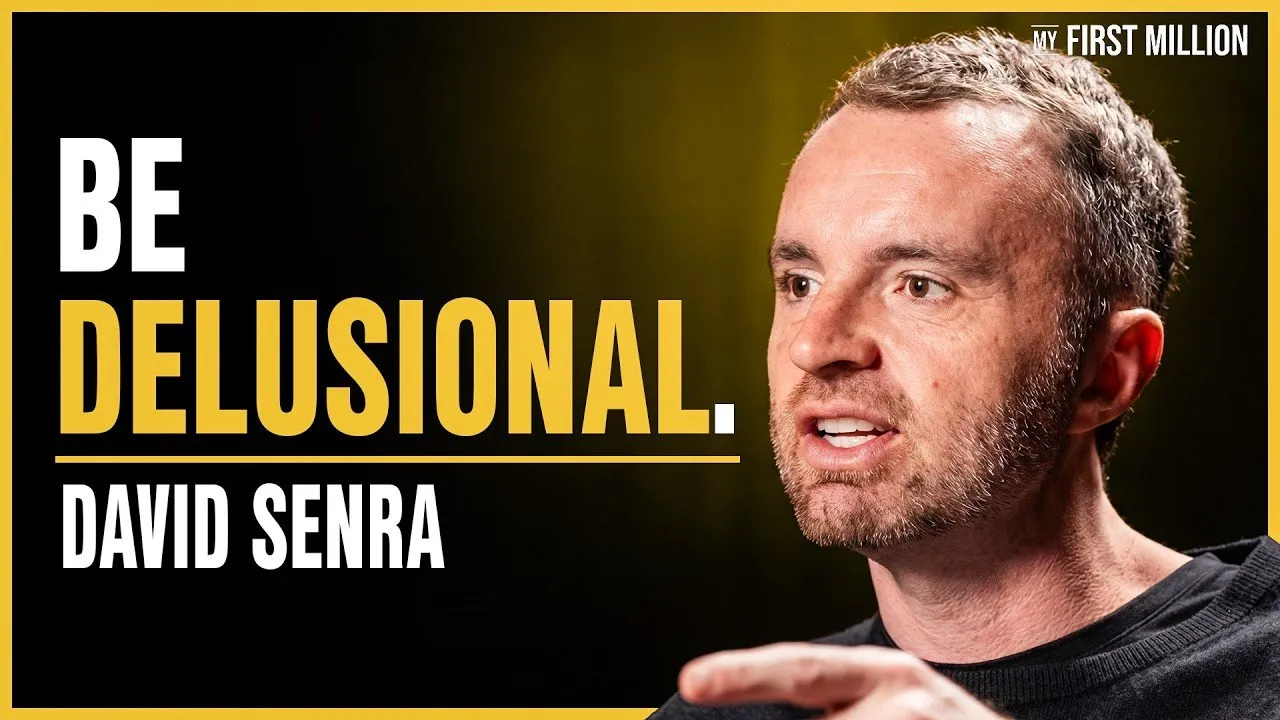
The gap between being "pretty good" and being the "greatest in the world" is not a matter of percentage points. It is not a linear progression where one is 20% better than the other. The difference is logarithmic—often a thousand times greater. This chasm is difficult for the average person to grasp because mediocrity remains invisible until true passion arrives to expose it.
David Senra, the host of the Founders podcast, has spent a decade dissecting the lives of history’s most singular entrepreneurs, reading over 400 biographies to understand the mechanics of greatness. His findings suggest that achieving the apex of any field requires a level of obsession that many would classify as madness. It involves a fundamental rejection of "balance" in favor of an intense, singular focus on craft, quality, and the constant refinement of one's environment.
Key Takeaways
- The logarithmic gap: The difference between world-class and "good" is not incremental; it is exponential, often requiring a level of dedication that makes a balanced life impossible.
- Refinement of association: Who you surround yourself with dictates your trajectory. As you improve, you must ruthlessly curate your circle to include only those striving for excellence.
- Learning equals behavioral change: Absorbing information is useless unless it alters your actions. If your behavior hasn't changed, you haven't learned.
- Differentiation is survival: Following the advice of Edwin Land (founder of Polaroid), true success comes from doing things that no one else can do, rather than copying existing models.
- Impact over happiness: The goal for many top performers is not personal happiness, but maximum positive impact on their field and the world.
The Psychology of Obsession and the "Madness" of Greatness
Society often praises the concept of a "balanced lifestyle," yet the biographies of history's most impactful figures—from Steve Jobs to Edwin Land—tell a different story. To become the best in the world at a specific craft requires a rejection of balance. It requires an addiction to the work that borders on the pathological.
For many high performers, this drive does not stem from a desire for accolades, but from a deeper, often darker place. It is a psychological need to prove something fundamental about their existence.
"I wanted professional success to say I was born in the wrong environment and I will prove to you that I am not like the rest of these people. It's almost like a revenge for being born."
This internal friction acts as a propulsion system. While healthy maladjustment can be a superpower in business, it presents challenges in personal life. The key for modern entrepreneurs is to utilize this drive to achieve mastery without letting the negative inner critic destroy their effectiveness. As Brad Jacobs, a billionaire serial entrepreneur, notes, the negative inner monologue that drives early success often becomes a liability later. Learning to reframe that energy is essential for longevity.
The Constant Refinement of Association
One of the most critical levers for growth is the company you keep. This concept, termed the "constant refinement of association," suggests that as your skills and outputs improve, you gain access to higher tiers of individuals. You must actively curate these relationships.
Mediocrity in your social or professional circle is dangerous because it normalizes casual effort. When you surround yourself with people who are singularly obsessed with quality, "good enough" becomes intolerable.
The Four Threats to Success
Drawing from the wisdom of music industry legend Jimmy Iovine, there are four primary ways successful people destroy their own progress. Awareness of these pitfalls is the first step in avoiding them:
- Substance Abuse: Drugs and pills have historically derailed countless geniuses before they reached their peak.
- Alcohol: Similar to drugs, excessive alcohol consumption blunts the sharp edge required for world-class decision-making.
- The Wrong Relationships: Allowing the wrong romantic partners or friends into your inner circle can cause catastrophic distraction. You need high-quality people in every domain—work, friendship, and romance.
- Megalomania: This is the belief that success is due to your inherent "godhood" rather than the work you put in. When you stop respecting the work and start believing your own press, you disconnect from reality.
The Art of Learning from History
Reading biographies is not merely an academic exercise; it is a search for patterns. By studying the lives of 400+ entrepreneurs, one can identify the strategies that worked for the winners and the common flaws that led to the ruin of others. However, the accumulation of knowledge is meaningless without application.
"Learning is not memorizing information. Learning is changing your behavior."
A profound example of this is Bruce Springsteen. despite a tumultuous childhood that left him unable to form stable relationships, he realized that his inability to connect would leave him wealthy but miserable. He treated his emotional deficits like a professional obstacle, seeking therapy and tools to "fix" his behavior. He learned, he changed his behavior, and consequently, he altered his destiny. This is the ultimate utility of studying history: to predict and alter your own future.
Differentiation: The Edwin Land Principle
Edwin Land, the founder of Polaroid and a hero to Steve Jobs, lived by a simple maxim: "Don't do anything someone else can do."
In a world of copycats and "best practices," true value is created through differentiation. Whether it is building a company, creating content, or designing a product, the goal should be to offer something that is uniquely yours. When you attempt to replicate another person's path to success, you are ignoring the specific context, timing, and unique "earned secrets" that made them successful.
Optimizing for Impact Over Happiness
There is a modern fixation on "happiness" as the ultimate metric of a life well-lived. However, for those operating at the highest levels, happiness is often secondary to impact. Daniel Ek, the founder of Spotify, advises optimizing life for impact rather than fleeting joy.
This does not mean living a miserable life. On the contrary, there is a deep, resonant satisfaction that comes from doing work that matters and having that work received by the world. When you pour your soul into a craft—whether it’s selling chicken fingers like Todd Graves or building a media empire—and the market responds, the value exchange goes beyond money. It becomes a validation of your contribution to the human experience.
Conclusion
Becoming the greatest at what you do is not for the faint of heart. It requires a willingness to be misunderstood, a refusal to compromise on quality, and the discipline to constantly refine who allows into your mental and physical space.
By studying the past, we can navigate the future with fewer unforced errors. By rejecting mediocrity in our associations, we raise our own standards. Ultimately, the madness behind greatness is simply a rational response to the desire to make a dent in the universe. As you refine your inputs—books, friends, and habits—you create a virtuous cycle where better inputs lead to a better human, which in turn attracts even higher-quality opportunities.