Table of Contents
For decades, the pace of innovation in the physical world has lagged behind the digital realm. While software engineers can push code updates instantly, hardware engineers face a massive, expensive bottleneck: the factory itself. Traditional metal manufacturing relies on static dies and stamping presses—monolithic tools that require months to build and millions of dollars to fund. This rigidity means that every time a company wants to build a new product, they essentially have to build a new factory first.
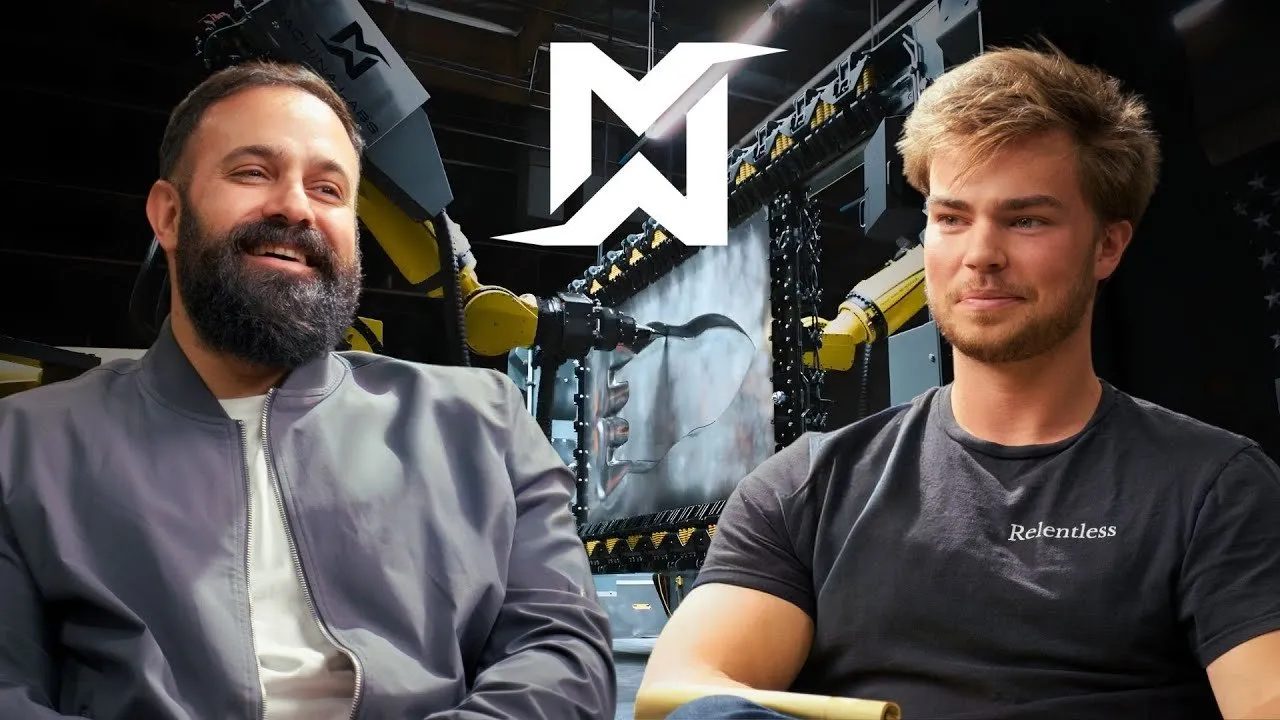
Ed Mayer, co-founder and CEO of Machina Labs, is dismantling this barrier. By combining advanced robotics with artificial intelligence, Machina Labs is pioneering "dieless" forming—a process that turns standard industrial robots into digital blacksmiths. Drawing on his experience at SpaceX and Relativity Space, Mayer is building a future where hardware iteration happens at the speed of software, enabling a renaissance of design freedom in the physical world.
Key Takeaways
- The End of Static Tooling: Machina Labs utilizes robotic sheet forming to eliminate the need for expensive, single-use dies, drastically reducing the cost and lead time for metal manufacturing.
- Software-Defined Hardware: By using sensors and AI to adjust forming paths in real-time, the company transforms standard industrial robots into "craftsmen" capable of handling chaotic physical variables.
- Iterative Agility: The technology allows for rapid prototyping and production changes, reducing the "cost of failure" and enabling hardware teams to iterate as fast as software teams.
- Revitalizing the Industrial Base: Machina Labs operates as a Tier 1 supplier, delivering finished assemblies to fill the gap left by the erosion of traditional American manufacturing capabilities.
- Scrappy Origins: The company’s foundation lies in a bias for action—launching with used robots bought from a Detroit graveyard for pennies on the dollar to prove the concept immediately.
The Billion-Dollar Bottleneck: Why Hardware is Hard
The central problem in modern manufacturing is the reliance on specific tooling. In the automotive industry, for example, creating the metal panels for a car requires massive stamping presses and custom-machined dies. This capital-intensive process stifles innovation because the cost of entry is prohibitively high.
Mayer highlights this with a stark statistic from the electric vehicle industry:
A full set of dyes for one of the first cars they made was $120 million. With our process, we realized, okay, we can get these robot sheet formers to form sheet metal without any need for dye.
When a single design iteration costs millions and takes months, engineers become risk-averse. They cannot afford to be wrong. This stands in sharp contrast to the software world, where "fail fast" is a celebrated mantra. To bridge this gap, Machina Labs aims to decouple the product from the factory. Instead of building a custom facility for every new rocket or car, they are deploying flexible "robotic craftsman" cells that can switch from making an aerospace part to a car fender simply by loading a new software file.
The Robotic Craftsman: Taming Chaos with AI
Machina Labs’ core technology, robotic sheet forming, functions similarly to a potter working with clay or a blacksmith with a hammer. Two robots work in unison on either side of a metal sheet. As they pinch and manipulate the material, they stretch and deform it into the desired 3D shape.
Real-Time Adaptability
Unlike a stamping press, which applies force in a predictable, linear motion, forming sheet metal freely is a chaotic process. The material can buckle, tear, or spring back in unpredictable ways. To counter this, Machina Labs integrates a feedback loop that mimics human intuition.
The system reviews sensor data every four milliseconds, making micro-adjustments to the robot's path in real-time. This allows the machine to account for material inconsistencies and physics that are difficult to model perfectly in simulation. While early iterations required over 25 trials to produce a usable part, the integration of better data and AI has reduced this to an average of four or five attempts, with the ultimate goal being "zero-shot" production—getting it right the first time.
SpaceX Roots and the Bias for Action
The philosophy driving Machina Labs is deeply rooted in the "SpaceX mentality." Mayer spent time working under Elon Musk, an experience that fundamentally altered his approach to engineering and risk. The key lesson was that multidisciplinary knowledge and sheer courage often outweigh specialized expertise when forging new paths.
The Detroit Robot Graveyard
This bias for action was evident in Machina Labs’ earliest days. With a small seed round of roughly $2 million, purchasing new industrial robots—which have lead times of up to a year and cost hundreds of thousands of dollars—was impossible. Mayer’s solution was to fly to Detroit.
I went to this... cemetery of robots. It was like this giant robot and the outskirts of Detroit... giant room of dead robots. So we went through that warehouse and find like couple that was working. And I think we bought those at the tenth of the price of a new set of robots and it was immediately available.
By securing functional equipment for a fraction of the cost, the team was able to start bending metal immediately. This scrappiness allowed them to secure their first contracts with the Air Force and NASA just months after founding the company, proving that speed of execution is a competitive advantage.
Strategic Evolution: From Machine Seller to Tier 1 Supplier
A critical "crucible moment" for Machina Labs was determining their business model. In the hardware world, companies generally choose between selling the machines (Capital Equipment) or selling the parts the machines make (Service Bureau/Supplier). Mayer and his team initially experimented with both but eventually pivoted to selling finished metal assemblies.
Filling the Industrial Void
This decision was driven by the reality of the United States' industrial base. Many legacy manufacturers operate on razor-thin margins and lack the capital or expertise to integrate bleeding-edge robotics into their existing workflows. They didn't want a robot; they wanted a solution.
By operating as a Tier 1 supplier, Machina Labs delivers the final product—a wing leading edge, a car door, or a rocket fuselage. This allows them to own the entire quality stack and deploy their technology rapidly without waiting for legacy industries to modernize their own facilities. It effectively positions them as a new-age industrial prime, capable of serving defense, aerospace, and automotive clients simultaneously from the same flexible factory floor.
Democratizing Design and Freedom of Expression
While the immediate commercial applications are in high-value sectors like aerospace and defense, the long-term vision is cultural. Mayer argues that the high cost of tooling has homogenized the physical world; cars, appliances, and buildings often look identical because unique designs are too expensive to manufacture.
Machina Labs seeks to enable a world where "Fran Solo"—a custom sculpture of Tesla designer Franz von Holzhausen frozen in carbonite—is not an anomaly, but a possibility for anyone.
If we make a company that enables freedom of expression in physical world, that's going to be a massive company. Today... all cars look the same. All buildings roughly look the same. There's not really design diversity in our physical world.
The company recently announced a collaboration with Toyota, exploring a future where customers can design vehicles that are uniquely expressive. By lowering the barrier to entry for custom manufacturing, Machina Labs hopes to unlock a "long tail" of physical products, similar to how the internet unlocked the long tail of content creation.
Financing the Hardware Revolution
Building a hardware company requires a sophisticated approach to capital that differs significantly from software startups. Mayer notes that while software companies typically rely on venture capital (equity) to fuel growth, hardware demands a complex "capital stack."
The Capital Stack Strategy
To scale a factory, a founder must leverage different types of money for different purposes:
- Equity: Used for R&D, engineering talent, and high-risk development.
- Debt: Used to finance tangible assets like robots and factory equipment.
- Grants and Government Funding: Critical for early-stage development of dual-use technologies (commercial and defense).
- Customer Financing: Strategic investments from partners (like Toyota or Lockheed Martin) who have a vested interest in the technology's success.
Mayer emphasizes that aligning incentives is key. Most of Machina Labs' major customers are also investors. This ensures that the customers are champions of the technology internally, helping the startup navigate the bureaucratic friction often found in massive organizations.
Conclusion
Machina Labs represents a shift in how we think about making things. By replacing hardware-specific tooling with software-defined robotics, they are removing the constraints that have long defined the manufacturing industry. The goal is not just to make parts cheaper or faster, but to make the factory itself portable, flexible, and accessible. As Mayer puts it, the ultimate ambition is to create a world where any great idea can become real, unencumbered by the static limitations of the past.