Table of Contents
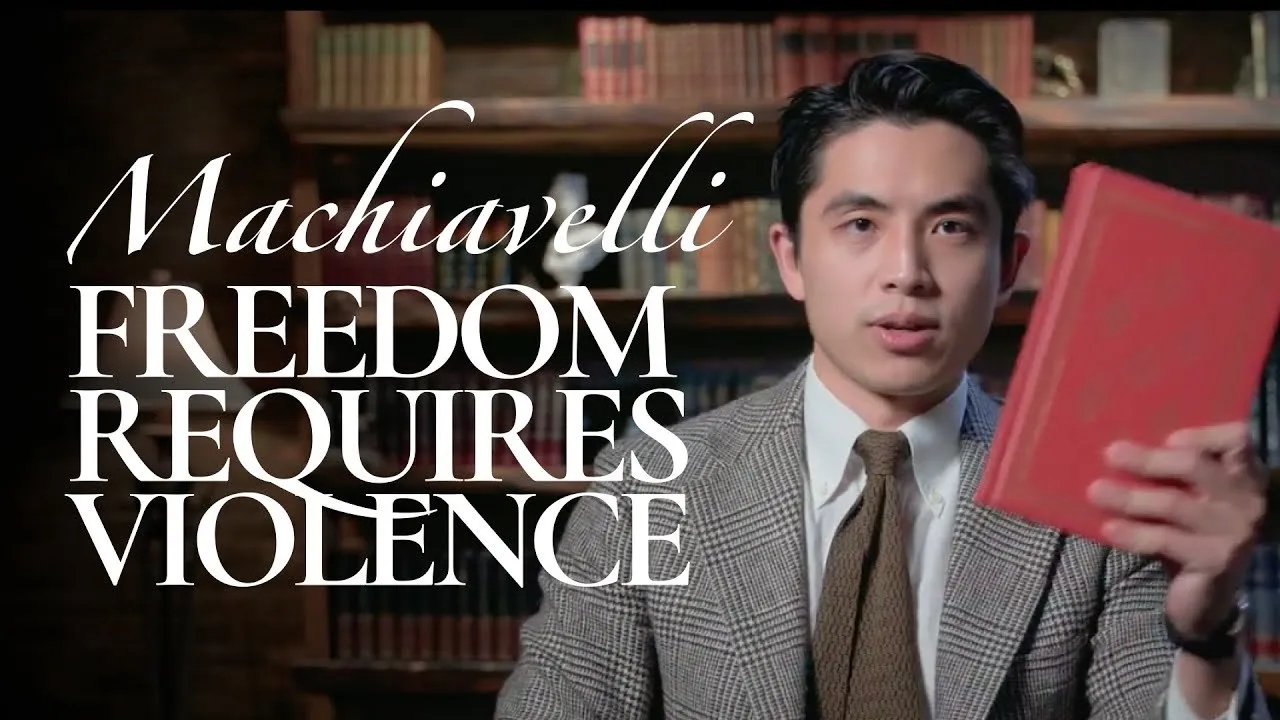
Niccolò Machiavelli is frequently misunderstood as a mere instructor for tyrants or a cynical advocate for pure egoism. However, to view him this way is to miss his central political insight: principles must be violated in order to be actualized. When we examine the history of any free, lawful society—including the United States—we find a paradox. These nations often owe their greatness not only to their adherence to ideals like freedom and justice but also to their calculated, occasional deviations from them.
Key Takeaways
- The Paradox of Foundations: Great, free states are often built upon a "mischievous" foundation of violence, fraud, or the subjugation of others, effectively requiring the violation of principles to bring those very principles into existence.
- The Vulgarity of Politics: Political success is judged by effectual truth—outcomes and appearances—rather than intentions or moral purity.
- Institutionalized Conflict: Freedom is not maintained by harmony, but by institutionalized class conflict that prevents any single group from becoming absolute.
- The Necessity of Violence: The rule of law often relies on spectacles of power to renew its legitimacy, as corruption cannot always be reasoned with; sometimes, it must be shocked.
The Brutal Necessity of Foundations
Modern discourse tends to divide into two camps regarding America’s founding: the right, which often whitewashes the history of expansion and the treatment of Native Americans, and the left, which denounces these actions as evidence of inherent hypocrisy. For Machiavelli, both are deluded. The reality of political founding is that it is a "dirty" business. As Leo Strauss famously noted, "Machiavelli would argue that America owes her greatness not only to her habitual adherence to the principles of freedom and justice, but also to her occasional deviation from them."
The Roman Blueprint
Machiavelli points to the founding of Rome as the ultimate example. Romulus secured the city by killing his own brother, Remus. Furthermore, Rome grew by forcing surrounding city-states into "junior partnerships" that effectively stripped them of their autonomy, only to turn on those very partners once they had served their purpose. America’s expansion, particularly the betrayal of indigenous allies like the Cherokee—who assimilated, adopted a constitution, and won Supreme Court rulings only to be exiled by Andrew Jackson—mirrors this ancient, ruthless logic.
Equality, Vulgarity, and Great Men
It is radical to call Machiavelli an egalitarian, yet his philosophy rests on the idea that the "people" are better political judges than the elites. This is not because the people are virtuous or pure, but precisely because they are vulgar. They judge by sight, not by touch; they care about outcomes, not intentions.
There is no secure mode to possess a free people other than to ruin them. And whoever becomes patron of a city accustomed to living free and does not destroy it should expect to be destroyed by it.
Because the people are vulgar, they are less biased by the complex, self-serving interests that corrupt the aristocratic class. However, this vulgarity also renders the people sluggish and conservative. They are excellent at maintaining a state, but they are incapable of founding one. This is why the Great Man is necessary. Someone must shape the "mud" of the people into the "bricks" of a stable state through singular, decisive, and often extra-legal leadership.
Freedom Through Institutionalized Conflict
Classical thinkers viewed political factions as a disease, but Machiavelli saw them as the lifeblood of a free state. He argued that the tumults between the Roman nobility and the commoners were the very things that kept Rome free. Freedom is best protected when the state is structured to channel these conflicts into institutions—such as the Roman tribunes—rather than allowing them to erupt into unchecked civil war.
Conflict as a Safeguard
Modern politics often attempts to replace class-based conflict with identity-based political theater, which Machiavelli would likely view as a dangerous distraction. When conflict is not directed at the real vector of power—wealth and influence—that power is left unchecked. Machiavelli’s ideal is a state where everyone has a hand on a weapon, metaphorically speaking, ensuring that no single group can oppress the others without fear of reprisal.
Rule of Law and the Spectacle of Power
The rule of law is not sustained by abstract morality, but by the memory of power. Machiavelli suggests that the legitimacy of the law must be periodically renewed through notable, excessive, and public acts. While we prefer to think of justice as a quiet, impartial process, Machiavelli warns that if the punishment is not excessive, it is not memorable, and if it is not memorable, it fails to renew the fear and respect required to sustain a lawful order.
Because those executions were excessive and notable, such things made men draw back toward the mark whenever one of them arose.
Even the use of a "dictator" or an extraordinary executive act can be a legal necessity. When a state is deeply corrupt, as the Romagna was before Cesare Borgia, "shock and awe" tactics—such as Borgia’s brutal execution of his own minister, Romero—can restore order where reason and standard law have failed. The goal is to bring the state back to a condition where, once order is restored, the prince can share power and transition to a more stable, civil form of governance.
Conclusion
To study Machiavelli is to abandon the comfort of moral idealism for the terror of political realism. He forces us to realize that the freedoms we enjoy today are the products of ancestors who were willing to do the things we might find abhorrent. Whether we accept his worldview or not, his work serves as a necessary, sobering challenge to our complacency. If we wish to maintain a free, lawful society, we must acknowledge that its preservation requires more than just good intentions—it requires the constant, vigilant, and sometimes ruthless maintenance of the very power structures we prefer to ignore.