Table of Contents
Leslie Lamport, a Turing Award winner and a titan of distributed systems, has spent over 50 years redefining how we think about computing. From the fundamental algorithms that allow global databases to remain synchronized to the type-setting system used by nearly every academic today, Lamport’s influence is pervasive. However, his most profound contribution might not be a specific piece of code, but rather a philosophical insistence on the necessity of writing and abstraction. Lamport argues that much of the complexity in modern software arises not from the problems themselves, but from a refusal to think clearly before the coding begins.
Key Takeaways
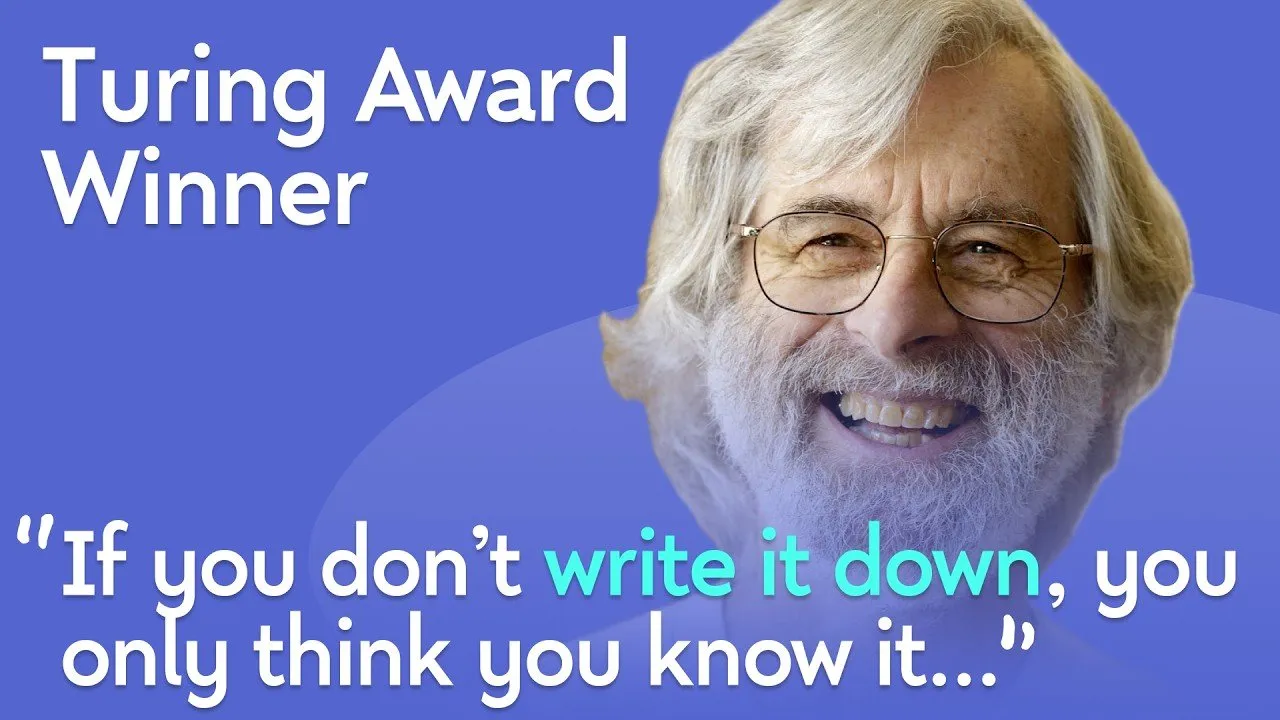
- Writing is Thinking: If you have not written down your ideas in a structured way, you only think you understand them.
- The Power of Abstraction: Success in computer science often stems from the ability to strip away irrelevant details and view systems as abstract state machines.
- Algorithm vs. Code: An algorithm is a higher-level concept that should be proven correct independently of the specific programming language used to implement it.
- The Importance of Naming: Catchy metaphors, like the "Byzantine Generals" or "Dining Philosophers," are essential for ensuring important scientific results gain the attention they deserve.
The Genesis of Concurrent Programming
The field of concurrency began in earnest with Edsger Dijkstra’s 1965 paper on mutual exclusion. At the time, computers were incredibly expensive, and "time-sharing" was the only way to make them accessible to multiple users. This created a new problem: how to prevent two processes from using the same resource, such as a printer, simultaneously. This became known as the critical section problem.
Lamport’s entry into this world was born from a failed attempt at a solution. After submitting what he thought was a simple algorithm to the ACM, he received a letter pointing out a bug. This failure led to two realizations: concurrent programs are deceptively difficult to get right, and they require rigorous proofs of correctness. This journey culminated in the Bakery Algorithm, inspired by the ticket-numbering system at a deli counter.
Remarkably, the Bakery Algorithm proved that mutual exclusion could be achieved without the assumption of atomic shared registers. Most researchers at the time believed it was impossible to implement such a system without lower-level hardware locks. Lamport’s solution worked even if a process read a memory register while it was being written to, potentially returning a nonsensical value. This result was so counterintuitive that many of his contemporaries initially refused to believe the proof.
Time, Clocks, and the Space-Time View of Computing
Lamport’s most cited paper, Time, Clocks, and the Ordering of Events in Distributed Systems, was inspired by an unlikely source: Albert Einstein’s theory of special relativity. He realized that the concept of "happening before" in a distributed system is analogous to the light-cone in physics. Because information cannot travel faster than the speed of light (or the speed of a network message), there is no absolute global clock that can order every event.
To solve this, Lamport introduced logical clocks, but he considers the paper's most important contribution—which was largely ignored at the time—to be the state machine approach. By treating a distributed system as a state machine where every node executes the same sequence of commands, synchronization becomes a solvable problem.
The only thing that tells the program what to do next is its current state.
This perspective shifted the focus from complex behavioral sequences to invariants—boolean functions of the state that must remain true throughout execution. Lamport argues that while behavioral proofs are exponentially complex, invariance proofs are quadratic, making them the only practical way to ensure a system’s correctness.
The Art of the "Byzantine Generals"
In the mid-1970s, Lamport worked on systems designed to fly airplanes. These systems had to be "fault-tolerant," meaning they could continue to operate even if some components failed. He realized that a simple failure (a computer stopping) was easy to handle, but a "malicious" failure (a computer sending conflicting data) was far more dangerous.
Initially, this was referred to as the "Chinese Generals Problem," but Lamport felt it needed a more distinctive name. Drawing inspiration from Dijkstra’s "Dining Philosophers," he renamed it the Byzantine Generals Problem. The metaphor describes a group of generals who must agree on a plan, even if some of them are traitors intent on spreading misinformation.
His research proved a fundamental limit: to tolerate n arbitrary (Byzantine) faults, a system requires at least 3n + 1 processes if digital signatures are not used. This result became a cornerstone of modern distributed computing and eventually provided the theoretical foundation for blockchain and cryptocurrency consensus mechanisms.
Paxos vs. Raft: Simplicity vs. Understanding
The Paxos algorithm is perhaps Lamport’s most famous contribution to the industry, designed to achieve consensus in a network of unreliable processors. However, Paxos is notoriously difficult for many engineers to grasp. This difficulty led to the creation of Raft, a competing algorithm marketed as a simpler, more understandable alternative to Paxos.
Lamport remains skeptical of the claim that Raft is superior. He notes that while Raft provides a "warm fuzzy feeling" of understanding, that feeling can be deceptive. He points out that early versions of Raft contained bugs that went unnoticed because the focus was on the narrative of the algorithm rather than a rigorous proof.
Stupid people think they’re smart because they’re too stupid to realize they’re not.
For Lamport, true understanding is not a feeling; it is the ability to write a formal proof. He argues that the perceived complexity of Paxos comes from its abstraction, which is actually what makes it powerful. By separating the consensus logic into two distinct phases, Paxos provides a clearer blueprint for building truly robust systems.
LaTeX and the Philosophy of Writing
While his algorithms run in the background of global data centers, Lamport is perhaps most visible through LaTeX. Created in the early 1980s, LaTeX was a set of macros built on top of Donald Knuth’s TeX system. Lamport’s goal was to separate the logical structure of a document from its visual formatting.
This follows his broader philosophy: If you are thinking without writing, you only think you are thinking. Lamport insists that writing is the primary mechanism for catching errors in logic. He applies this even to mathematical proofs, advocating for a hierarchical structure rather than the traditional narrative style used by most mathematicians.
The Hierarchical Proof Method
- Break a proof into a sequence of steps.
- Each step must have its own proof (either a paragraph or further sub-steps).
- Mention every fact being used to justify a step.
- Structure the document so that the level of detail can be expanded or collapsed.
When he first presented this method to mathematicians, he was met with visceral anger. He believes this reaction stems from fear—the fear that mathematicians will be forced to write their proofs with the same grueling honesty required by a computer program. Yet, he maintains that this honesty is exactly what prevents the errors that plague one-third of all published mathematical papers.
Conclusion: The Gift of Abstraction
Reflecting on a career that has earned him the Turing Award, Lamport remains humble about his "raw intelligence." He credits his success not to being faster or smarter than his peers, but to a specific gift for abstraction. By looking at a complex piece of code and seeing a state machine, or by looking at a network and seeing a light-cone, he has been able to solve problems that others found insurmountable.
His advice to the next generation of engineers is simple: don't get hung up on programming languages. Languages are tools for efficiency, but mathematics is the tool for understanding. Before you write the code, write the algorithm. Before you write the algorithm, write the specification. To think clearly is to write clearly, and in the world of distributed systems, there are no shortcuts to correctness.