Table of Contents
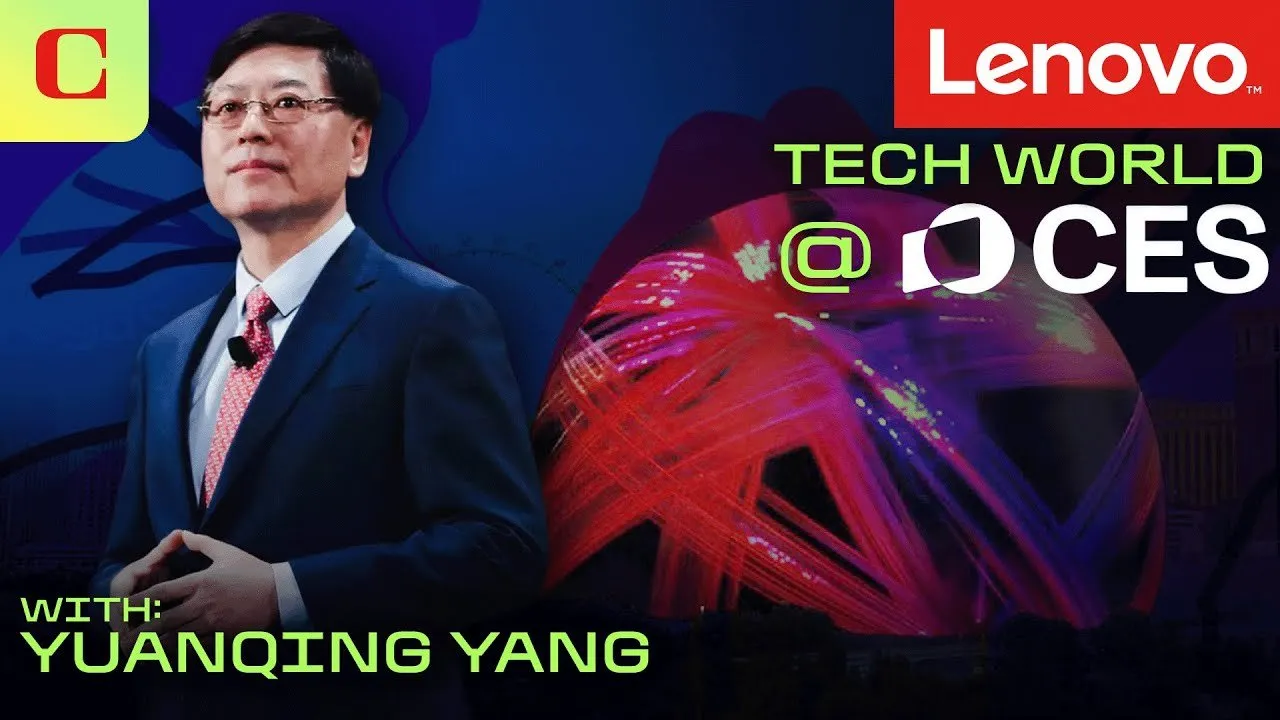
LAS VEGAS — At a sprawling event held at the Las Vegas Sphere during CES 2026, Lenovo unveiled a comprehensive strategy to dominate the next phase of artificial intelligence, shifting focus from cloud-based training to on-device inferencing and personal agents. Under the banner of "Smarter AI for All," Chairman and CEO Yongqing Yang introduced a suite of hybrid AI hardware, a new cross-platform personal agent named "Lenovo Kira," and massive infrastructure partnerships with semiconductor giants Nvidia, AMD, and Intel.
Key Takeaways
- Lenovo Kira Launch: A personal AI "super agent" designed to orchestrate tasks across PCs, smartphones, and wearables, functioning as a cohesive digital twin.
- Nvidia Collaboration: Announcement of the Lenovo AI Cloud Gigafactory, utilizing the Nvidia Rubin platform to accelerate AI deployment and "time to first token."
- Infrastructure Expansion: Introduction of the "Helios" rack-scale AI architecture and the ThinkSystem SR675i server powered by AMD to handle enterprise inferencing.
- Wearable Innovation: Proof-of-concept "intelligent wearables" developed with Qualcomm, including smart glasses and jewelry that leverage visual perception data.
- Major Sponsorships: Lenovo confirmed as the official technology partner for the FIFA World Cup 2026, providing AI-driven analytics and broadcasting tools.
The Era of the Personal AI Agent
The centerpiece of Lenovo's consumer presentation was the debut of Lenovo Kira, described as a "cognitive human-machine interface." Unlike current voice assistants restricted to specific ecosystems, Kira is engineered to operate horizontally across Lenovo’s vast portfolio, including PCs, Motorola smartphones, and tablets. The system utilizes a "super agent" architecture capable of intelligent model orchestration—routing queries to either on-device small language models or cloud-based large language models depending on complexity and security requirements.
Lenovo CTO Dr. Tolga Kurtoglu emphasized that the future of AI lies in "agentic" capabilities, where systems do not merely generate text but take action.
"Imagine if AI wasn't the wild west of models, apps, and gimmicks you're coping with today, but a single simple user interface that turns complexity into access and data into knowledge. That's the kind of future hybrid AI will make possible," said Kurtoglu.
To support this vision, Lenovo introduced "Project Cubit," a personal AI compute hub designed to centralize data processing for an individual's device ecosystem. The company also showcased the integration of Kira with Microsoft’s Copilot, allowing for seamless handoffs between mobile and desktop environments. According to Lenovo leadership, AI PCs are projected to constitute 80 percent of the market within three years.
Intelligent Wearables and Foldables
In the mobile sector, Motorola unveiled the Razr Fold, featuring a massive 8.1-inch display and a "sketch-to-image" feature powered by Moto AI. Beyond phones, the company demonstrated a new category of "intelligent wearables" developed in partnership with Qualcomm. These proof-of-concept devices, ranging from smart glasses to fashion-forward necklaces, utilize cameras and microphones to "see what you see" and "hear what you hear," feeding real-time context to the user's personal AI agent.
Infrastructure: The AI Factory Strategy
While consumer devices took the spotlight, Lenovo aggressively expanded its enterprise infrastructure capabilities, positioning itself as a neutral broker capable of working with all major chip manufacturers. CEO Yongqing Yang argued that the industry is shifting from a training phase to an "inferencing" phase, where businesses need to run AI models on-premise and at the edge to reduce latency and cost.
In a major joint announcement, Nvidia CEO Jensen Huang joined Yang to launch the Lenovo AI Cloud Gigafactory. This solution leverages Nvidia's next-generation Rubin platform and Lenovo's Neptune liquid cooling technology to help cloud providers scale to hundreds of thousands of GPUs.
"One third of the world's top 500 supercomputers are built by Lenovo... The question is whether we could package and productize Lenovo's expertise in manufacturing and installing these systems to turn them into an AI factory for customers as quickly as possible," stated Huang.
Simultaneously, Lenovo strengthened its ties with AMD, introducing the ThinkSystem SR675i—internally nicknamed "The Beast." This server is optimized for high-throughput AI inferencing and supports the new AMD Helios rack-scale architecture. AMD CEO Dr. Lisa Su highlighted that the partnership aims to bring AI computation closer to where enterprise data actually resides.
Global Partnerships: FIFA and The Sphere
Demonstrating the practical application of its technology, Lenovo showcased its role as the technology partner for the 2026 FIFA World Cup. The company is deploying AI infrastructure to process petabytes of data generated during the tournament, which will feature 48 teams and millions of fans. Innovations include a stabilized "referee view" camera and 3D player avatars for enhanced broadcast analytics.
The event itself served as a case study for Lenovo’s high-performance computing. Jennifer Koester, CEO of Sphere, revealed that Lenovo workstations are the primary engine behind "Big Sky," the venue’s proprietary ultra-high-resolution camera system. The system captures 18K video at 60 frames per second, generating 30 gigabytes of data per second, which requires immense processing power to render for the Sphere’s interior display.
What’s Next
Lenovo’s announcements at CES 2026 signal a definitive pivot from hardware manufacturing to full-stack AI solutions. By attempting to own the interface layer with Kira and the infrastructure layer with its "AI Factory" approach, Lenovo is betting that the future of technology belongs to companies that can successfully bridge the gap between physical devices and digital intelligence. The company expects the first wave of Kira-enabled devices and the new AI infrastructure solutions to roll out globally over the coming months.