Table of Contents
In a rapidly expanding digital asset ecosystem, the number of blockchains is exploding. From Ethereum layer-2s to app-specific chains, liquidity and users are increasingly fragmented. This proliferation creates a critical infrastructure challenge: how do distinct networks communicate without introducing systemic risk?
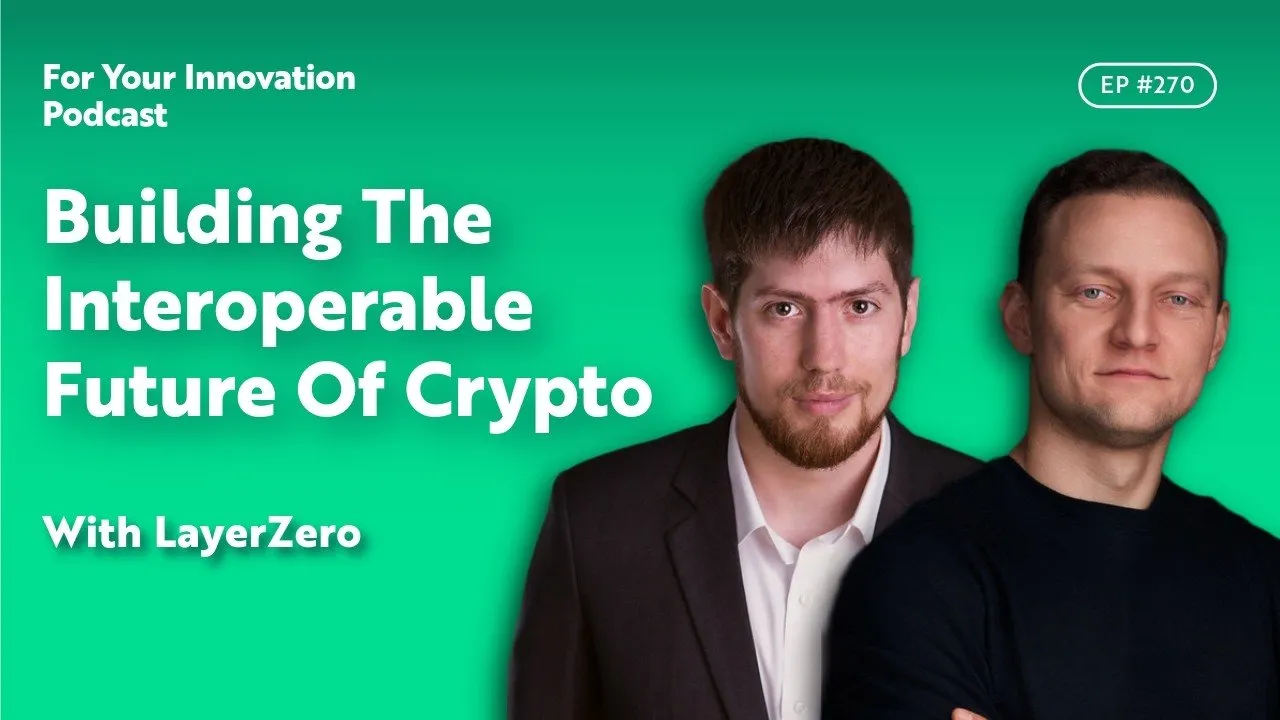
In a recent discussion, Ark Invest’s Cathie Wood and Brett Winton sat down with Bryan Pellegrino, Co-Founder and CEO of LayerZero, and Simon Bakhsh, Director of Business Development. They explored the architecture of the interoperable future, the security flaws of traditional bridges, and how AI agents and stablecoins are poised to become the dominant drivers of cross-chain volume.
Key Takeaways
- The End of "Prison" Bridges: Traditional cross-chain bridges act as honey pots by locking assets in centralized escrow. LayerZero replaces this with an immutable messaging layer where asset issuers retain control over security.
- Fragmentation is Temporary: While the industry is currently experiencing a horizontal explosion of new chains (L2s, app chains), history suggests a cycle of technological advancement followed by consolidation.
- Stablecoins as the Killer App: The globalization of the US dollar is happening bottom-up via stablecoins in emerging markets, driving significant demand for seamless cross-chain transferability.
- AI Agents Will Drive Volume: Future autonomous AI agents will require the ability to negotiate resources across different environments instantly, likely generating transaction volumes that dwarf human activity.
The Security Crisis of Traditional Bridging
To understand the value proposition of LayerZero, one must first understand the perilous state of traditional blockchain bridges. Historically, moving assets between chains—say, from Ethereum to Solana—has been a cumbersome and risky process. The standard solution has been the "lock and mint" bridge.
In this model, a user sends an asset to a bridge contract on the source chain, which locks the funds. The bridge then issues a wrapped version (an IOU) on the destination chain. The vulnerability lies in the storage of the original funds.
"I have money on Ethereum. I need to move over there. So I take the money and freeze it in an escrow account that we call a bridge, but it’s really a prison for your money... as I’m messing around over here, somebody drills a hole in the prison and siphons all the money out."
When these centralized "prisons" are breached—as seen in hacks totaling over $5 billion in recent years—the wrapped assets on the destination chain become worthless. Furthermore, traditional bridges often require users to trust a small set of validators. If that verification layer is compromised, it can corrupt the state of every network it connects, creating global systemic risk.
The LayerZero Approach: Immutable Messaging
LayerZero fundamentally changes the relationship a user has with risk. Rather than acting as a custodian, LayerZero functions as a transport layer—similar to TCP/IP for the internet. It allows smart contracts on different chains to communicate directly.
In this architecture, the asset issuer (such as Circle for USDC or a tokenized real estate firm) defines the security parameters. They can choose to run their own verification or utilize multiple verifiers (like Google Cloud) to authenticate transactions. This modularity ensures that if a specific asset has poor security configurations, a breach is contained solely to that asset, preventing the contagion effects seen in previous bridge hacks.
The Future of Blockchains: Expansion vs. Consolidation
The crypto industry moves in waves of technological advancement followed by horizontal dispersion. Currently, the barrier to entry for launching a new blockchain is near zero. Tools exist to deploy a new Layer-2 rollup in a day, leading to a fragmented landscape where liquidity is trapped in walled gardens.
However, this fragmentation creates a poor user experience. Without an interoperability layer, a user on a specialized app chain cannot interact with liquidity on Ethereum without navigating complex hurdles, such as acquiring different gas tokens for every hop.
Abstracting the Complexity
The ultimate goal for interoperability protocols is complete abstraction. In a post-LayerZero world, a user should be able to click a button to execute a transaction without knowing—or caring—which blockchains are involved in the background.
This seamlessness is achieved through the Omnichain Fungible Token (OFT) standard. Instead of wrapping assets, the OFT standard allows tokens to be burned on the source chain and minted natively on the destination chain. This preserves the canonical value of the asset and eliminates the friction of managing gas fees on multiple networks.
Stablecoins and the Bottom-Up Globalization of Finance
While institutional adoption remains a major topic, the most aggressive growth in digital assets is currently driven by stablecoins in emerging markets. Data suggests that the mobility of money is hitting all-time highs, but the drivers have shifted.
Historically, financial globalization was top-down, driven by trade agreements and government policy. Today, it is bottom-up. Individuals in countries with high inflation or limited banking infrastructure are using smartphones to access US dollar equivalents via stablecoins like USDT and USDC.
"If you have access to a smartphone and the internet, you now have access to US dollars and you have access to financial instruments that you never did before."
This shift represents a move toward global permissionless markets. LayerZero’s infrastructure is critical here, as it allows these stablecoins to move fluidly across the ecosystem. Currently, a significant majority of new stablecoin projects act as Omnichain tokens by default, ensuring they are not siloed on a single network.
The Convergence of AI Agents and Crypto
Looking further toward the horizon, the intersection of Artificial Intelligence and blockchain technology presents a massive opportunity for interoperability protocols. As AI agents become more autonomous, they will need to transact to fulfill their objectives—buying compute power, accessing data sets, or negotiating services.
An AI agent designed to optimize for efficiency cannot be burdened by the complexities of holding gas tokens for 50 different blockchains. It requires a unified execution environment where it can instantly negotiate and settle transactions regardless of the underlying infrastructure.
High-Frequency Economic Activity
The implications for transaction volume are profound. While human users have physical limitations on how many transactions they can execute daily, software agents do not.
"Agents are probably going to send a thousand, ten thousand times more messages than most people will... purely agents is likely best for LayerZero."
In this future state, protocols like LayerZero will serve as the connective tissue for a machine-to-machine economy, handling millions of micro-transactions per second as agents optimize global resources in real-time.
Conclusion
The blockchain industry is maturing from a speculative phase into an infrastructure build-out phase. Whether through the immediate demand for stablecoin liquidity in emerging markets or the future demands of autonomous AI commerce, the need for secure, seamless connectivity is paramount.
By removing the centralized risks of traditional bridges and empowering asset issuers to control their own security, LayerZero is laying the groundwork for an interoperable future where the technology fades into the background, leaving only the utility for the end user.
![Bitcoin: An Unfortunate Pattern [Update]](/content/images/size/w1304/format/webp/2026/03/bitcoin-unfortunate-pattern-update.jpg)