Table of Contents
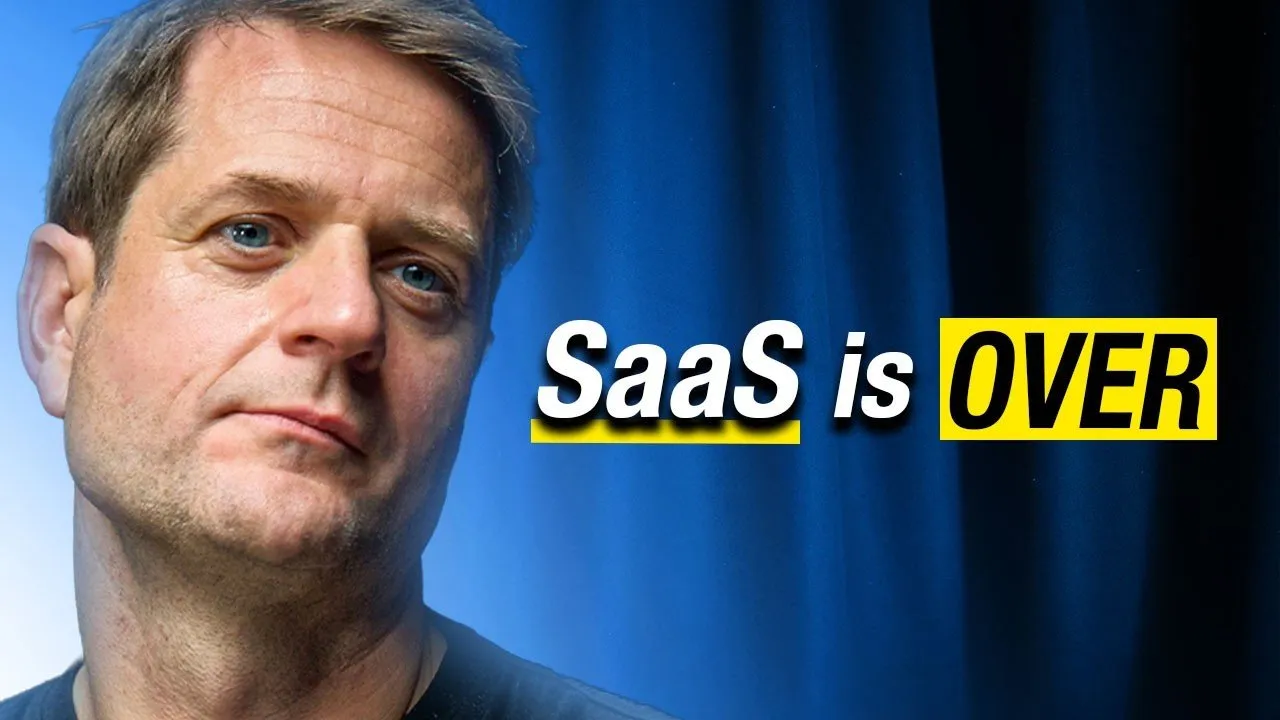
In the rapidly evolving landscape of fintech and enterprise software, few voices are as provocative—or as practically grounded—as Sebastian Siemiatkowski, CEO of Klarna. In a wide-ranging discussion on the future of technology, Siemiatkowski challenges the foundational business models of Silicon Valley, predicting the decline of traditional Software as a Service (SaaS) and detailing how Klarna has radically restructured its workforce around artificial intelligence. His insights offer a glimpse into a future where "systems of record" die, software costs plummet to zero, and the banking industry is upended by digital assistants.
Key Takeaways
- The End of the SaaS Era: As the cost of generating software nears zero, the traditional SaaS per-seat business model faces an existential threat from AI agents that can easily migrate data between providers.
- Radical Efficiency through AI: Klarna has reduced its workforce from 7,000 to under 3,000 employees while expanding its product lines, attributing this efficiency to aggressive AI adoption rather than budget cuts.
- The Theory of Data Compression: Siemiatkowski argues that while consumer AI focuses on "generation," enterprise AI will drive "compression"—eliminating data duplication across organizational silos.
- The Digital Financial Assistant: Klarna’s long-term strategy is shifting from Buy Now, Pay Later (BNPL) to becoming a comprehensive AI-driven financial assistant that competes directly with retail banks.
- In-House Development: To maximize AI context and effectiveness, Klarna is moving away from off-the-shelf software vendors (like Salesforce and Workday) to build its own interconnected internal stack.
Why "Systems of Record" and SaaS Are Dying
For the past decade, the dominant narrative in tech investment has been the durability of the SaaS model. However, Siemiatkowski argues that the industry is approaching a tipping point where the cost of creating software effectively drops to zero. In this new paradigm, the proprietary moats that protected major software vendors are drying up.
The primary threat to incumbents like Salesforce or SAP isn't just cheaper software; it is the reduction of switching costs. Historically, data has been locked inside proprietary data models, making migration painful. Siemiatkowski predicts that AI agents will soon automate the migration of data between vendors, dismantling the "lock-in" effect that sustains high SaaS valuations.
"The next thing that's going to hit everyone bad is the switching cost of data... How do I get all of my data from the existing vendor and move it to the new vendor with the help of AI through one click?"
The Rise of "Company in a Box"
This shift suggests a future where software becomes modular—like Lego pieces—rather than monolithic. Siemiatkowski describes an experiment he conducted called "Company in a Box," where he combined open-source accounting and CRM software with an Anthropic Claude agent. The result was a system capable of bookkeeping and customer management without a human intermediary. This democratization of software utility poses a significant risk not just to software vendors, but to service industries like accounting and administrative support.
Klarna’s Aggressive AI Transformation
While many companies talk about AI integration, Klarna is executing it at a scale that serves as a case study for the future of work. The company has shrunk its headcount by approximately 50%—dropping from a peak of 7,000 to under 3,000 employees—primarily through natural attrition and a hiring freeze, rather than layoffs. Despite this reduction, the company continues to launch new products and expand into new markets.
Siemiatkowski notes that he did not request additional budget to launch massive new banking initiatives. Instead, he relied on the acceleration of AI to ship new features with a leaner organization.
"We've gone from 7,000 people, we're now below 3,000... And I didn't ask for a single dime to do all this."
Building vs. Buying: The Context Problem
A major driver of Klarna's efficiency is its decision to move away from third-party SaaS providers. When data is siloed in Slack, Salesforce, and Jira, AI models lack the full context required to be effective. To solve this, Klarna is rebuilding its tech stack internally to serve as a unified "operating system." By centralizing data and logic, their AI agents gain access to the source code and full context, allowing them to handle complex tasks—like customer service inquiries involving interest calculations—that off-the-shelf bots cannot manage.
The Economics of AI: Generation vs. Compression
One of the most novel concepts Siemiatkowski introduces is the distinction between how AI serves consumers versus enterprises. While the consumer market is focused on generation (creating images, music, and entertainment), the enterprise market is destined for compression.
Large enterprises currently suffer from massive data duplication. Information about a single customer might exist in a dozen different formats across various software platforms. AI has the potential to act as a universal compression algorithm, synthesizing this information into a "single source of truth," much like Wikipedia reduces thousands of sources into a single article.
This theory has profound implications for the hardware market. While the demand for compute power for generation is skyrocketing, the demand for enterprise compute might actually stabilize or decrease as AI eliminates redundancy and inefficient code execution.
From BNPL to Digital Financial Assistant
Klarna is widely known for its "Buy Now, Pay Later" products, but Siemiatkowski views this merely as an entry point. The company’s trajectory is aimed at disruption of the retail banking sector. The vision, established as early as 2015, is to create a digital assistant that proactively manages a user's finances—renegotiating mortgages, identifying savings, and handling administrative tasks.
To achieve this, Klarna is pivoting from a transactional relationship to a high-engagement banking relationship. By leveraging the rich data from their payment network (which includes SKU-level data on what customers actually buy), Klarna aims to offer personalized advice that traditional banks, which only see transaction totals, cannot match.
"The future of retail banking... is going to be some kind of digital financial assistant [that] wakes you up in the morning, says, 'I checked your mortgage, you're overpaying like hell, and I have renegotiated for you.'"
Conclusion
Sebastian Siemiatkowski’s outlook serves as a warning and a blueprint for the technology sector. The era of bloated software contracts and massive headcounts is ending, replaced by lean, AI-native organizations that prioritize data mobility and operational context. For Klarna, the bet is clear: by ruthlessly adopting AI and consolidating their internal stack, they aim to transition from a payment provider to the primary interface for their customers' financial lives.