Table of Contents
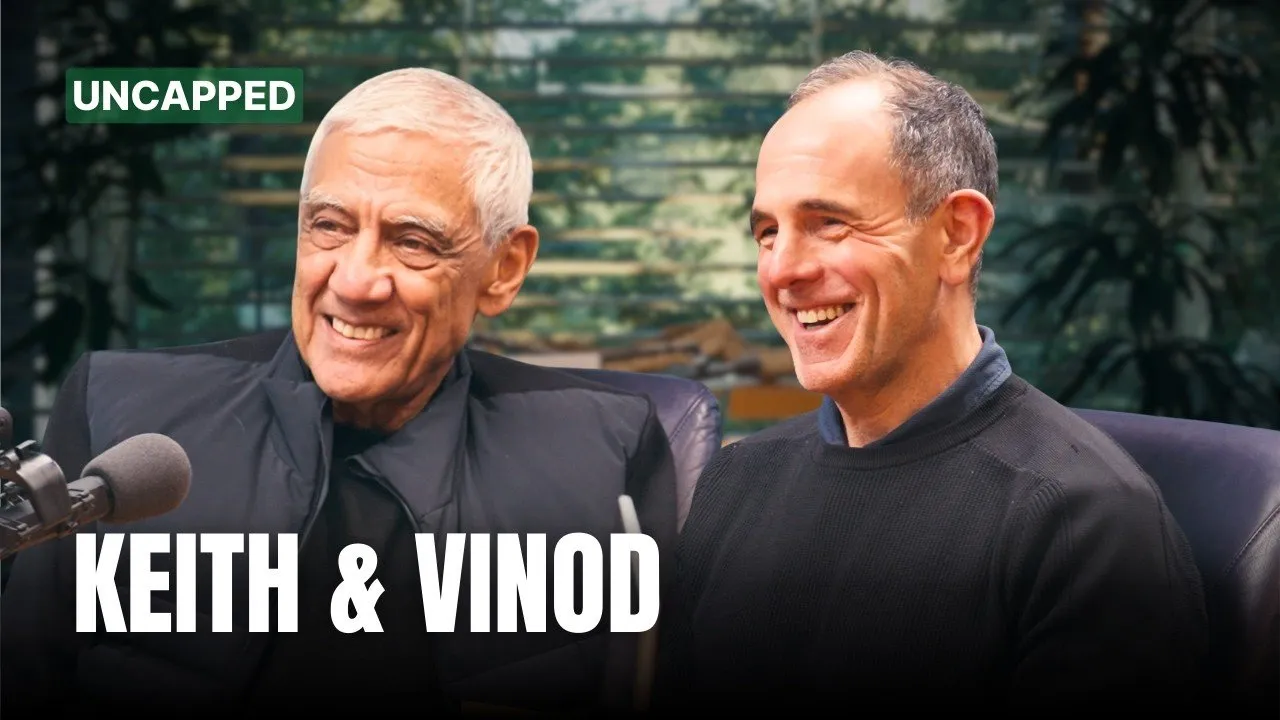
When two of Silicon Valley’s most opinionated and successful investors sit down together, the conversation inevitably moves past surface-level trends into the mechanics of building generational companies. Vinod Khosla, founder of Khosla Ventures, and Partner Keith Rabois represent a unique dynamic in venture capital: a shared obsession with "first principles" thinking, despite having distinct personal styles and political views.
Their recent discussion offers a masterclass in how top-tier investors evaluate talent, the structural shifts occurring in the AI landscape, and why the traditional playbook for building startups is rapidly becoming obsolete. For founders and investors alike, their insights provide a roadmap for navigating the "techno-economic" battles of the next decade.
Key Takeaways
- The "Venture Assistant" Model: Great investors don't just provide capital; they earn the right to advise by helping founders navigate critical early decisions, specifically in team building and strategy.
- The "Incomplete A+" Founder: Khosla Ventures prioritizes founders who are exceptional in one specific dimension—even if they lack experience elsewhere—over well-rounded but mediocre candidates.
- Agents Over Co-Pilots: The firm’s AI thesis has shifted away from tools that assist humans (co-pilots) toward autonomous agents that "do the work" entirely, from structural engineering to oncology.
- Death of the Traditional Roadmap: In the AI era, the speed of technological evolution makes 12-month product roadmaps and traditional Product Manager (PM) roles obsolete.
- Geopolitical Stakes: Both investors view deep tech and AI not just as commercial opportunities, but as critical components in the geopolitical competition with China.
The Philosophy of Venture Assistance
In an industry often critiqued for "hypocritical politeness," Khosla and Rabois pride themselves on brutal honesty. Their operating model stands in stark contrast to firms that aim to be purely "founder-friendly" by avoiding difficult conversations. Instead, they view their role as "venture assistants"—partners who have earned the right to advise through their own operational history.
The core of their partnership relies on a shared belief: the team you build is the company you build.
"In 40 years that I've done venture capital, I've not once called myself a venture capitalist or an investor. I always say I'm a venture assistant to entrepreneurs trying to build companies."
This philosophy dictates that the investor's primary value add is not capital, but the ability to help a founder identify and recruit the right talent. Khosla notes that most founders, regardless of their brilliance, are often unqualified to interview for roles outside their domain expertise. A technical founder may not know what a "zero-to-one" marketing executive looks like versus a brand sustainer from a legacy corporation like Cisco. The venture assistant’s job is to bridge that gap.
Identifying the "Incomplete A+" Founder
When evaluating potential investments, Khosla and Rabois rarely disagree on the quality of a founder. Their assessment framework rejects the notion of the well-rounded entrepreneur. Instead, they hunt for extreme outliers.
The Power of Exceptionalism
Rabois describes his heuristic as looking for a "top one basis point" trait. He seeks founders who are the best in the world at one specific thing—whether it is tenacity, storytelling, or technical brilliance. The logic is that while 99% of humanity will not change the world, the 1% who do invariably possess a spike in ability that compensates for their deficiencies.
Khosla reinforces this by categorizing ideal candidates as "Incomplete A+" founders. It is acceptable for a founder to be completely deficient in areas like sales or finance, provided they are exceptional in their core competency and possess a high learning rate. The firm can help hire around the gaps, but they cannot manufacture genius.
The Learning Rate and Recruitment
Two non-negotiable traits accompany this exceptionalism:
- High Learning Rate: Khosla tests this by taking contrarian positions to see if a founder blindly agrees or critically engages. The ability to discard bad ideas and rapidly absorb new information is more valuable than prior experience.
- Recruiting Magnetism: A founder must be able to convince the first 10 employees to join a risky venture. Even if they are not polished, they must possess a specific energy or vision that compels others to follow them.
The AI Investment Thesis: Agents Over Co-Pilots
Since rejoining Khosla Ventures, Keith Rabois has pivoted aggressively, with approximately 70% of his recent investments focused on Artificial Intelligence. However, the firm’s thesis is specific: they are less interested in "co-pilots" that help humans work faster, and more interested in AI that performs the labor entirely.
The firm envisions a future of "AI workers"—an AI oncologist, an AI mental health therapist, or an AI chip designer. The goal is to replace the labor function rather than merely augment it. This distinction is critical for founders building in the space; the value proposition must be the outcome of the work, not just efficiency gains for a human operator.
Beyond Transformers and Hallucinations
While the current market is dominated by transformer models, Khosla suggests the technology is still in its early innings. The firm is actively betting on alternative architectures, including diffusion models, real-world models, and neuro-symbolic approaches.
A major point of contention in the industry is hallucination. Khosla argues that for certain sectors—banking, payments, and healthcare—zero hallucination is a requirement, not a "nice to have." Startups like Sierra and Decagon that build customer support agents are missing the mark if they rely on probabilistic models that can lie to customers. Khosla Ventures advocates for architectures designed specifically for accuracy in high-stakes environments, suggesting that the winning models in these verticals will look different from today's general-purpose LLMs.
Reinventing Company Building for the AI Era
Perhaps the most tactical insight from the discussion is that the playbook for building a company has fundamentally changed. The growth rates seen in AI startups are unprecedented, breaking the mental models investors used for decades.
"It's like running the 4-minute mile. Once you see someone run the 4-minute mile, then no company should have an excuse for not growing rapidly."
The End of the Product Manager?
Rabois argues that the role of the Product Manager (PM) is often counterproductive in AI startups. Traditionally, a PM might interview customers to build a 12-month roadmap. In AI, where research papers and capabilities evolve weekly, a 12-month roadmap is an illusion.
Instead of traditional product management, successful AI companies are pairing research teams directly with customer acquisition teams. This allows for tighter feedback loops that accommodate the rapid pace of technological improvement.
Rethinking Compensation and Structure
The cost structure of building an AI company is also unique. Competing for research-grade talent against giants like Google and Meta—who can pay seven-figure packages—requires startups to rethink their P&L. Founders must find talent driven by missionary zeal rather than short-term cash compensation, or find creative ways to structure equity to compete with big tech liquid compensation.
Geopolitics, Hard Tech, and Manufacturing
Beyond software, both investors are deeply focused on "hard tech"—robotics, defense, and manufacturing. This interest is driven by a shared worldview that the United States is in a critical techno-economic battle with China.
Khosla emphasizes that the U.S. must leverage AI to onshore manufacturing. The opportunity isn't just about robots on an assembly line; it is about using AI to replace the thousands of manufacturing engineers required to run a supply chain. By automating the cognitive labor of manufacturing, the U.S. can regain industrial sovereignty.
This extends to defense. Investments in companies like Anduril and Varda Space Industries reflect a belief that the government must embrace commercial technology to survive. Both Khosla and Rabois argue that while regulation is necessary, premature regulation of AI could hamstring Western innovation, handing a decisive advantage to adversaries who do not play by the same rules.
Conclusion
The collaboration between Vinod Khosla and Keith Rabois serves as a reminder that venture capital, at its best, is an active pursuit. It requires a willingness to take unpopular stances—whether on political principles, personnel decisions, or contrarian technology bets. As the AI wave reshapes the economy, their advice to founders is clear: ignore the consensus, optimize for learning speed, and aim to solve problems that matter on a global scale.