Table of Contents
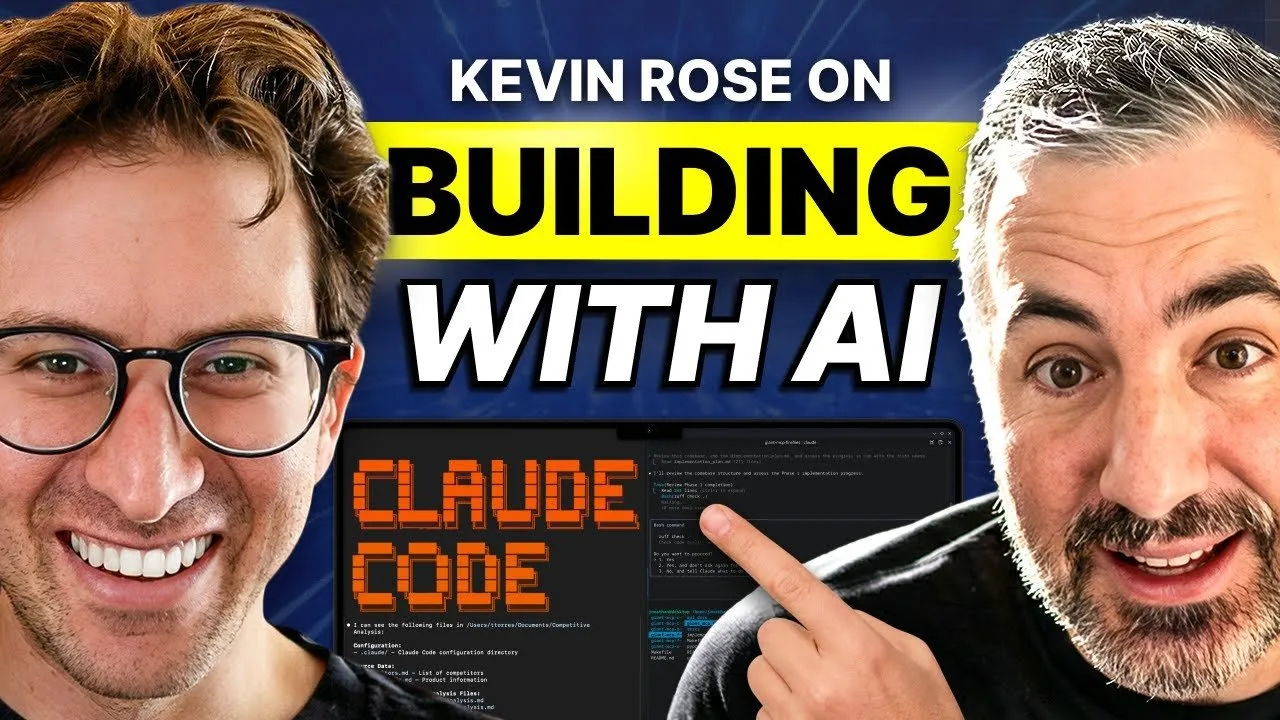
Kevin Rose, the iconic entrepreneur behind Digg, Zero, and True Ventures, is no stranger to building products that define internet culture. However, his latest venture isn't backed by a massive engineering team. Instead, Rose is leveraging the modern AI stack to build "Nylon," a sophisticated news aggregator, entirely as a solo developer.
In a recent deep-dive session, Rose shared his screen to reveal the exact tools, workflows, and philosophies he is using to build software in the AI age. From orchestrating complex background jobs to utilizing vector embeddings for semantic understanding, his workflow offers a blueprint for how technical founders and product managers can build enterprise-grade applications without a full development team.
This breakdown explores the specific technology stack Rose utilizes, his approach to "vibe coding," and why he believes we are entering the era of hyper-personalized software.
Key Takeaways
- The "Nylon" Architecture: Rose is building a high-fidelity news aggregator using a combination of Supabase, Vercel, and custom orchestrators to analyze tech trends with greater nuance than traditional keyword search.
- Durability is Key: To handle complex AI agent tasks that might time out on standard serverless functions, Rose relies on Trigger.dev to manage background jobs, retries, and long-running processes.
- The Modern Scraper Stack: The workflow combines Firecrawl for stealth mode scraping and iFramely for rich metadata extraction to bypass modern anti-bot measures.
- Vector Embeddings over Keywords: By using OpenAI’s vector embeddings, the system understands the semantic difference between "Apple sues Google" and "Google sues Apple," allowing for sophisticated clustering of news stories.
- The Rise of Personal Software: The barrier to entry for coding has lowered to the point where individuals can and should build bespoke software tailored specifically to their own needs and tastes.
The "Nylon" Project: Reimagining News Aggregation
The core of Rose's current workflow is a project codenamed "Nylon." While drawing inspiration from aggregators like TechMeme, Nylon attempts to solve a specific problem: the signal-to-noise ratio in the rapidly evolving AI sector. Rather than simply listing links, the application ingests RSS feeds, social signals, and raw HTML to determine the "gravity" and "novelty" of a story.
The system ingests data from approximately 63 sources. However, because RSS feeds are often truncated or broken, Rose has developed a sophisticated pipeline to enrich this data before it is ever presented to a user.
"I wanted to dive into what's going on in AI because it is moving just so fast. How can I slice this in really interesting ways to find my version of this?"
The Solo-Developer AI Stack
Building a complex aggregator requires more than just generating code with an LLM; it requires a robust infrastructure. Rose’s stack is a masterclass in combining managed services to reduce overhead.
Ingestion and Parsing: Firecrawl and iFramely
Standard RSS feeds rarely provide enough context for high-quality AI analysis. To solve this, Rose uses a "winner-takes-all" approach to data ingestion:
- iFramely: Used to fetch rich metadata, high-quality images, and social cards. This API is particularly useful for extracting clean titles and descriptions similar to how X (formerly Twitter) displays links.
- Firecrawl: When deep crawling is necessary, Firecrawl is deployed with "stealth mode" capabilities to access content that might otherwise block standard scrapers. It also utilizes AI to intelligently determine the main content of a page.
- Gemini for Ground Truth: Rose explicitly mentions using Google's Gemini model as a fallback for crawling. Because Gemini has deep integration with YouTube, it can extract transcripts from video content, providing text data for video-heavy news stories that other scrapers miss.
Orchestration with Trigger.dev
One of the primary challenges with serverless architectures (like Next.js on Vercel) is the execution time limit. AI workflows often take longer than the standard timeout window allows. To bypass this, Rose utilizes Trigger.dev.
Trigger.dev allows developers to write long-running background jobs in TypeScript that live in the cloud. It handles the orchestration of agents, manages retries automatically if an API fails, and ensures durability. This means if an AI summarization task fails, the system automatically spins up a new instance to retry without crashing the application.
Model Switching via Vercel AI Gateway
Rather than hard-coding a specific Large Language Model (LLM) into every function, Rose uses the Vercel AI SDK. This allows him to swap models programmatically based on the task's requirements. For example, he might use GPT-4o-mini for fast, inexpensive summarization, but switch to a more reasoning-heavy model for complex analysis. This flexibility is crucial for managing costs while maintaining quality.
Algorithmic Curation: Vectors and Gravity
The most technically fascinating aspect of the Nylon project is how it determines which stories matter. It moves beyond simple keyword matching by utilizing vector embeddings.
The Power of Embeddings
In the past, search relied on exact keyword matches. Today, Rose stores articles in a Postgres database (via Supabase) with vector extensions. This converts the text of an article into a mathematical representation of its meaning.
"There is a difference... between Apple sues Google and Google sues Apple. And that is impossible to do with keyword search because you're not understanding at a deep level what's going on here."
By clustering these vectors, the system can group 47 different articles about an NVIDIA investment into a single "cluster," identifying them as the same story despite different headlines. This enables the system to detect when a story is gaining traction across multiple disparate sources.
The "Gravity" Score
Rose implemented a custom algorithm dubbed the "Gravity Engine." This acts as a synthetic editorial board. AI agents evaluate stories based on a rubric of distinct criteria:
- Novelty: Is this information new, or a rehash of old news?
- Intellectual Gravity: Does this have long-term implications for the industry?
- Viral Potential: Is this likely to spread on social media?
- Consumer vs. Industry Impact: Who does this story affect?
This automated "scoring" allows the application to filter out press release fluff and focus on high-signal technical developments.
Vibe Coding and Personal Software
Rose coined the term "vibe coding" to describe the modern workflow where the barrier to creation is drastically lowered by AI. He reveals that he suffers from aphantasia (the inability to visualize mental images), which historically made retaining code syntax difficult. AI assistants like GitHub Copilot and Claude have bridged that gap.
He argues that the future of software is hyper-personal. We are moving away from massive, one-size-fits-all SaaS products toward a world where individuals build bespoke tools for themselves.
"I think we're entering into this era of personal software... If there's a workout app that you don't like because the buttons placement doesn't do it for you... you just build your own."
The critique that AI-generated code is "buggy" or "unoptimized" misses the point. The goal of "vibe coding" is to prove utility. Once a product is proven to be useful and finds an audience, the code can be refactored and optimized by professional engineers. The difficult part is not the code; it is the clarity of the product vision.
Conclusion: The Builder's Advantage
Kevin Rose's workflow demonstrates that the distinction between "non-technical" and "technical" founders is blurring. With tools like Trigger.dev for backend orchestration and vector databases for semantic intelligence, a single person can now build systems that previously required a dedicated engineering team.
For entrepreneurs, the lesson is clear: do not let technical limitations stop you from building. The stack exists to handle the heavy lifting. The true value now lies in curation, taste, and the ability to distinguish between signal and noise.