Table of Contents
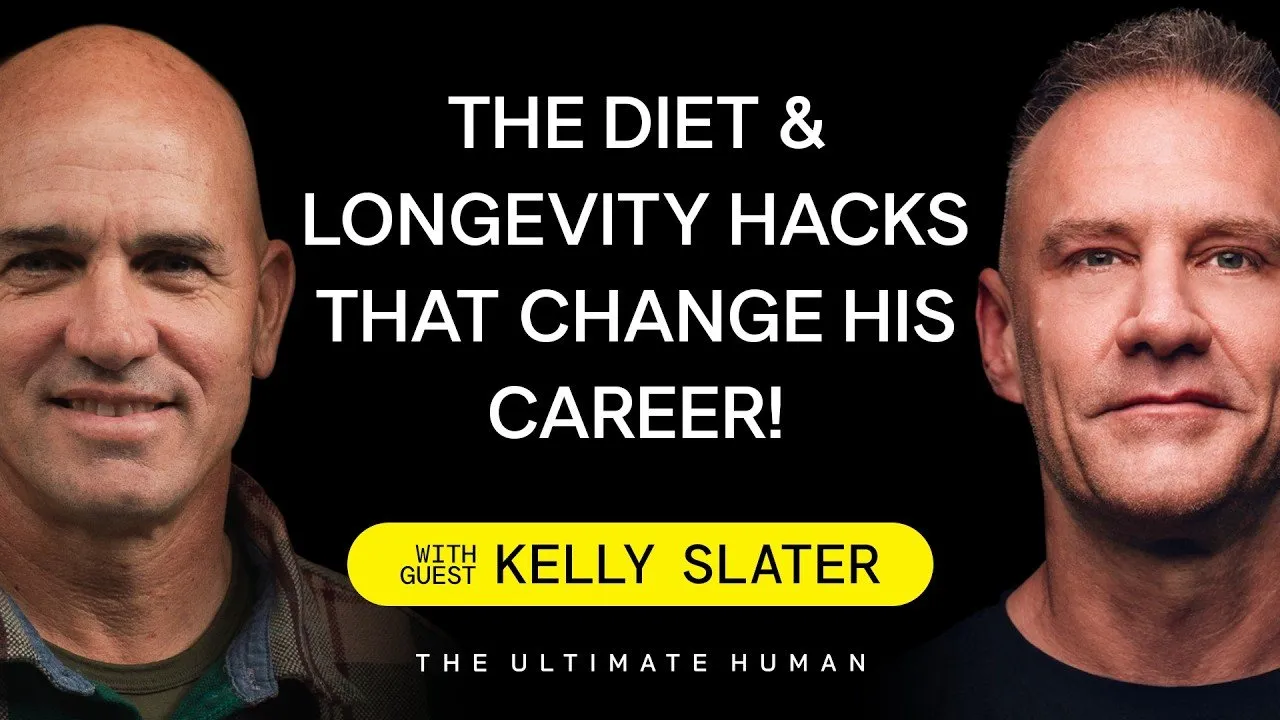
In the world of professional sports, longevity is rare, but dominance spanning three decades is nearly unheard of. Kelly Slater, the 11-time World Surfing Champion, defied the typical athlete's lifecycle by winning his first world title at age 20 and his last at age 39. Now in his 50s, Slater remains a competitive force and a cultural icon. His sustained success isn't just a result of natural talent; it is the product of a rigorous, evolving approach to nutrition, recovery, and mindset. In a revealing conversation with human biologist Gary Brecka, Slater opens up about the biohacking protocols, dietary shifts, and mental frameworks that have allowed him to remain at the apex of surfing for over 30 years.
Key Takeaways
- Strategic Fasting: Slater utilizes multi-day water fasts to reset digestion and clear mucoid plaque, citing day three as the turning point for mental clarity and energy.
- Intuitive Nutrition: Moving away from a sugar-laden youth, he adopted food combining principles inspired by the Gracie family to optimize digestion and energy.
- Aggressive Recovery: His longevity protocol relies heavily on deep tissue Thai massage, cold plunges, saunas, and hydrogen tablets to manage inflammation.
- Flow State Reliance: Slater views surfing as a singular connection to nature that induces a necessary "feeling" or flow state, vital for mental health and performance.
- Rehab Discipline: Despite severe injuries, including a shattered foot and hip replacement, Slater emphasizes that post-operative dedication is more critical than the surgery itself.
The Evolution of a Champion’s Diet
Slater’s approach to nutrition was not always scientific. Growing up in Cocoa Beach, Florida, his early diet consisted of processed snacks and sugar-laden breakfasts. He candidly admits to starting his mornings with chocolate milkshakes filled with ice cream and cookies, a habit that often left him with stomach cramps during school. The pivot toward health consciousness occurred in his early 20s, sparked by a cassette tape from Dr. Joel Wallach regarding nutrient deficiencies.
"No one dies from old age. There's no such thing. You die of a deficiency of something over a long period of time."
This realization fueled a decades-long obsession with anatomy and digestion. Slater began experimenting with food combining, a practice popularized in the martial arts world by the Gracie family. By separating proteins and carbohydrates, he noticed immediate improvements in his sleep quality and digestion, allowing his body to allocate more energy to recovery rather than processing heavy meals.
The Power of Water Fasting
Perhaps the most profound tool in Slater’s nutritional arsenal is water fasting. He advocates for fasting periods lasting three to ten days to allow the digestive system to heal and reset. While the first two days can be physically taxing, Slater notes that the third day often brings a surge of energy and clarity.
He describes the expulsion of mucoid plaque—hardened mucus and toxic residue in the intestines—as a critical component of these fasts. For Slater, the result is not just physical lightness but a complete sensory reboot, where eyesight seems sharper and vitality returns to youthful levels.
Longevity Protocols: Recovery Over Intensity
As Slater transitioned from a young prodigy to a veteran competitor, his focus shifted from sheer volume of training to meticulous recovery. While he jokingly refers to the sauna and cold plunge as the "lazy man’s workout," he acknowledges their vital role in cardiovascular health and inflammation management.
Physical Therapies and Supplementation
To combat the wear and tear of professional surfing, Slater employs aggressive bodywork. He favors Thai massage, a modality known for assisted stretching and deep pressure, often pushing his pain threshold to ensure maximum mobility. This is coupled with a post-session routine of hot baths or saunas to relax the muscles.
On the supplementation front, Slater and Brecka discussed the efficacy of molecular hydrogen tablets. These dissolvable tablets act as selective antioxidants, targeting inflammation and aiding in tissue repair—a crucial biohack for an athlete managing decades of high-impact stress.
The Psychology of Dominance and Flow
Beyond the physical, Slater’s longevity is rooted in his spiritual and psychological relationship with the ocean. He describes surfing not merely as a sport, but as a method to access deep feeling in an increasingly numb, technology-driven world.
"I think most humans nowadays with the way life is, we've lost that feeling. In surfing, it's kind of more personal because you are in the ocean."
This connection creates a flow state where thought and action merge. In big-wave surfing, where mistakes can be fatal, this state is essential. The adrenaline acts as a natural analgesic, masking fear and pain, allowing the surfer to perform on the edge of disaster. Slater notes that maintaining this passion requires shifting motivations: initially driven to beat his heroes, he later found motivation in fending off the "young guns" trying to dethrone him.
Navigating Injury and Rehabilitation
Slater’s career has not been without physical cost. He has competed through torn labrums and recently underwent a total hip replacement after battling issues for over 30 years. His most grueling injury, however, was a Lisfranc fracture in his foot, which required multiple surgeries and nearly two years of rehabilitation.
The lesson Slater emphasizes is that the surgery is only a fraction of the solution. The real work lies in the post-operative rehabilitation. He aligns with the philosophy that one must push through the monotony of physical therapy—likened to "tearing pages out of a phone book"—to regain full function. His ability to return to competition in his 50s after joint replacement serves as a testament to his dedication to the unglamorous side of healing.
Business, Environment, and Future Goals
As he looks toward the next chapter, Slater is diversifying his legacy. He founded the sustainable clothing brand Outerknown and developed cutting-edge wave pool technology, which is currently expanding to a private community in Austin, Texas. These ventures reflect his broader philosophy on environmental stewardship. Rather than being preachy, Slater focuses on tangible issues like plastic pollution, which he has witnessed firsthand choking the oceans he loves.
Ultimately, Slater defines the "Ultimate Human" not by physical accolades, but by the pursuit of purpose. Whether through regenerative farming, which he plans to pursue in the future, or mentoring the next generation, his goal is to maximize potential and maintain a deep connection to the natural world.
Conclusion
Kelly Slater’s journey from a junk-food-eating teenager to a biohacking pioneer illustrates that longevity is a deliberate practice. By combining ancestral wisdom—like grounding and fasting—with modern recovery science, he has extended his prime well beyond the statistical norm. His story offers a blueprint for anyone looking to optimize their health: listen to your body, prioritize recovery, and find a passion that demands your absolute presence.