Table of Contents
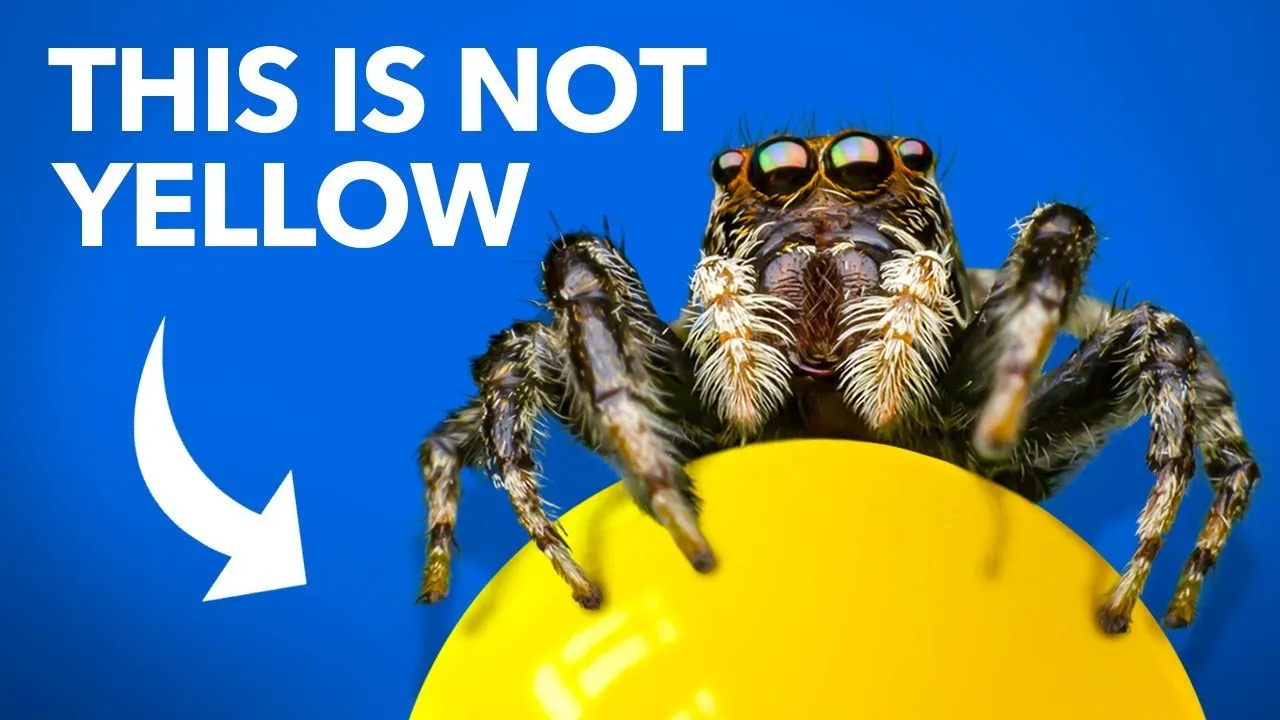
When you look at a yellow object on your smartphone screen, your brain is lying to you. The screen doesn't actually produce yellow light; it uses a mix of red and green subpixels to trick your brain into perceiving yellow. This phenomenon highlights a fundamental truth: color is not just a property of an object, nor is it solely a creation of the mind. It is a complex interaction between physics and biology.
While humans rely on trichromatic vision—mixing red, green, and blue—we are far from the only masters of color in the animal kingdom. In fact, to truly understand the evolution and purpose of color vision, we shouldn't look at primates or birds, but rather at the "fly tigers" of the undergrowth: jumping spiders. These tiny arachnids are revolutionizing our understanding of how eyes work, how color evolves, and how reality is perceived across the animal kingdom.
Key Takeaways
- Visual Engineering Marvels: Jumping spiders possess "principal eyes" that function like Galilean telescopes, allowing them to see fine detail better than elephants or cats.
- Repeated Evolution: Unlike primates, who evolved color vision once, jumping spiders have independently evolved the ability to see red multiple times through different biological mechanisms.
- Survival Advantages: Experiments prove that expanded color vision helps spiders distinguish between toxic and safe prey, leading to faster growth and reproduction.
- The Depth Illusion: Some spiders use color not for hue perception, but to calculate distance via chromatic aberration, effectively turning colors like red into 3D depth cues.
The Tiny Giants of Visual Acuity
Jumping spiders, or Salticidae, defy the biological rule of thumb that "bigger is better." In most of the animal kingdom, a larger eye equates to better function. Yet, these arachnids—often smaller than a fingernail—possess a visual system that rivals, and in some ways surpasses, much larger animals.
Their visual dominance is achieved through a decentralized system using eight eyes. The secondary eyes provide a 360-degree motion detection system, acting as a perimeter alarm. However, the true marvel lies in the two large, central "principal eyes."
The Galilean Telescope in Nature
The anatomy of a jumping spider's principal eye is unique in the animal kingdom. While a human eye uses a single lens to focus light onto the retina, the jumping spider utilizes a structure akin to a telescope or binoculars.
"That big lens that you see from the outside of the animal is one of two lenses in these eyes... At the end of that fluid-filled tube is a second lens, and what that lens does is it magnifies the image... it increases the ability to see detail by the retina that sits right below it."
This structure allows them to see fine patterns better than a lap dog or a pigeon. However, this high acuity comes with a trade-off: a very narrow field of view. The spider essentially "scans" its environment, painting high-resolution color and detail onto the broad, black-and-white canvas provided by its secondary eyes.
A Laboratory for Evolutionary Innovation
Perhaps the most fascinating aspect of jumping spiders is not just how they see, but how often they reinvent the ability to see. In primates, trichromatic color vision evolved once in a common ancestor and persisted. In contrast, jumping spiders are constantly evolving new forms of visual perception.
By analyzing the family tree of over 6,000 known species, researchers have discovered that the ability to see red has evolved independently at least 12 times. Furthermore, nature has solved this problem in two distinct ways within the same family of spiders:
- Gene Duplication: In some species, the gene for green-sensitive pigments was accidentally duplicated, and the copy drifted to become sensitive to red light—similar to how human vision evolved.
- Retinal Filtering: Other species took a hardware approach. They evolved a red filter within the eye that sits in front of green-sensitive cells. This filter blocks green light, forcing the cell to respond only to longer red wavelengths.
The Evolutionary "Why": Food vs. Mating
Why would a tiny predator invest so much energy into evolving high-definition color vision? Researchers like Lisa Taylor have tested two primary hypotheses: sexual selection and foraging efficiency. Using controlled experiments with painted termites—making some red and bitter (toxic) and others gray and tasty—scientists asked if color vision offered a tangible survival benefit.
The results were conclusive. Spiders with the biological hardware to distinguish red from gray quickly learned to avoid the "toxic" red prey. More importantly, those who could use color cues to forage laid eggs sooner and were heavier than their color-blind counterparts. This provides some of the first empirical evidence linking expanded color vision directly to evolutionary fitness through foraging.
The Paradox of the Invisible Red
While foraging explains some color vision, it doesn't explain the Mexigonus paradox. In this genus, males sport brilliant red colors during courtship dances, yet physiological tests suggest the females are dichromats—they possess only UV and green sensors and technically cannot see red.
Why would a male evolve a color his mate cannot see? The answer lies in the physics of light refraction, specifically chromatic aberration.
Turning Color into Distance
Lenses naturally bend different wavelengths of light by different amounts; blue light bends sharply, while red light bends gradually. In a camera, this causes color fringing, which engineers work hard to correct. Jumping spiders, however, harness this "flaw."
Their retinas consist of multiple stacked layers. Green light might focus perfectly on one layer, while red light—being a longer wavelength—focuses on a layer further back. Because these spiders have layered retinas, a fuzzy red object might not be perceived as a color, but rather as a specific type of depth information.
"Essentially, colors like red might create this perception of being close, or being looming towards the receiver... a jumping spider's red coloration might not look red to another jumping spider, but instead create a sort of depth illusion."
By displaying red, a male spider might be hacking the female's depth perception, making himself appear closer or creating a confusing optical illusion that prevents the female—who is often cannibalistic—from attacking him immediately.
Conclusion: The Dance of Perception
Jumping spiders challenge our binary definitions of color. Is color a physical wavelength, or is it a mental phenomenon? The research suggests it is an emergent property—a relationship between the observer and the environment.
From "telescope" eyes to retinal depth-hacking, these creatures demonstrate that there are countless ways to experience the universe. Every time a species goes extinct, we lose not just an animal, but a unique biological solution to the problem of perception—a specific way of seeing the world that will likely never exist again.