
Table of Contents
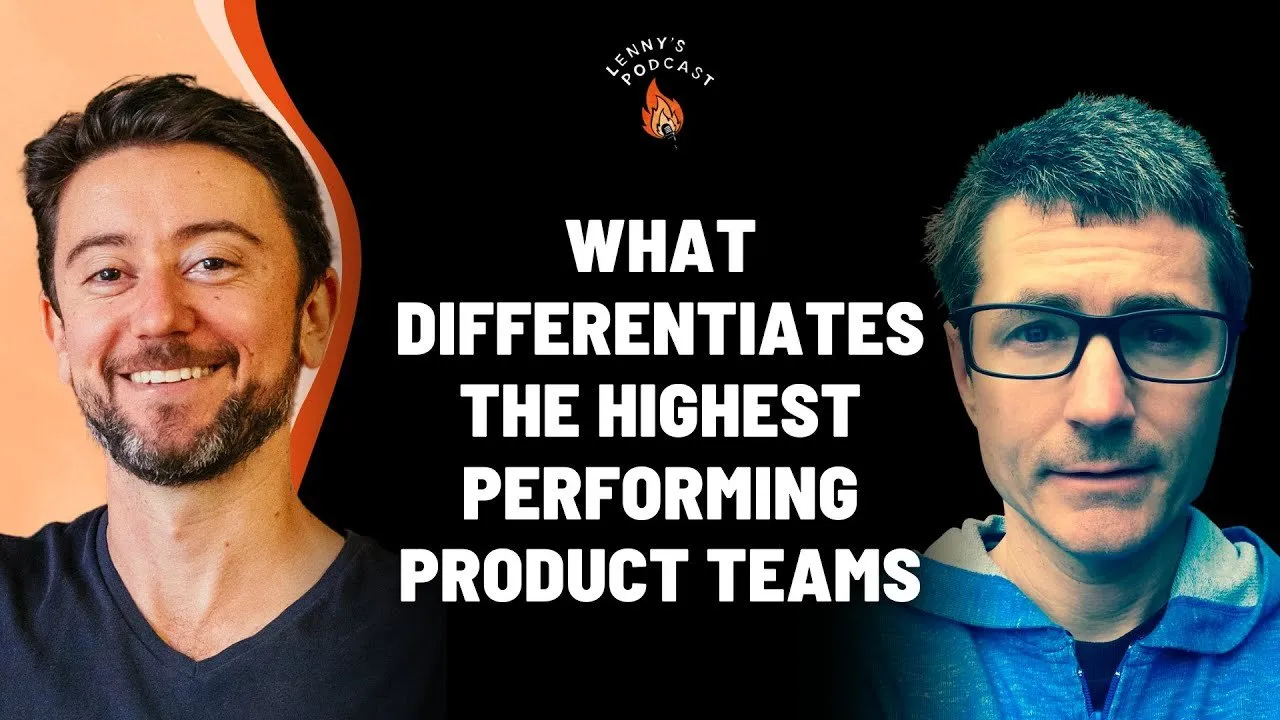
When you have worked with hundreds of product teams across the globe—from two-person startups to massive enterprises like Amazon and LEGO—you start to see patterns that are invisible to the average operator. John Cutler, formerly the Product Evangelist at Amplitude and a prolific writer, possesses perhaps the most comprehensive view of the modern product landscape of anyone in the industry.
Through his work, Cutler has discovered that while we often search for a single framework or silver bullet to solve our product woes, the reality is far more complex. High performance isn't a checklist; it is a coherent system where strategy, structure, and culture align. In this deep dive, we explore the nuances of what differentiates elite teams, why Silicon Valley advice often fails elsewhere, and how to navigate the "beautiful mess" of building software.
Key Takeaways
- The "Reverse Anna Karenina" Principle: Dysfunctional product teams tend to fail in identical ways, but high-performing teams succeed in vastly different, unique ways.
- Coherence is King: The best companies exhibit a tight alignment between their strategy, their organizational structure, and their leadership style.
- Context Matters: Advice that works for a high-churn, individualistic Silicon Valley startup often fails in collectivist or legacy enterprise environments.
- The Product Loop: Success isn't just about knowledge; it's about how many times a team can cycle through strategy, modeling, betting, measuring, and learning.
- Deconstructing "Product Sense": We must stop treating product intuition as magic and start breaking it down into teachable skills like systems thinking and facilitation.
The "Reverse Anna Karenina" Principle of Product Teams
There is a pervasive desire in the industry to identify the specific rituals or frameworks that define success. However, Cutler argues that looking for a uniform "best practice" is a trap. He references a concept from his friend Josh Arnold, which flips the famous opening line of Tolstoy's Anna Karenina.
The dysfunctional companies are all the same and then the happy companies... can be very, very different.
When you analyze low-performing teams, the anti-patterns are glaringly consistent: lack of trust, bureaucratic drag, and disconnected feedback loops. However, high-performing teams achieve their results through a diverse array of methods.
- Decision-Making Variance: Some elite teams rely on rigorous, process-driven decision-making with red teams and formal documents. Others thrive on ad-hoc, serendipitous collaboration. Both can yield world-class results if they fit the company culture.
- Leadership Styles: Success does not require a specific personality type. You will find humble, servant-leaders running massive innovative engines, and you will find dominant, "sparring-partner" style leaders running equally successful ships.
- Structure vs. Freedom: Some companies succeed with empowered, bottom-up autonomy. Others dominate their market with a top-down, CEO-driven roadmap. The variable for success is not the method itself, but how well that method is executed.
The Five Pillars of High-Performing Teams
If the tactics vary, what remains constant? Cutler identifies five foundational attributes that appear consistently across the top 1% of product teams. These are not about specific tools (like Jira or Notion) but about the underlying physics of the organization.
1. Structural Coherence
The highest-performing teams possess coherence between their strategy and their structure. You cannot have a fluid, emergent strategy while maintaining a rigid, bureaucratic funding model. As companies scale, the "physics" of the organization catches up to them. Elite teams ensure their incentives, org charts, and technical architecture support their current strategic goals.
2. Strong Opinions, Loosely Held
Great teams balance stubbornness with flexibility. They often hold a slightly irrational belief in their vision or the power of product quality—a belief that no amount of A/B testing or ROI spreadsheets can justify in the short term. Yet, they remain capable of pivoting when the market reality shifts.
3. Coherent Leadership
Authenticity is a competitive advantage. Leaders in top companies do not pretend to be something they are not. If a company is top-down, the leaders own that identity rather than paying lip service to "empowerment" while micromanaging. This coherence reduces cognitive dissonance for the team.
Great product leadership... it’s very much about being who you are and not being embarrassed about that thing.
4. A Belief in the Power of Product
There is a shared understanding that product success is a "layer cake" of decisions made over years. Successful teams understand that today's wins were set in motion by architectural and cultural investments made three years ago. They resist the urge to optimize solely for short-term quarterly metrics at the expense of long-term product health.
5. Contextual Skills and Experience
While culture is critical, raw skill matters. High-performing environments either hire the absolute best talent or have developed a systematic machine for upskilling people. They understand that a Product Manager successful in B2B enterprise sales might need significant adaptation to succeed in a bottom-up PLG (Product-Led Growth) motion.
Beyond Silicon Valley: Contextualizing Advice
A significant portion of product management literature is written by and for Silicon Valley startups. Cutler warns that applying this advice blindly to legacy enterprises or companies in different cultural contexts can be disastrous.
The Individualism vs. Collectivism Divide
US-centric tech culture is highly individualistic. It often rewards the "hero" PM who brokers deals and drives outcomes. In contrast, teams in Europe, India, or Latin America often operate with a more communitarian view. In these environments, the team is the unit of value, not the individual. Implementing a "rockstar" meritocracy in a collectivist culture can destroy morale and velocity.
Navigating Inertia in Legacy Companies
Most PMs do not work at Figma or Airbnb; they work at companies transforming through technology, like banks, logistics firms, or retailers. These organizations face structural inertia that digital-native advice ignores.
- Adapt, Don't Copy: Do not try to "install" the Spotify Squad model or Amazon's "Working Backwards" process as if it were software. Treat frameworks as job aids or learning scaffolds, not end goals.
- Create Pockets of Innovation: If you cannot transform the whole company, create "pods" where a team can get the reps in. Isolate a small group to practice shipping and learning cycles without the weight of the entire corporate bureaucracy.
- Honor the Context: There are unsexy businesses—plumbing supply in Australia or refrigeration AI in Santa Barbara—that are printing money and solving real problems. They may not look like a Silicon Valley unicorn, but they are often high-performing in their own context.
The Product Loop: Moving from Knowledge to Practice
We are living in the golden age of product content. However, consuming podcasts and newsletters can create a false sense of competence. Cutler emphasizes that product management is a skill, and skill is knowledge multiplied by practice.
To evaluate your career or your team, you must look at how often you are completing The Data-Informed Product Loop:
- Strategy: Defining where you are going.
- Qualitative Modeling: Creating frameworks (like the North Star) to understand the problem.
- Measurement: Adding data to those models.
- Prioritization: Deciding where to focus.
- Betting: Designing and shipping experiments.
- Impact Analysis: Measuring the result of those bets.
- Circulation: Feeding that learning back into the strategy.
- Repeat.
Many teams get stuck at different stages. Some have great strategy but cannot ship bets. Others ship constantly but never measure impact. The goal is to close the loop. If you are in a difficult environment where you cannot ship to production easily, you can still practice the loop by writing the one-pagers, defining the risks, and simulating the decision-making process.
Embracing the "Beautiful Mess"
Finally, Cutler advocates for moving away from the "great man theory" of product management—where a single genius leader or a perfect framework saves the day—and toward an appreciation of systems thinking. The work we do is complex and non-linear.
Deconstructing "Product Sense"
Terms like "product sense" or "product mindset" are often used as gatekeeping mechanisms. They imply you either have it or you don't. To build better teams, we need to unpack these vague terms into tangible competencies:
- Systems Thinking: The ability to see how changing one variable impacts the whole ecosystem.
- Facilitation: The skill of extracting diverse perspectives from a group to form a coherent plan.
- Uncertainty Modeling: The ability to make decisions with incomplete information.
Measurement as Uncertainty Reduction
When it comes to data, many teams fall into the trap of trying to measure everything perfectly. Referencing Douglas Hubbard’s work, Cutler reminds us of the true purpose of measurement.
You only need to reduce the uncertainty to an acceptable amount to be able to make the next decision that you need to make.
Product management is not a hard science; it is an art played out in a complex adaptive system. The highest-performing teams are those that stop looking for the perfect map and start getting better at navigating the terrain.
Conclusion
Whether you are at a hyper-growth startup or a legacy enterprise, the path to high performance starts with introspection. It requires aligning your actions with your beliefs, understanding the unique context of your market, and focusing on completing the loops of learning. There is no perfect company, and even the "elite" teams are often messy on the inside. Success comes from embracing that mess, creating coherence where you can, and relentlessly focusing on the feedback loop between what you build and what you learn.



)