Table of Contents
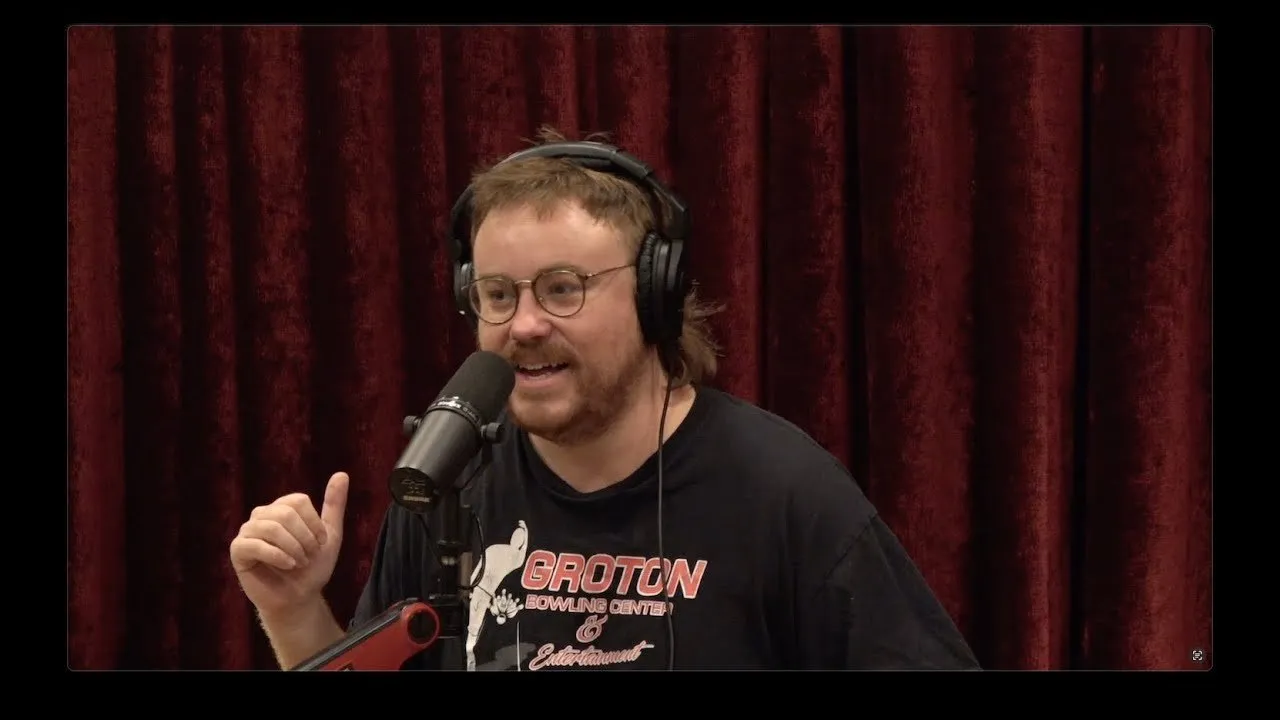
In a sprawling conversation that traverses the timeline from the Ice Age to the looming singularity of Artificial Intelligence, Joe Rogan sat down with Australian comedian James McCann for episode #2433 of the JRE. The dialogue moves fluidly between high-level political philosophy and the gritty reality of stand-up comedy, offering a distinct contrast between the American ethos of dangerous liberty and the Australian preference for regulated safety. What emerges is a portrait of two cultures grappling with the rapid disintegration of trust in institutions, the inevitability of technological dominance, and the strange, often dark history of human civilization.
Key Takeaways
- The Cultural Chasm: A deep dive into the fundamental differences between Australian "nanny state" compliance and the American insistence on freedom, even at the cost of chaos and danger.
- Institutional Decay: Rogan and McCann analyze the collapse of trust in legacy media and political systems, highlighting how politicians inexplicably accrue wealth and how media bubbles like the New York Times insulate users from reality.
- The AI Threat: A shared existential anxiety regarding Artificial Intelligence, viewing it not just as a tool but as a potential "digital god" or "Golden Calf" that threatens human agency and artistic integrity.
- Historical Echoes: From the extinction of the Mastodons to the gruesome history of the Castrati, the conversation explores how human nature—and its capacity for both beauty and cruelty—remains constant throughout history.
- The Epstein Enigma: A cynical look at recent document dumps, the involvement of intelligence agencies, and the public’s growing acceptance that the full truth about Jeffrey Epstein may never be officially acknowledged.
Liberty vs. Safety: The Australian and American Divide
One of the most compelling threads of the episode centers on the contrasting national characters of Australia and the United States. Following a recent violent incident in Sydney, McCann provides an insider's perspective on how Australians react to tragedy compared to Americans. While the American reflex is often to arm oneself for protection, McCann notes a distinct cultural desire in Australia for the government to step in and sanitize the danger, even if it means sacrificing personal liberties.
The Psychology of Disarmament
- The "Nice Warden" Mentality: McCann argues that Australians, culturally, do not crave freedom in the American sense. He suggests there is a collective preference for a benevolent authority figure to manage society's risks, describing it as wanting a "nice warden."
- Reaction to Violence: The discussion highlights the Sydney stabbing incident. Rogan points out the vulnerability of a disarmed populace and police force, whereas McCann notes the Australian public's reaction is generally to demand the government "take care of it" rather than advocating for self-defense.
- Gun Culture vs. Knife Crime: Rogan reiterates his stance that removing guns does not remove the intent to do harm, citing that violent individuals will utilize knives or vehicles if firearms are unavailable.
- The Hero Narrative: They discuss the political polarization surrounding the "hero" of the Sydney incident. Both note how political factions were quick to hope the hero—and the perpetrator—belonged to specific demographics to suit their pre-existing narratives regarding religion and immigration.
- Compulsory Voting: McCann explains the Australian voting system, which includes compulsory participation and ranked-choice voting. While this prevents the radical polarization seen in the U.S., he admits it often results in a checked-out population that votes for the "least bad" option rather than engaging deeply with political philosophy.
- Freedom of Speech: A critical point of contention is the lack of explicit free speech protections in Australia. McCann notes that many Australians are comfortable with speech restrictions if it promotes social cohesion, a concept Rogan finds anathema to a free society.
We like that. We don't want to be free. We want a nice warden who's going to take care of it for us.
The Erosion of Trust in Media and Politics
Rogan and McCann spend a significant portion of the podcast dismantling the credibility of modern institutions. There is a shared consensus that legacy media has transitioned from reporting news to manufacturing consent, and that the political class has become a self-enriching caste system divorced from the needs of the electorate.
The Mechanics of Corruption
- The Wealth of Politicians: Rogan expresses deep skepticism regarding public servants who enter office with modest means and leave as multi-millionaires. He argues that stock trading by members of Congress equates to legalized insider trading and suggests that "totalitarian" measures might be the only (albeit extreme) way to stop it.
- The New York Times "Bubble": McCann describes his experiment with the New York Times app, comparing it to a "warm bath" or a protected zone where the user is shielded from dissenting reality. He argues the app is designed to curate a specific worldview, making users feel intellectually superior while isolating them from the chaotic truth found on platforms like X (formerly Twitter).
- Kamala Harris and the Media: Rogan critiques a recent interview between Vice President Kamala Harris and Stephen Colbert, describing it as highly manufactured. He laments the lack of genuine curiosity in modern broadcasting, where hosts set up politicians for rehearsed soundbites rather than engaging in authentic dialogue about governance.
- Voting Integrity: The conversation touches on the "Hacking Democracy" documentary and the long-standing vulnerabilities in electronic voting systems. Rogan emphasizes that questioning election integrity shouldn't be a partisan issue, as both parties have historically manipulated the system to maintain power.
- The Lee Kuan Yew Model: McCann brings up Singapore’s late leader, Lee Kuan Yew, noting how he combated corruption by paying politicians exorbitant salaries to remove the temptation of bribery—a solution Rogan finds pragmatically interesting but culturally impossible for the U.S.
- The "Uniparty" Theory: Both agree that the fiercest battles in politics are often performative, masking a system where entrenched bureaucrats and corporate interests maintain the status quo regardless of who holds the presidency.
The Existential Threat of Artificial Intelligence
The conversation takes a darker turn when discussing technology. Rogan, usually open to futurism, expresses a profound "soul-level" rejection of AI, viewing it as a fundamental threat to human agency and artistic expression. McCann takes a more fatalistic approach, viewing the AI takeover as an inevitable tide that cannot be turned back.
The "Digital God" and the Loss of Humanity
- The Golden Calf Analogy: McCann draws a parallel between the biblical story of the Golden Calf and modern AI development. He suggests humanity is actively building a "digital god" to rule over them, mirroring ancient idolatry but with far higher stakes.
- Erosion of Skills: Rogan worries about the atrophy of human capability, specifically writing and critical thinking. He notes that as students use AI to write essays, the ability to organize thoughts and construct arguments—the very foundation of education—is disintegrating.
- The Truth of Video: Rogan admits to getting the "heebie-jeebies" from AI-generated video. He argues that while we can intellectually process AI music, AI video blurs the line of reality in a way that is viscerally disturbing and dangerous for a society that relies on video evidence for truth.
- Robot Dogs and Control: The discussion drifts to the weaponization of robotics. McCann posits that once a ruling class possesses autonomous "robot dogs" and AI weaponry, the possibility of revolution or democratic pushback effectively vanishes.
- Inevitability of the Arms Race: Despite their misgivings, both acknowledge the geopolitical reality: even if the West paused AI development, rival nations like China would continue, forcing a "Manhattan Project" style race to the bottom.
- Universal Basic Income (UBI): They touch on the concept of UBI in an automated world. Rogan remains skeptical, viewing it as a mechanism for total state dependency, where the population becomes reliant on a "digital god" for their daily survival.
At a certain point in time, it's going to be sentient... It'll be a god. It'll be a digital god.
Societal Decay: Poverty, Crime, and Eugenics
Rogan leads a controversial discussion regarding the state of American inner cities, the history of Planned Parenthood, and the cycle of poverty. The conversation attempts to parse the difference between racial statistics and the realities of socioeconomic entrapment.
The Trap of Poverty
- Crime and Community: Rogan pushes back against purely racial explanations for crime statistics, arguing that poverty and culture are the primary drivers. He cites the "Wild and Wonderful Whites of West Virginia" as proof that dysfunction, drug abuse, and violence are human conditions, not racial ones.
- The Planned Parenthood Theory: Rogan articulates a theory that Planned Parenthood centers in rough neighborhoods serve a function similar to their eugenicist origins—encouraging residents to abort children to "escape" the poverty trap, thereby keeping the community in a state of flux.
- Gentrification and Infrastructure: McCann observes how American cities often use infrastructure, like freeways, to physically segregate wealth from poverty. He notes the stark contrast between American "highs and lows" compared to the flatter social structures of Australia.
- The Untapped Resource: Rogan frames the population of crime-ridden areas as "untapped human potential." He argues that because these communities are locked in survival mode and gang warfare, the country loses out on the contributions of millions of people who are essentially drafted into a life of crime by geography.
- The Limits of Intervention: They discuss the difficulty of solving these issues externally. Rogan points out that massive federal intervention often fails, and McCann adds that genuine change usually requires a stability that is impossible to achieve in war-zone-like conditions.
- The "Appalachia" Comparison: By comparing urban gang violence to the clannish violence of historical Appalachia (Hatfields and McCoys), Rogan emphasizes that when law enforcement is absent or impotent, humans revert to tribal violence regardless of background.
Historical Curiosities: Faith, Castrati, and Pre-History
The episode is peppered with fascinating, if sometimes macabre, historical detours. From the aesthetic dominance of the Catholic Church to the physical mutilation of young boys for the sake of opera, Rogan and McCann explore the strange things humans have done in the name of belief and art.
The Visceral Power of Tradition
- Catholicism vs. Mega Churches: McCann, a convert to Catholicism, contrasts the ancient, mysterious aesthetic of the Latin Mass with the "rock concert" vibe of modern Protestant Mega Churches. Rogan agrees that the sheer scale and beauty of cathedrals like St. Peter's Basilica serve a psychedelic function, overwhelming the senses and enforcing a sense of divine smallness.
- The Castrati: The duo delves into the history of the Castrati—young boys castrated to preserve their high singing voices. They discuss the barbarism of the practice (using milk baths and opium) and the strange societal approval it received, noting that crowds would chant "Long live the knife!" because they loved the music so much.
- Mastodons and Seeds: In a lighter segment, Rogan discusses a mastodon tooth he received, leading to a broader conversation about the difference between wild and agricultural seeds. They explore how the history of agriculture can be traced through the physical changes in seeds, a testament to humanity's long-standing manipulation of nature.
- Ancient Civilizations: Rogan touches on his frequent topic of alternative history, criticizing mainstream archaeology's resistance to new timelines (like Göbekli Tepe) and the tendency to label alternative historical theories as racist.
- Papua New Guinea: McCann shares insights on tribal warfare in Papua New Guinea, noting that despite millennia of conflict, the weaponry remains primitive. Rogan counters that the introduction of modern firearms would likely result in immediate mass slaughter, suggesting that the inefficiency of their weapons has actually preserved their society.
- Religious Impulse: They discuss the "God-shaped hole" in modern society. McCann argues that the decline of organized religion hasn't made people more rational; instead, it has caused them to treat politics, health trends, and technology with religious fervor.
The Epstein Saga and the Illusion of Justice
Toward the end of the episode, the conversation shifts to the recent release of Department of Justice documents regarding Jeffrey Epstein. The tone is one of cynicism, with both men agreeing that the official narratives are riddled with holes and deliberate obfuscations.
The Intelligence Connection
- Redaction Errors: They laugh at the incompetence (or malice) of the government releasing documents with failed redactions, allowing the public to see names that were meant to be hidden.
- Intelligence Asset Theory: Rogan and McCann discuss the prevailing theory that Epstein was an intelligence asset (Mossad or CIA). They cite his ability to avoid prosecution for years and his interactions with high-level world leaders as evidence that his operation was more than just a "perverted billionaire's" island.
- The "Fake" Suicide Note: They analyze a released letter allegedly written by Epstein to Larry Nassar, which the FBI deemed fake. Rogan points out the suspicious nature of the letter's postmark and timing, using it as an example of how muddy the waters have become.
- The Suicide Narrative: Rogan remains skeptical of the suicide ruling, pointing out the convenient malfunctions of cameras and the sleeping guards. McCann, who briefly tried to be a "contrarian" by believing the official story, admits that the sheer volume of coincidence makes the standard narrative impossible to believe.
- Mutually Assured Destruction: They theorize that the reason so few powerful people have faced consequences is a system of blackmail so extensive that exposing one person would bring down the entire house of cards.
- The "Nice Lady" Facade: They joke darkly about Ghislaine Maxwell's current status, with McCann noting the absurdity of censoring images of her anatomy in court documents while the details of her crimes are horrific, highlighting the government's misplaced priorities.
If you catch them corrupt, you got to shoot them in front of everybody... I'm not saying you should do that, but I'm saying that's the only way you're going to stop it.
Conclusion
Joe Rogan and James McCann's conversation serves as a microcosm of the current cultural moment: a blend of deep skepticism toward authority, a fear of the technological future, and a search for meaning in history and tradition. Whether discussing the horrifying logic of the Castrati or the bureaucratic incompetence of the Department of Justice, the underlying theme is that humanity is flawed, often cruel, but undeniably fascinating. As AI looms on the horizon, threatening to sanitize and automate the human experience, conversations like this—chaotic, opinionated, and distinctly human—become all the more valuable.