
Table of Contents
Most of us move through life with a subtle, protective armor. We believe that by shielding our hearts, we protect ourselves from pain, rejection, and failure. Yet, paradoxically, this defensive posture often creates the very suffering we are trying to avoid. Whether it manifests as a constant loop of anxious thoughts, a feeling of helplessness in our relationships, or a persistent sense of burnout despite our best efforts at efficiency, the root cause is often the same: a resistance to feeling.
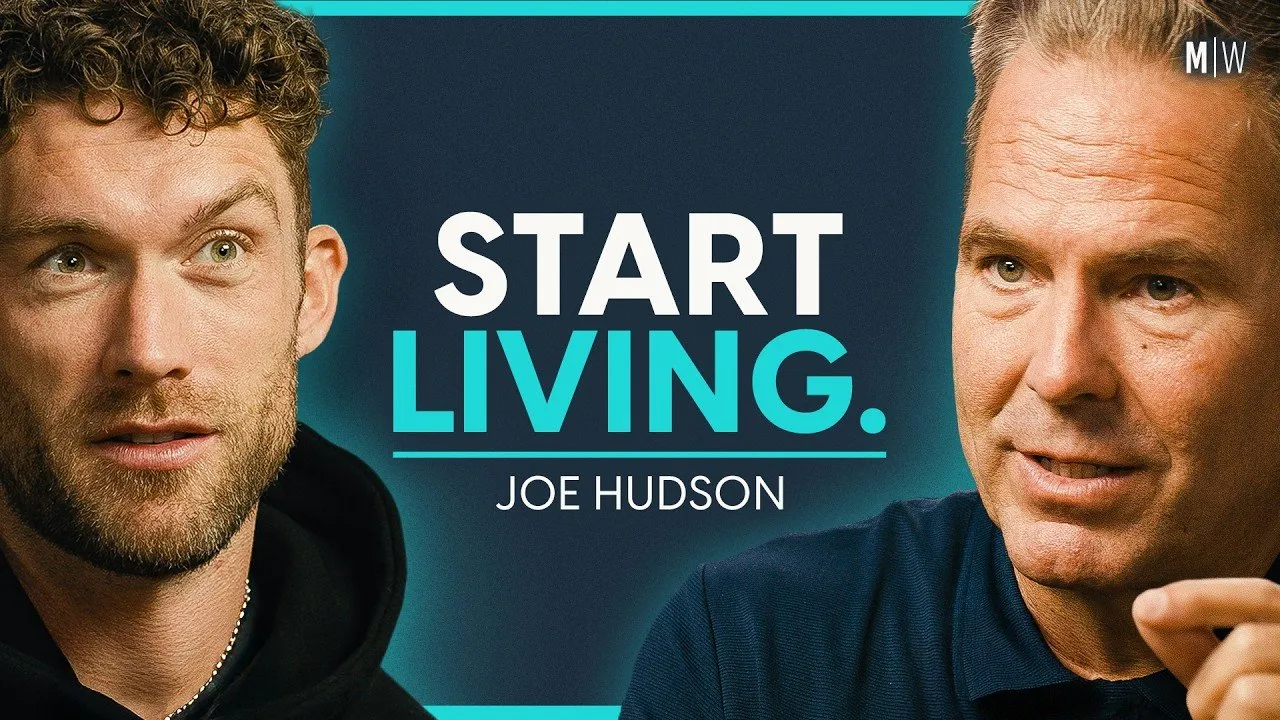
In a profound dialogue between Chris Williamson and executive coach Joe Hudson, they explore the counterintuitive path to emotional freedom. The journey requires a shift from resisting pain to embracing it, and from controlling others to mastering our own internal landscape. By understanding the mechanics of an "open heart," we can break the loops of helplessness and move toward a life of genuine connection and agency.
Key Takeaways
- Heartbreak is a capacity builder: Avoiding emotional pain shrinks your world, while moving through it expands your capacity for love and resilience.
- True boundaries are about self-governance: A healthy boundary is not telling someone else what to do; it is defining what you will do in response to a situation.
- Binary thinking indicates fear: When you feel stuck between two rigid options, it is usually a sign of unexpressed fear rather than a logical dilemma.
- The "Lonely Chapter" is necessary: Personal growth often requires a transitional period where you no longer fit with old peer groups but haven't yet found new ones.
- "Want" is a cleaner fuel than "Should": Motivating yourself through obligation ("I should work out") is inefficient compared to uncovering the genuine desire behind the action.
Living with an Open Heart in a Real World
There is a pervasive belief that living with an "open heart" makes one soft, vulnerable to attack, or ill-equipped for the harsh realities of the modern world. However, experience suggests the opposite. Closing the heart does not prevent pain; it merely traps it inside, often manifesting as a dull, persistent ache or anxiety.
The daunting nature of vulnerability is similar to "depatterning" a mistreated animal. If a puppy has learned that a raised hand means a blow, it will cower. It takes repeated exposure to a raised hand that offers a pat, rather than a hit, to rewire that nervous system response. Humans are similar; we have been entrained to associate love with guilt, smothering, or obligation. Consequently, we fear the very thing we crave.
My experience is that if you close your heart down, it hurts. It's just painful... I don't know anything that feels better with a closed heart.
Living openly is not about being passive. It is about removing the internal armor that prevents genuine connection. When you stop resisting the world and your own emotions, you stop attracting the patterns you fear. You move from a state of protection to a state of connection, which paradoxically makes you more effective and less likely to be taken advantage of.
The Misunderstood Role of Boundaries
Pop psychology has weaponized the term "boundaries," often turning it into a tool for control rather than connection. Many people mistakenly believe a boundary is telling someone else how to behave—for example, "You need to stop yelling at me." In reality, this is a power struggle, not a boundary.
Internal vs. External Control
A true boundary defines your own actions, not the other person's. It shifts the dynamic from "You must do this" to "If this happens, I will do this."
- Power Struggle: "You are not allowed to speak to me like that."
- True Boundary: "If you yell at me, I will leave the room and return in 20 minutes when things are calmer."
- The Outcome: The former attempts to control the other; the latter restores your own safety and agency.
When boundaries are drawn correctly, they actually help keep your heart open. By knowing you have the power to remove yourself from oppression or toxicity, you no longer need to view the other person as a threat. You can love them without needing to change them, because you are secure in your ability to take care of yourself.
Breaking the Loop of Helplessness and Rumination
One of the strongest signals that you are avoiding emotion is looping thoughts. When the mind fixates on a problem, spinning in endless circles without resolution, it is usually trying to solve an emotional problem with intellectual tools. This often manifests as binary decision-making—obsessing over whether to take option A or option B.
This binary paralysis is almost always a mask for fear. We freeze because we are trying to avoid the potential negative feelings associated with both choices. The antidote to overthinking is not more thinking; it is feeling.
If you look at the strong smoke signals that you're avoiding emotion: Number one, looping thoughts... Number two, binary decisions... Number three, harsh judgments of others.
The Judgment Mirror
Judgment is another potent distraction from internal work. Whenever we harshly judge another person, it is often a projection of a part of ourselves we have rejected. To break this loop, Hudson suggests a powerful inquiry: "If I couldn't feel that judgment, what would I have to feel?"
Often, beneath the judgment lies jealousy, shame, or a sense of inadequacy. By facing the underlying emotion, the compulsion to judge dissolves, and the mind clears.
The "Lonely Chapter" of Reinvention
As you begin to integrate these practices—setting boundaries, feeling emotions, and dropping the mask—you may encounter a difficult social phenomenon: the "Lonely Chapter." This occurs when you have outgrown your old environment but have not yet established a new one.
People in your life hold an "object relation" to you—a mental sketch of who they believe you are. When you change, you disrupt their internal stability, and they may unconsciously try to hand you back your "old costume." This creates friction. You may find that old friendships no longer resonate, leading to a period of solitude.
The hardest part of changing yourself isn't just improving your habits. It's escaping people who keep handing you your old costume.
While this phase is painful, it is a necessary corridor of transformation. The key to navigating it is context. Sharing your journey with friends—explaining why you are changing rather than just acting differently—can sometimes bring them along for the ride. However, one must accept that some relationships may not survive the transition to authenticity.
Efficiency, Burnout, and the Power of "Want"
In a culture obsessed with optimization, we often confuse speed with efficiency. True efficiency is not about doing more things faster; it is about energy management and doing the right things. Burnout rarely comes from working too hard on things we love; it comes from the friction of doing things we think we "should" do.
Dirty Fuel vs. Clean Fuel
Motivation driven by "should" (e.g., "I should be successful," "I should fit in") is dirty fuel. It creates resistance and eventually exhaust the system. Motivation driven by "want" is clean fuel. It is sustainable and self-perpetuating.
Consider the artist who loves painting until it becomes a job they "should" do to make money; suddenly, the joy evaporates. To reclaim agency, we must look beneath our "shoulds" to find the "wants."
- Instead of "I should go to the gym," ask: "I want to feel vital and strong. What are 20 ways I could achieve that?"
- This opens the door to options you actually enjoy, like hiking, dancing, or sports, rather than forcing yourself into a rigid routine you despise.
Overwhelm is simply the result of accumulated unexpressed emotions and ignored essential tasks. By feeling the emotions as they arise and focusing on the true "wants," we move from a state of frantic busyness to one of calm, effective mastery.
Conclusion
The transition from a life of protective patterns to a life of open-hearted agency is not linear. It involves facing the fears we have spent a lifetime avoiding. It requires us to risk being seen, to set boundaries that might disappoint others, and to endure the loneliness of growth.
However, the reward is a life where you are no longer at war with yourself. By accepting all parts of your experience—the anger, the sadness, the joy, and the fear—you gain access to a deep reservoir of intuition and resilience. You stop trying to manipulate the world to make you feel safe, and instead, find safety in your ability to handle whatever the world presents.

)