Table of Contents
The markets have felt undeniably chaotic recently. From a massive selloff in software stocks to wild volatility in precious metals and a sharp downturn in crypto, investors are grappling with what appears to be a disjointed series of crises. However, when you look closer, these events share underlying currents of technological disruption and macroeconomic shifts.
To make sense of the noise, Bankless brought on macro expert Jim Bianco. The discussion dissected the "SaaSpocalypse," the hidden drivers behind gold’s rally, and why the recent crypto crash wasn't a failure of blockchain technology, but rather a failure of traditional finance market structures. Bianco’s analysis suggests we are in a transitional period—one where old business models are collapsing, and new narratives are struggling to be born.
Key Takeaways
- Software pricing is collapsing: AI is driving the cost of writing code toward zero, threatening the "per seat" business model of legacy SaaS companies like Salesforce.
- The "Infrastructure Phase" of AI: We are currently in an infrastructure bubble similar to the 1999 internet boom; while necessary, the real value (the "App Layer") has yet to emerge.
- Asia is driving the metals rally: The surge in gold and silver is primarily driven by capital flight from China and Japan, not by US investors.
- Synthetic crypto caused the crash: The recent crypto downturn was triggered by leverage in TradFi derivatives (ETFs, options), not by on-chain failures.
- New narratives are needed: For the next bull run, crypto must pivot from seeking institutional permission to building a parallel replacement financial system.
The "SaaSpocalypse" and the Collapse of Software Costs
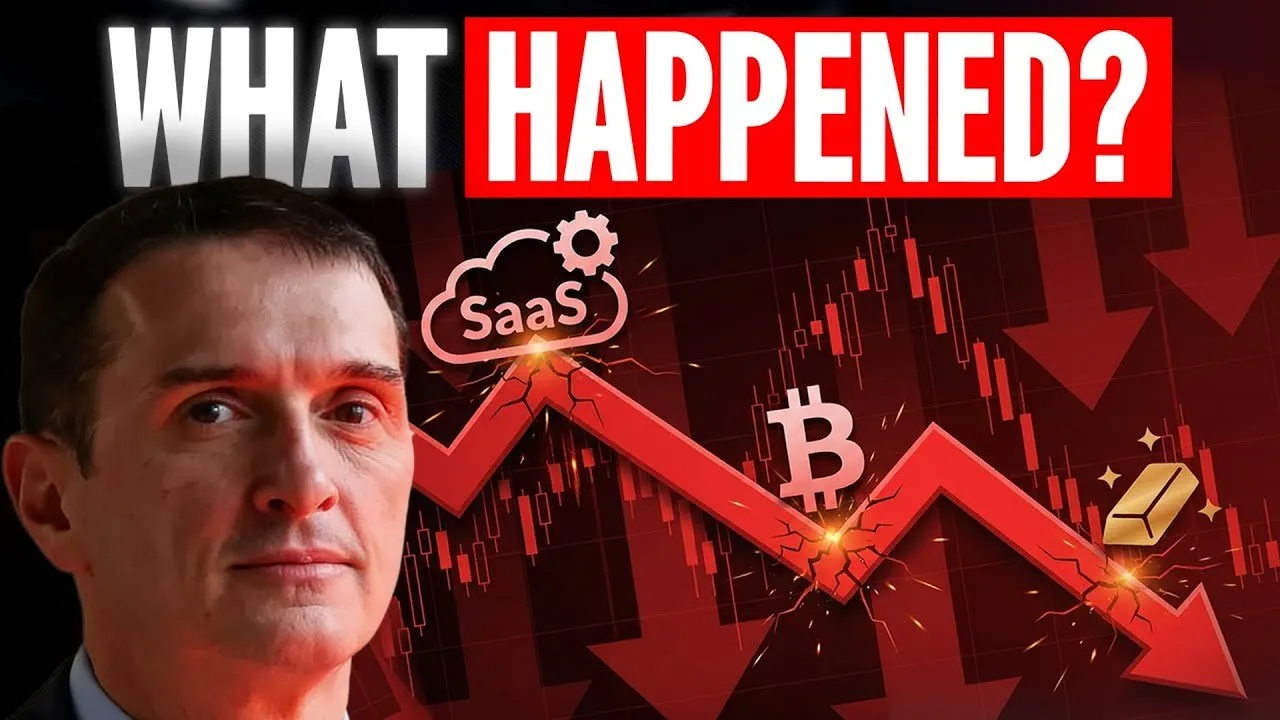
One of the most jarring recent market events has been the aggressive selloff in software-as-a-service (SaaS) stocks. Critics have dubbed this the "SaaSpocalypse," a fear-driven reaction to the realization that Artificial Intelligence is no longer just a feature that makes software better—it is a substitute that makes software creation nearly free.
Jim Bianco argues that the legacy pricing models of companies like Salesforce or Microsoft are under attack. These companies charge businesses on a "per seat" basis, a model justified by the immense cost of human capital required to build and maintain complex software. However, AI is collapsing that cost basis.
The Cursor Experiment
Bianco highlights a recent experiment by the company Cursor to illustrate this shift. Developers fed a prompt into an AI model describing the functionality of Google Chrome. In roughly a week, the AI produced 3 million lines of code and a functional browser for a token cost of roughly $150,000. Previously, such a feat would have required hundreds of engineers, tens of millions of dollars, and over a year of development.
"The cost of producing software in the future is collapsing towards zero... Their pricing mechanism is going to have to change."
This deflationary pressure means startups can now replicate the functionality of legacy giants for a fraction of the cost. While companies won't switch away from established platforms overnight, the long-term threat to high-margin SaaS valuations is real. Interestingly, because crypto is fundamentally "programmable money"—effectively software—it has been swept up in this same repricing dynamic.
Echoes of 1999: The Infrastructure Bubble
The current massive capital expenditure (CapEx) by hyperscalers like Google, Amazon, and Microsoft has spooked investors. Google alone announced plans to spend $200 billion on CapEx in 2026—a figure larger than the entire Russian military budget. Markets are fearful that this spending will lead to massive overcapacity.
Bianco draws a parallel to the internet bubble of 1999. During that era, the market overinvested in infrastructure—laying fiber optic cables and building routers (Cisco). This eventually led to a crash where the NASDAQ fell 77%. However, that "bubble" left behind the essential rails that allowed the modern internet to exist.
Waiting for the App Layer
Just as the 1999 crash paved the way for the "App Layer" (companies like Uber, Facebook, and Netflix) to emerge years later, the current AI spend is building the foundation for future applications. Currently, investors are crowding into infrastructure plays like NVIDIA because the "App Layer" of AI does not exist yet. The companies that will utilize this cheap infrastructure to revolutionize the economy are likely still being conceived in dorm rooms today.
For investors, this presents a timing challenge. While the infrastructure trade may be overheated, the transformative economic impact of AI is inevitable. The value will eventually accrue to the users—the businesses and consumers who utilize these tools to create new products—rather than just the companies building the chips.
The True Drivers of the Metals and Crypto Volatility
Beyond tech, the markets have seen confusing moves in commodities and digital assets. Gold and silver have seen historic volatility, while crypto experienced one of its worst weeks in years. Bianco identifies a disconnect between what is happening on the surface and the structural causes underneath.
The Asian Bid for Gold
While Western investors often assume they are the center of the financial universe, the recent rally in precious metals appears to be driven almost entirely by Asia. The Chinese economy is facing severe headwinds, particularly in real estate, prompting a flight to safety. Similarly, Japan is grappling with soaring interest rates and currency instability.
Investors in these regions are buying gold and silver as a hedge against systemic risk. The volatility seen in the West is largely a result of "degens" chasing a trend that originated overseas, leading to speculative spikes followed by washouts.
Synthetic Crypto and the Fractional Reserve Problem
The recent 30-40% drop in crypto assets baffled many because, unlike the collapse of FTX or Terra Luna, nothing "broke" on-chain. The protocols functioned perfectly. Bianco attributes the crash to the rise of "Synthetic Bitcoin"—crypto exposure held through TradFi instruments like ETFs, futures, and options.
We have effectively created a fractional reserve system for crypto within traditional finance. Institutions and traders can leverage positions in Bitcoin without ever touching the blockchain. When the market turns, it is these synthetic, leveraged positions that face liquidation, forcing selling pressure that cascades into spot prices.
"We've created a fractional reserve system around Bitcoin... These systems are inherently unstable."
This introduces a new dynamic: crypto volatility is now partly a function of TradFi market structure, not just crypto adoption curves.
Macro Outlook: The Fed and Portfolio Strategy
Looking ahead, the macro environment remains complex. With potential changes in Federal Reserve leadership—specifically the rumors regarding Kevin Warsh—the central bank may shift toward a more fractured, debate-heavy "Supreme Court" style of governance rather than the consensus-driven approach of the past. This could lead to more unpredictable interest rate policies as governors openly dissent.
Adjusting Return Expectations
Bianco warns that the era of "easy" 20% annual returns in the S&P 500 is likely over. He suggests a "4-5-6" framework for the coming years:
- Cash: ~4% returns
- Bonds: ~5% returns
- Stocks: ~6% returns
While these are positive returns, they represent a significant downward adjustment from recent years. The market rotation is favoring value stocks and mid-caps—companies that benefit from lower software costs—over the mega-cap tech growth stocks that have dominated the last decade.
Conclusion: A New Narrative for Crypto
The "institutional adoption" narrative—the idea that BlackRock and the ETFs would send Bitcoin to the moon—has played out. As Bianco notes, relying on permission from traditional finance turns crypto into just another asset class in a casino.
To exit the current winter, the industry needs to pivot back to its roots: replacement. The next bull market will likely be driven not by asking for regulatory clarity, but by building a parallel financial system that renders the old one obsolete. When the focus shifts from price speculation back to building decentralized alternatives that actually work, the real recovery can begin.