Table of Contents
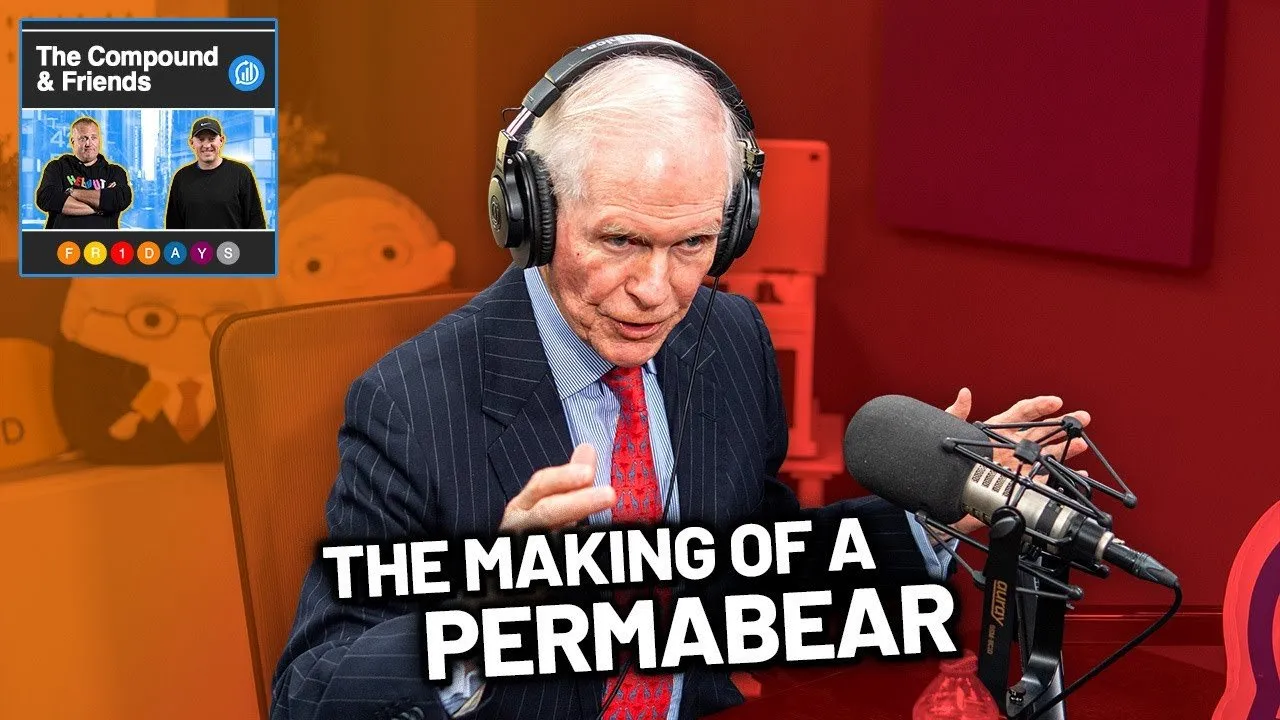
When Jeremy Grantham speaks, the investment world listens—even if they don't always like what they hear. As the co-founder of GMO and a legendary figure in asset management, Grantham has spent six decades studying market history, identifying bubbles, and navigating the treacherous waters of value investing. In a recent appearance on The Compound and Friends, Grantham sat down with Josh Brown and Michael Batnik to discuss his new memoir, The Making of a Perma Bear, and to offer a masterclass on the current state of the global economy.
Grantham’s analysis moves beyond simple stock picking. He weaves together threads of market history, demographic shifts, climate science, and technological breakthroughs to present a complex worldview. While often labeled a pessimist, his latest insights offer a nuanced mix of dire warnings regarding asset prices and surprising optimism for the future of human energy consumption.
Key Takeaways
- The "Perma Bear" Myth: Grantham argues that he isn't permanently bearish, but that rational investors often look that way during extended asset bubbles that detach from trend value.
- The Four-Stage Bull Market: The current cycle, starting in 2009, has morphed through four distinct phases, with the AI revolution interrupting what would have been a standard bear market in 2023.
- AI is a "Magnificent" Bubble: Contrary to popular belief, great bubbles are rarely built on fluff; they are built on transformative technologies (like railroads or the internet) that are temporarily overhyped.
- The End of Mean Reversion: Corporate profit margins have broken historical trends due to increased monopoly power and a lack of antitrust enforcement.
- Demographics and Energy: The long-term future will be defined by a shrinking global workforce and the critical transition to cheap, infinite green energy.
Deconstructing the "Perma Bear" Label
Jeremy Grantham’s new book, The Making of a Perma Bear, co-authored with financial historian Edward Chancellor, addresses his reputation head-on. While the title might seem like a concession to his critics, Grantham views it more as a "middle finger to the industry." The central tension, he explains, is the mismatch between the time horizon of a historian-investor and the average client.
Bull markets frequently push asset prices above their trend value for years at a time. When a cycle extends for over a decade—as the post-2009 run has—anyone pointing out that prices are statistically expensive appears irrational or out of touch.
"The patience and the time horizon of the average investor is extremely short. Whenever you have a long drawn out bull market, it spends several years above trend value... That’s far too long for anyone to imagine anything else other than rising stock prices."
Grantham notes that prices were already in the top 5% of historical valuations by 2010. For a value investor, the market has been "over-normal" for 15 years. The career risk for asset managers in these environments is extreme; pointing out a bubble two years before it bursts often results in getting fired, while riding the bubble over the cliff is often professionally forgiven as "market conditions."
The Four Faces of the Current Bull Market
One of the most compelling insights from the discussion is the categorization of the market cycle that began in 2009. Rather than viewing it as a single, uninterrupted run, Grantham agrees with the assessment that investors have experienced four different bull markets rolled into one continuous timeline:
- The Post-Crisis Bounce: The initial recovery from the Great Financial Crisis lows.
- The Buyback Era: A period defined by corporate stock repurchases shrinking the float, making stocks feel "unsinkable."
- The Stimulus Boom: The COVID-19 era, characterized by direct injections of cash into consumer accounts.
- The AI Capex Frenzy: The current phase, driven by massive capital expenditures in artificial intelligence.
How AI Interrupted the Bear Market
According to Grantham, the bear market of 2022 was proceeding according to historical norms. The "speculative fluff"—led by assets like SPACs and unprofitable tech—had crashed. The S&P 500 was down 25%. In a standard cycle, the market would have continued downward to reset valuations.
However, the introduction of ChatGPT and the subsequent explosion of generative AI changed the psychological and economic landscape almost overnight. Grantham notes that without the AI-driven excitement and the associated capital spending, the economy likely would have slipped into recession. Instead, "animal spirits" were revived.
"Bubbles are absolutely the opposite of crappy ideas that are overhyped. Bubbles are magnificent ideas that are overhyped."
Grantham compares the AI moment to the railway boom of the 19th century. It is a transformative technology that will change the world, but that does not prevent the stocks associated with it from becoming detached from reality in the short term. He points out that while the "Mag 7" stocks soared, the rest of the market remained relatively flat for much of 2023, creating a divergence often seen in the late stages of great bubbles.
The Broken Law of Mean Reversion
For decades, Grantham’s investment philosophy relied heavily on mean reversion—the idea that profit margins and valuations eventually return to historical averages. If margins get too high, competition usually enters the market and drives them down. However, this rule appears to have broken in the 21st century.
Grantham attributes this shift to a fundamental change in capitalism: the rise of unchecked monopoly power. He argues that since the mid-1970s, the U.S. has effectively stopped enforcing antitrust laws with the vigor seen in the early 20th century. This has allowed corporations to grow to sizes where they can acquire potential competitors before they pose a threat.
Furthermore, the political landscape has shifted. Grantham points to Citizens United and the influence of money in politics as factors that have cemented a system favorable to the "rich and powerful." The result is a persistent elevation in corporate profit margins that defies historical gravity, shifting wealth away from labor and toward capital owners.
The Twin Headwinds: Demographics and Climate
Looking beyond the immediate stock market cycle, Grantham identifies two massive, slow-moving forces that will dictate the economic future: population decline and climate change.
The Demographic Ice Age
Grantham highlights startling data regarding global fertility rates. Japan serves as the leading indicator, with its workforce of 20-year-olds currently at 50% of its 1948 peak. This trend is not isolated; China, South Korea, and eventually the Western world are following similar trajectories.
A shrinking workforce creates a deflationary drag on economic growth. Grantham suggests that living in a country with decades of declining population saps the "animal spirits" and risk-taking ability of a culture. When schools close and villages empty out, the optimism required for aggressive capitalist expansion diminishes.
The Cost of Climate Damage
Simultaneously, the physical costs of climate change are moving from theoretical models to balance sheets. Grantham cites estimates suggesting that a significant portion of recent global GDP growth is merely spending to repair or prepare for climate damage—floods, fires, and bad farming conditions. This "defensive spending" registers as growth, but it doesn't improve the standard of living; it merely maintains the status quo against a deteriorating environment.
A Tech-Optimist Conclusion: The Green Energy Revolution
Despite his bearish views on asset prices and demographics, Grantham offers a surprisingly optimistic vision for humanity’s long-term survival. He believes the solution lies in a specific formula: a lower global population combined with infinite, cheap green energy.
He points to rapid advancements in several key technologies:
- Geothermal Energy: Grantham believes the U.S. can transfer its "fracking genius"—the ability to drill laterally through solid rock—to geothermal energy. This could allow access to the earth’s infinite heat reserves almost anywhere, not just in volcanic regions like Iceland.
- Fusion: While historically a moving target, recent progress in nuclear fusion has been exponential. Grantham views it as a probable future energy source.
- Storage and Renewables: The cost of solar, wind, and battery storage continues to plummet, defying conservative estimates year after year.
"If you want to survive as a species in a world where we're living beyond our means, what you need is fewer people... and infinite cheap green energy. And frankly, it sounds like we're getting both."
Grantham’s ultimate message is one of transition. The financial markets may face a reckoning as they adjust to higher interest rates and valuation realities, but the physical world is undergoing a necessary transformation. If the global economy can navigate the friction of a shrinking workforce and the climate crisis, the technological unlock of unlimited clean energy could usher in a sustainable era for civilization.
Conclusion
Jeremy Grantham remains one of the financial industry's most provocative thinkers because he refuses to separate investing from the broader human experience. His "perma bear" label obscures a deep-seated humanitarianism—a desire to see capital used to solve existential threats rather than simply chasing short-term yield. Whether or not his market timing proves correct in the immediate future, his focus on the intersection of demographics, energy, and economic structure offers a roadmap for understanding the turbulent decades ahead.