Table of Contents
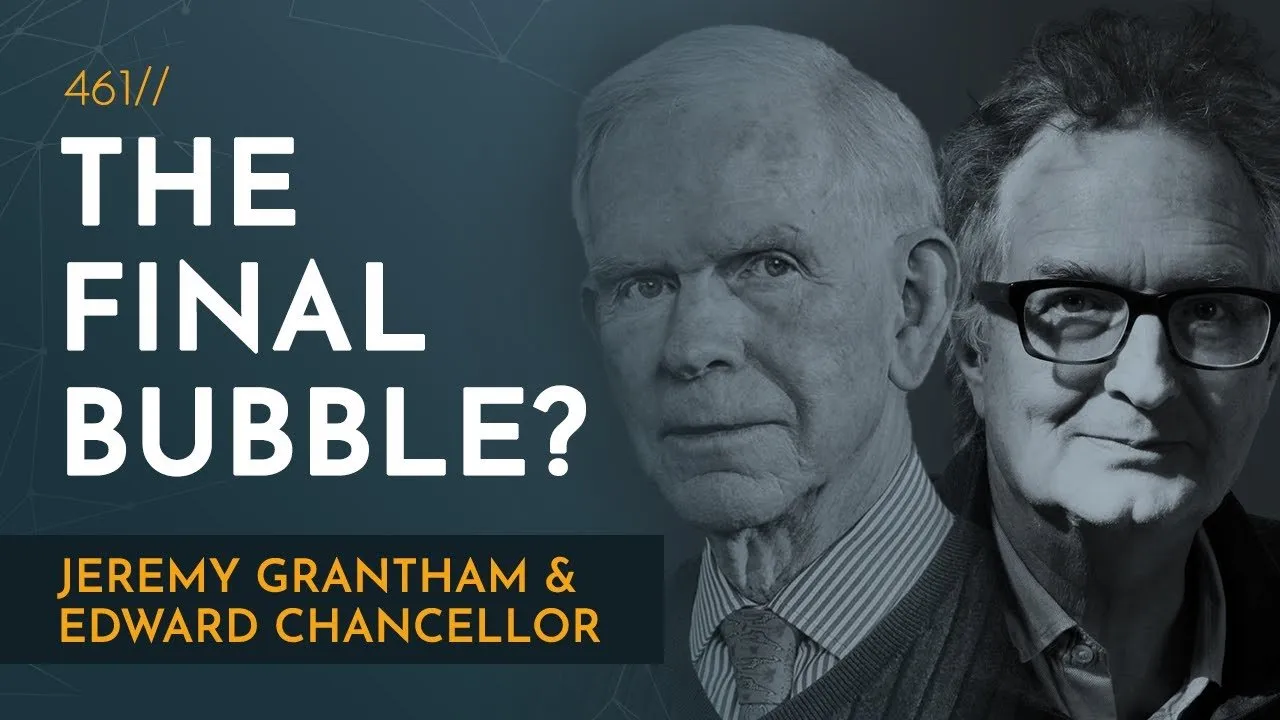
In a financial landscape increasingly dominated by momentum trading and short-term narratives, the voice of historical perspective is often drowned out. Yet, few investors command the respect of Jeremy Grantham, the co-founder of GMO, and Edward Chancellor, a renowned financial historian. In a recent conversation on the Hidden Forces podcast, these two seasoned minds discussed their collaboration on Grantham’s autobiography, The Making of a Perma Bear, and dissected the precarious state of global markets.
Their dialogue bridges six decades of investment experience with deep historical analysis, offering a sobering look at the mechanics of bubbles, the consequences of ultra-low interest rates, and the difficult search for value in a "world on fire." While the mainstream narrative often leans toward optimism, Grantham and Chancellor provide a rigorous, evidence-based counter-narrative that suggests we may be witnessing the final stages of a historic asset bubble.
Key Takeaways
- Mean Reversion is Inevitable: Profit margins and asset prices historically revert to their long-term averages; current high valuations suggest a painful adjustment is overdue.
- The Cost of Easy Money: Decades of asymmetric Federal Reserve policies and artificially low interest rates have encouraged debt accumulation rather than productive growth.
- US Markets are an Outlier: While US equities are trading at near-record premiums, international and emerging markets offer valuations that are far more aligned with historical norms.
- The Housing Market "Freeze": Unlike the 2008 crash, the current US housing market is defined by a lack of turnover due to the gap between legacy low mortgage rates and current high rates.
The Making of a Contrarian
The title of Grantham’s biography, The Making of a Perma Bear, is somewhat tongue-in-cheek. Grantham does not view himself as a pessimist by nature, but rather as a realist operating in a world that is "ludicrously optimistic." His evolution into a value investor was not immediate; it was forged through early, painful experiences with speculation.
In the late 1960s, Grantham experienced the allure of momentum investing firsthand. He invested in "go-go" stocks like American Raceways and Market Monitor—companies with little fundamental value but massive price momentum. While these investments initially doubled, they eventually collapsed, wiping out his savings. This baptism by fire taught him a critical lesson: you can be cynical and aware of a bubble, yet still be destroyed by the speed of its collapse.
The Role of Personal Experience
Edward Chancellor, who acted as the "tailor" to Grantham’s "model" for the book, argues that such losses are essential for the development of a mature investor. No amount of academic theory can replace the visceral experience of losing capital. This transition from speculator to value investor laid the groundwork for Grantham’s philosophy: a relentless focus on replacement cost and fundamental value, regardless of market sentiment.
We all have different currents running inside... Edward decided which of those would be presented to the public. The financial world doesn't really need to hear too much about climate change and toxicity... Ironically, the things for which I became well known, they want to hear about the stock market.
The Iron Law of Mean Reversion
Central to the GMO investment philosophy is the concept of mean reversion. In a functioning capitalist system, abnormally high profits should attract competition, which subsequently drives down returns. Conversely, low returns should repel capital, leading to a supply shortage and eventually higher returns. This "eb and flow" is the heartbeat of healthy markets.
However, Grantham notes that this mechanism has faced headwinds in the 21st century. Since 2000, the "monopoly factor" has grown significantly. Large US corporations have managed to maintain high profit margins not through innovation alone, but through market concentration and protective moats. This has allowed high-quality companies to outperform for longer than historical models would predict, creating a "loophole" in the efficient market hypothesis.
Despite this, Grantham maintains that gravity cannot be defied forever. When asset prices detach significantly from their replacement cost—as they have in the current US market—the forces of regression eventually take hold. The higher the valuation climbs above the mean, the more severe the eventual correction.
The Trap of Ultra-Low Interest Rates
Edward Chancellor’s recent work, The Price of Time, complements Grantham’s views by focusing on the monetary roots of asset bubbles. History shows a consistent confluence between easy money and speculative manias, from the Dutch Tulip mania of the 1630s to the post-pandemic meme stock boom.
The Federal Reserve’s policy since the Greenspan era has been characterized by asymmetry: bail out the market during busts, but let it run wild during booms. This "Fed Put" encouraged a massive accumulation of debt. Grantham points out that while debt-to-GDP tripled over the last 40 years, economic growth actually slowed. The assumption that more debt equals faster growth has proven false.
Bernanke thinks he's got a racehorse, but he's got a donkey and he's going to keep whipping that donkey until it either turns into a racehorse or drops dead.
The result of these policies is a financial system addicted to liquidity. Even as interest rates have normalized recently, the system remains awash in the liquidity injected during the pandemic, keeping asset prices elevated despite deteriorating fundamentals.
The Housing Market Anomaly
A puzzling aspect of the current economic cycle is the resilience of US housing prices despite a sharp rise in mortgage rates. In a typical mean-reversion scenario, a tripling of mortgage rates should crush home values. Grantham explains that the US market is currently in a state of paralysis rather than a crash.
The Lock-In Effect
Homeowners who locked in 30-year mortgages at 2.7% cannot afford to sell and buy a new home at 6.9%. This brutal spread has frozen inventory, artificially supporting prices because there is no supply. This contrasts with markets like the UK or Australia, where variable-rate mortgages transfer the pain of rate hikes to homeowners much faster, leading to softer prices.
However, this is not a permanent victory for bullishness. It simply delays the inevitable. The lack of turnover eventually grinds down the market, and overbuilding—though less severe this cycle than in 2008—remains a risk factor in specific regions.
Finding Value in an Overpriced World
For investors, the most pressing question is where to hide. Cash faces the threat of inflation and financial repression. Gold has historically been a store of value but has developed its own bubble-like characteristics. Grantham’s solution is geographic diversification.
The "bubble" is primarily a US phenomenon. The valuation gap between US equities and the rest of the world has reached historic extremes. Grantham advocates for a decisive shift away from the S&P 500 toward international value stocks and emerging markets.
- International Value: Non-US developed markets trade at significantly lower multiples, offering a margin of safety that American tech giants do not.
- Emerging Markets: Despite geopolitical risks, emerging markets are priced for disaster, which paradoxically makes them safer from a valuation standpoint.
- Deep Value Strategy: Returns over the next decade will likely come from dividends and multiple expansion in cheap markets, rather than the continued growth of already expensive US mega-caps.
Conclusion
The collaboration between Jeremy Grantham and Edward Chancellor serves as a reminder that "this time is different" are the four most dangerous words in finance. While government intervention and monopolistic trends can delay mean reversion, they cannot repeal the laws of economics. The current environment, characterized by record valuations and debt, demands caution.
For the prudent investor, the path forward involves challenging consensus narratives. It requires the discipline to look past the excitement of US tech stocks and find value in unloved corners of the global market. As Grantham’s career demonstrates, looking foolish in the short term is often the price paid for long-term survival and success.
![Bitcoin Is on Sale [How to Buy It in 2026]](/content/images/size/w1304/format/webp/2026/03/how-to-buy-bitcoin-2026.jpg)