Table of Contents
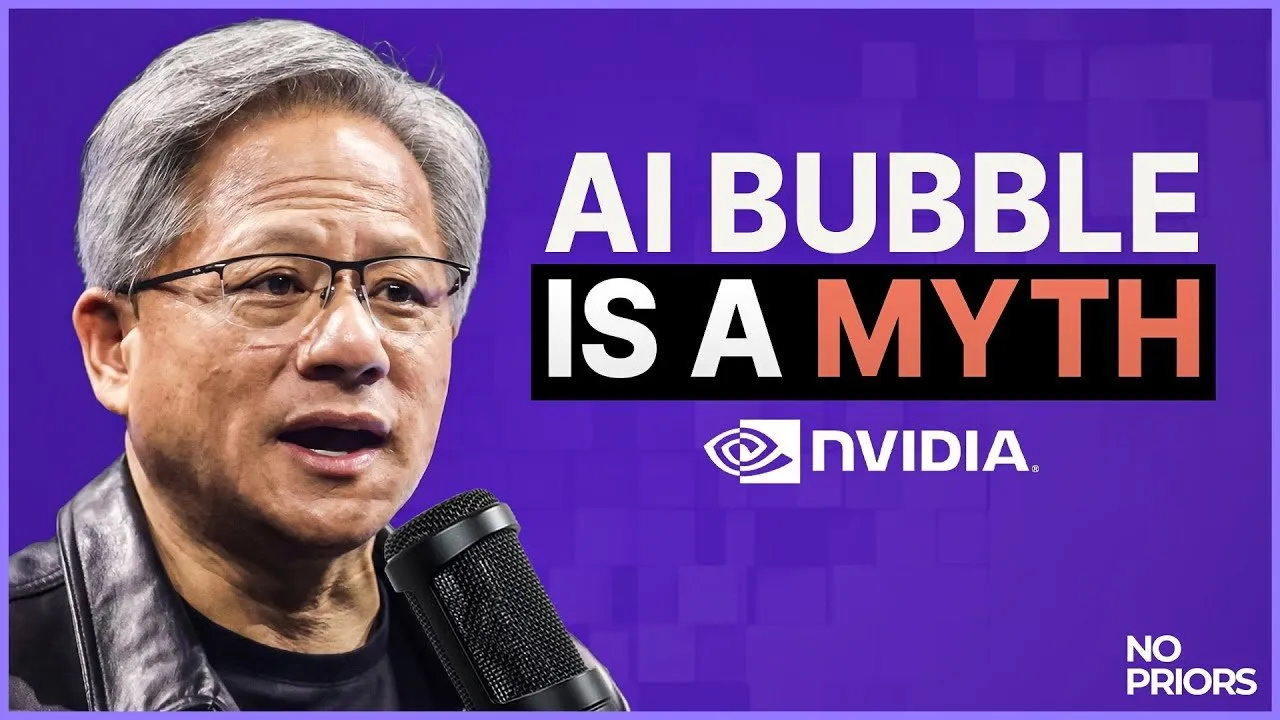
As the CEO of NVIDIA, Jensen Huang sits at the epicenter of the artificial intelligence revolution. His perspective offers a unique vantage point on the industry's trajectory, moving beyond the daily volatility of stock prices and hype cycles to focus on fundamental shifts in computing. In a wide-ranging discussion with the No Priors podcast, Huang offered a grounded yet highly optimistic outlook for 2025 and beyond.
Reflecting on a pivotal year, Huang dismisses the idea that the industry is hitting a wall. Instead, he points to the rapid evolution from simple chatbot interactions to complex reasoning models, the emergence of "physical AI" in robotics, and a fundamental re-architecture of the global computing stack. While critics worry about bubbles and energy consumption, Huang argues that we are witnessing the birth of a new industrial sector: the AI factory.
Key Takeaways
- Task vs. Purpose: AI automates tasks, not necessarily jobs. By decoupling specific duties (like coding or reading scans) from the broader purpose of a profession (solving problems or diagnosing disease), productivity and demand actually increase.
- The End of the "AI Bubble" Narrative: Huang argues that the massive infrastructure build-out is not speculative but a necessary transition from general-purpose computing (CPUs) to accelerated computing (GPUs) required to process the world's data.
- The Rise of Physical AI: We are transitioning from digital intelligence to embodied intelligence. Huang predicts that "everything that moves will eventually be robotic," driven by end-to-end reasoning models.
- Digital Biology’s Moment: The convergence of generative AI and biological data is creating a "ChatGPT moment" for science, where we move from understanding proteins to generating new biological structures.
- Strategic Open Source: Restricting open-source AI to thwart adversaries is counterproductive. Open innovation is the lifeblood of US startups, healthcare, and industrial applications.
Redefining Employment: The "Task vs. Purpose" Framework
One of the most persistent anxieties surrounding AI is the fear of mass unemployment. Huang reframes this debate by distinguishing between the tasks a worker performs and the purpose of their job. When technology automates a task, it rarely eliminates the need for the human; instead, it expands their capacity to fulfill their purpose.
Huang cites the example of radiology. Years ago, experts predicted that AI would make radiologists obsolete because machines could read scans faster than humans. Today, AI powers 100% of radiology applications, yet the demand for radiologists has never been higher.
"The task is to study scans, but the purpose is to diagnose disease and to research... The fact that they're able to study more scans more deeply, do a better job diagnosing disease, the hospital's more productive, they can have more patients."
This dynamic applies equally to software engineering. While tools like Cursor allow engineers to generate code rapidly, "coding" is merely a task. The purpose of an engineer is to solve problems. By automating the syntax generation, engineers can tackle more complex, undiscovered problems, ultimately creating more value and demand for their skills.
Refuting the "AI Bubble" and the Infrastructure Boom
Skeptics often point to the gap between massive infrastructure spending and current software revenue as evidence of a bubble. Huang counters this by explaining that we are not merely building servers for chatbots; we are fundamentally replacing the world's computing infrastructure.
The Shift to Accelerated Computing
For decades, the world relied on general-purpose computing (CPUs). However, with Moore’s Law slowing down, CPUs can no longer keep up with the data processing demands of modern software. The shift to accelerated computing is essential regardless of the specific success of any single AI application. This transition spans industries from financial services (quants) to self-driving cars and digital biology.
Huang describes the new data centers not as server rooms, but as AI Factories. These facilities accept raw data and electricity as inputs and produce "intelligence tokens" as outputs. Just as the industrial revolution required new power plants, the AI revolution requires these new factories.
"If generative AI... if none of that existed today, NVIDIA would be a multi-hundred billion dollar company... because the foundation of computing is shifting to accelerated computing."
Inference and Profitability
A critical development in the last year has been the profitability of inference (running the models). Companies like Open Evidence and Cursor are generating tokens that provide high enough value that customers are willing to pay significant margins. This proves that AI is moving from a "training cost" center to a revenue-generating utility.
The Next Frontier: Reasoning, Robotics, and Biology
Looking toward 2026, Huang identifies three major vectors of innovation: reasoning models, robotics (Physical AI), and digital biology.
From Perception to Reasoning in Robotics
The first generation of self-driving cars relied on a brittle stack of smart sensors, mapping, and human-coded rules. The industry is now moving toward end-to-end models that utilize reasoning. Rather than following a script, these systems can assess a novel situation, reason through a solution, and execute a plan.
This breakthrough is not limited to humanoids or cars. Huang envisions a future where AI is embodied in everything from excavators to manufacturing arms. The constraint isn't the hardware, but the intelligence to navigate the physical world—a gap that is closing rapidly.
The ChatGPT Moment for Biology
Perhaps the most profound impact will occur in digital biology. We are moving from simply understanding biological languages (proteins, amino acids) to generating them. Foundation models for cells and proteins will allow scientists to simulate and design interactions in silico before entering the wet lab.
"The ChatGPT moment, the generative AI moment... is coming together for digital biology."
Geopolitics and the Strategic Value of Open Source
In the context of US-China relations, Huang advocates for a nuanced approach that protects national security without suffocating innovation. He introduces the concept of the "5-Layer Cake" of the AI stack:
- Energy
- Chips
- Infrastructure (Hardware/Software)
- Models
- Applications
While protecting the very top of the stack (frontier models) or the bottom (advanced chips) might make strategic sense, Huang argues that open-source models are essential for the middle layers. Restricting open source hurts American startups, universities, and industries that rely on these tools to innovate. He points to the recent success of Chinese models like DeepSeek as evidence that innovation is global, and that the US ecosystem benefits from studying and building upon global advancements.
"Whatever you decide, whatever you do, don't forget open source... Without open source, some of 100-year-old companies that I work with in industrial spaces, in healthcare spaces, they would be suffocated."
Energy and the Optimist’s View
Finally, Huang addresses the energy constraints facing the AI industry. Rather than viewing high energy consumption as a roadblock, he views the immense demand for power as a catalyst for green energy innovation. The need for AI factories is driving investment in solar, nuclear, and battery technology at a scale that policy alone could never achieve.
Huang concludes that the "doomer" narratives—whether regarding energy, jobs, or "God AI" taking over—are ultimately unhelpful distractions. Practical, evidence-based optimism is what drives humanity forward.
Conclusion
The coming years will likely be defined by the integration of AI into the physical world and the biological sciences. For NVIDIA, the goal isn't to wait for a mythical AGI, but to power the immediate, practical revolution happening in industries ranging from healthcare to heavy manufacturing. As Huang puts it, optimists aren't naive; they are simply the ones willing to build the technology that solves the problems pessimists fear.