Table of Contents
The tech landscape has kicked off 2026 with a decisive shift in momentum. After years of the "stay private longer" mantra dominating Silicon Valley, the IPO window has swung wide open, signaling a return to liquidity and public market scrutiny. Simultaneously, the consumer electronics world has gathered in Las Vegas for CES, showcasing a future where robotics and autonomous systems are finally transitioning from prototypes to mass production. From Discord’s confidential filing to Nvidia’s bid to become the operating system of the automotive world, the industry is entering a mature phase of deployment and capitalization.
Key Takeaways
- The IPO Market Thaws: Major US tech players like Discord and Strava have filed confidentially to go public, while Chinese AI startups are aggressively listing in Hong Kong.
- Anthropic’s Valuation Soars: The AI safety startup is reportedly raising capital at a $350 billion valuation, signaling that foundational model costs have scaled beyond traditional venture capital capacities.
- Nvidia’s "Android Moment" for Cars: Nvidia launched an open-source autonomous driving stack, aiming to provide a universal platform for OEMs to compete with proprietary systems like Tesla’s.
- Robotics Enter Mass Production: CES 2026 highlighted that manufacturing giants like Hyundai (Boston Dynamics) and LG are preparing to scale humanoid and household robots to millions of units.
- Cross-Border Deal Tension: Meta’s acquisition of Manus has sparked regulatory friction with China, highlighting the continued complexities of cross-border tech M&A.
The IPO Resurgence: Discord, Strava, and Hong Kong
For the past few years, the prevailing wisdom in Silicon Valley was to avoid the public markets until absolutely necessary. However, the first week of 2026 has brought a distinct change in the weather. Two major US consumer technology companies, Discord and Strava, have filed confidentially to go public, marking a significant psychological turn for late-stage investors.
Discord and the Quest for Monetization
Discord, the communication platform that evolved from a gaming chat service to a digital "third place" for 200 million monthly active users, is finally moving toward an exit. This comes years after rejecting a $10-$12 billion acquisition offer from Microsoft. While secondary trading suggests the company’s valuation has corrected from its 2021 highs—settling closer to $7-8 billion—the business fundamentals remain robust.
The challenge for Discord moving forward will be demonstrating growth outside of its core user base. Having sat at roughly 200 million users for some time, the company has aggressively pivoted toward monetization, introducing new advertising formats and "Orbs," a virtual currency system. The move mirrors Reddit’s successful transition to public markets, where data licensing and advertising fueled post-IPO performance.
Strava and the Power of Data Lock-In
Strava, the fitness tracking platform, represents a different kind of public offering. Profitable and growing at over 50% year-over-year, Strava relies heavily on subscription revenue rather than advertising. Its strength lies in data lock-in; for millions of athletes, Strava holds a decade of performance history that makes switching costs prohibitively high.
The upcoming IPO will likely spur consolidation in the health-tech sector. As Strava gains a public currency, it will be well-positioned to acquire smaller, specialized players in the fitness tracking space, potentially rolling up the fragmented market of sleep trackers, weightlifting apps, and biometric monitoring.
The Asian Market Strategy
While US companies aim for massive scale before listing, the Hong Kong market is witnessing a flurry of activity from earlier-stage AI companies. Zhipu AI and MiniMax, two of China’s leading AI startups, went public this week with valuations in the $6-7 billion range. Despite revenue figures under $100 million, these listings provide public investors access to high-growth, high-risk assets—a dynamic that is currently missing from the US market, where companies often wait until they hit billions in revenue to list.
The AI Capital Arms Race
In the private markets, the capital requirements for foundational AI models continue to defy historical norms. Anthropic is reportedly closing a new funding round that values the company at $350 billion, raising an additional $10 billion from sovereign wealth funds like GIC and firms like Coatue.
While the headline numbers appear staggering, the valuation reflects the sheer scale of revenue growth in the AI sector. Investors are effectively betting that Anthropic can maintain its trajectory, moving from a multi-billion dollar run rate to becoming a central pillar of the global software economy.
"We seem to have scaled past what VCs can afford to put up themselves... But frankly for any company growing this fast, paying 35x current run rate is just not crazy."
This round underscores a shift in the venture landscape: the "voting machine" of private valuations is beginning to merge with the "weighing machine" of public market metrics. As these companies mature, they are being judged less on pure hype and more on the quality of their earnings and the sustainability of their massive infrastructure spend.
The Future of Autonomy: Nvidia’s Power Play
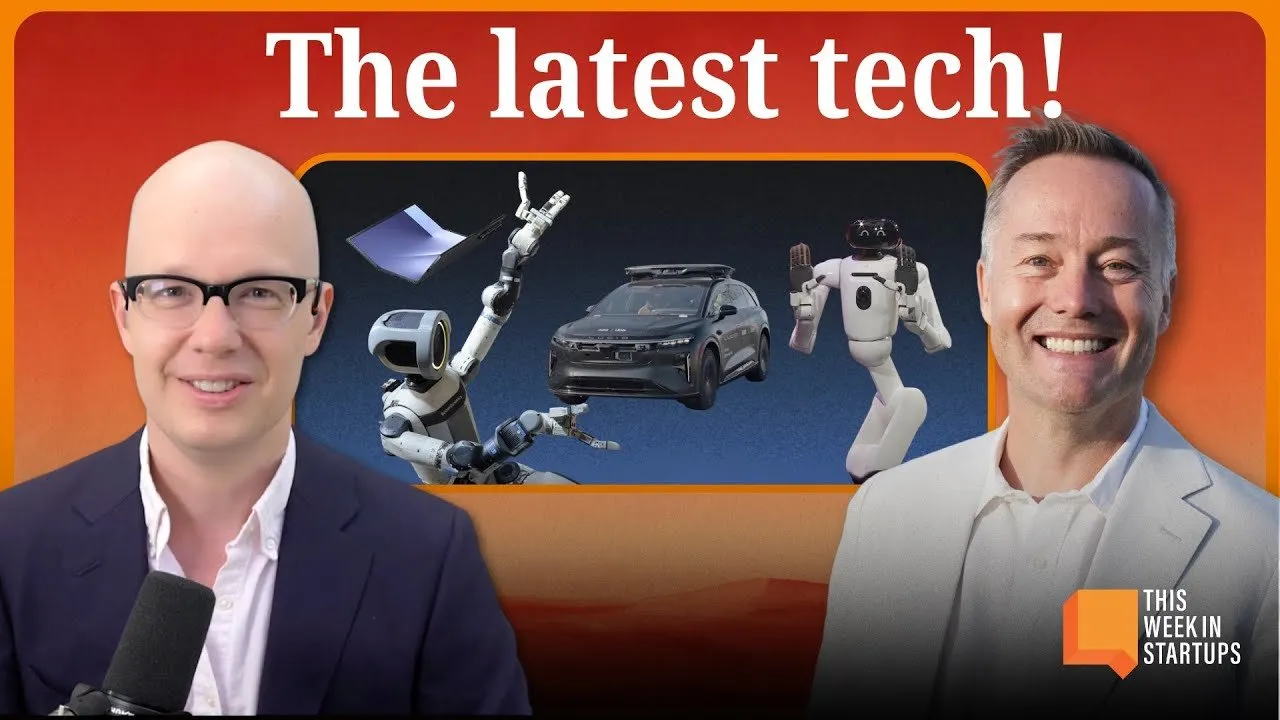
One of the most significant announcements at CES 2026 was Nvidia’s strategic move to open-source its end-to-end autonomous driving stack. By offering a complete solution—chips, sensors, and software—to any automaker, Nvidia is effectively positioning itself as the "Android" of self-driving cars, offering a counterweight to vertically integrated "iOS" competitors like Tesla and Waymo.
Democratizing Self-Driving Tech
This move allows legacy automakers (OEMs) to bypass the decade of R&D required to build proprietary autonomous systems. Manufacturers like Mercedes-Benz can now integrate Nvidia’s "Drive Hyperion" ecosystem, enabling supervised self-driving capabilities that rival the industry leaders. This dramatically lowers the barrier to entry and accelerates the commoditization of autonomy.
The Nuro and Lucid Partnership
We are also seeing the segmentation of the robotaxi market. Nuro has partnered with luxury EV maker Lucid and Uber to deploy autonomous fleets using the Lucid Gravity SUV. This signals a tiered approach to autonomous transport:
- Premium Tier: Nuro/Lucid offering a "Uber Black" experience.
- Standard Tier: Waymo and Tesla Robotaxis serving the mass market.
- Economy Tier: Zoox and shared autonomous shuttles.
CES 2026 Highlights: Robotics and Gadgets
Beyond the headline announcements, CES 2026 offered a glimpse into the hardware that will define the latter half of the decade. The clear trend is that robotics is moving from "research project" to "consumer product."
Industrial and Home Robotics
The standout demonstration came from Boston Dynamics, now majority-owned by Hyundai. Their latest humanoid robot features extensive integration with Large Language Models (LLMs), allowing it to interpret complex commands. Crucially, Hyundai’s expertise in mass manufacturing suggests these robots could eventually see their price points drop to between $10,000 and $20,000, making them viable for widespread industrial and eventually domestic use.
On the consumer side, LG debuted "CLOi," a legless household robot designed for chores like laundry and dishwashing. While still slow compared to humans, the removal of legs solves balance and battery density issues, making it a practical first step toward home automation.
"These companies will have no problem making hundreds of thousands of these and eventually millions. So if people want them, they'll get these down to $5,000 to $10,000 eventually."
The Form Factor Dilemma
In the mobile sector, hardware continues to outpace software. Samsung revealed a "Tri-Fold" Galaxy device that unfolds into a full-sized tablet. However, the recurring theme with foldable devices remains the lack of "killer apps." Until developers utilize the unique screen real estate for distinct workflows—such as separating AI assistants from active tasks—these devices remain niche luxuries rather than essential tools.
Conclusion
As we settle into 2026, the technology sector is characterized by execution. The theoretical promise of AI and autonomy is hardening into deployable products and investable public companies. With M&A activity rebounding and the IPO market thawing, the next 24 months promise to be a period of significant liquidity and rapid physical deployment of the technologies that were merely concepts just a few years ago.
![URGENT: This Next Market Rotation Will Go Parabolic! [& It’ll Be Quick]](/content/images/size/w1304/format/webp/2026/03/market-rotation-parabolic-shift-forecast.jpg)