Table of Contents
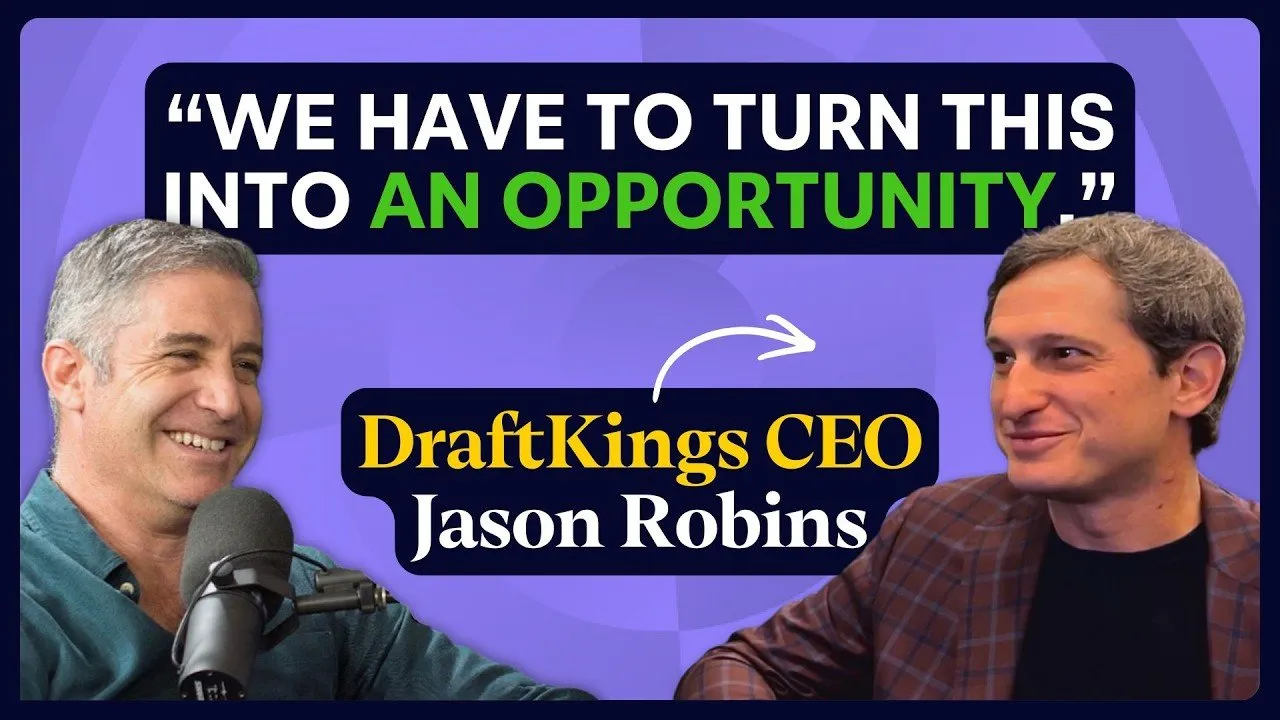
When Jason Robins co-founded DraftKings, it was a daily fantasy sports operation run by three friends. Today, it stands as a titan in the sports betting industry with a market cap exceeding $13 billion. The journey from a "garage startup" to a ubiquitous household name required more than just understanding sports; it demanded a relentless focus on data, a willingness to pivot, and the foresight to navigate a complex regulatory landscape.
In a recent conversation on Masters of Scale with Jeff Berman, Robins opened up about the company's strategic playbook. From the high-stakes pressure of Super Bowl week to the ethical implementation of AI in responsible gaming, Robins provided a rare look under the hood of a company operating at the intersection of technology, entertainment, and regulation.
Key Takeaways
- Live Betting is the New Frontier: DraftKings is shifting its Super Bowl strategy from pre-game customer acquisition to driving in-game engagement through improved live betting products.
- AI as a Safety Net: The company is leveraging artificial intelligence not just for odds-making, but to analyze customer behavior patterns and flag potential problem gaming earlier than human teams could alone.
- Prediction Market Ethics: While prediction markets represent a growth opportunity, Robins argues for regulatory guardrails against "negative" bets, such as wagering on player injuries or political instability.
- Talent Over Ideas: For startup founders, Robins insists that the initial core team is more critical than the idea itself, as early hires set the cultural foundation for all future scaling.
- Future-Proofing Careers: Professionals entering the workforce must learn to "manage teams of AI" to remain competitive in a rapidly evolving economy.
The Super Bowl Strategy: Art, Science, and Live Betting
For a company like DraftKings, the Super Bowl isn't just a sporting event; it is the single most critical business day of the year. The volume of activity during this week dwarfs any other single event, serving as a massive funnel for acquiring new customers who, ideally, stick around for the NBA playoffs and March Madness.
However, the company’s approach to the Big Game has evolved. After taking a hiatus from Super Bowl television advertising for two years, DraftKings returned to the airwaves, driven by a partnership with NBC and a strategic pivot in their product focus. While previous years focused heavily on pre-game hype, the current strategy leans into the real-time excitement of the game itself.
"This year though we have made so many great upgrades to a live betting product that we're really going to try to... take a shot at getting some live betting activation. So that's really what the campaign will be about this year."
Robins acknowledges that marketing on this scale is often more art than science. Despite having access to mountains of data, predicting which creative concepts will resonate with a national audience remains elusive. He notes that the campaigns he is initially skeptical of often perform the best, teaching him to trust his CMO and the data over his own gut instincts regarding creative direction.
Leveraging AI for Responsible Gaming
As sports betting becomes more accessible through mobile apps and live integrations, the industry faces scrutiny regarding addiction and financial risk. Robins emphasizes that DraftKings views responsible gaming not just as a regulatory hurdle, but as a core component of a sustainable business model. The goal is to keep customers playing for entertainment within their means, rather than burning out through financial distress.
To achieve this, DraftKings has appointed a Chief Responsible Gaming Officer and is deploying artificial intelligence to monitor user health. While critics often worry AI will be used to induce more spending, Robins argues its most powerful application is in protection.
Pattern Recognition at Scale
Human teams cannot manually review every interaction for millions of users. AI, however, can analyze a customer's behavior across disparate touchpoints—marketing responses, customer service tickets, and betting patterns—to identify distress signals that might otherwise go unnoticed.
"It allows you to look at all forms... it takes all the communications, and there's so many of them... and find any sorts of patterns that we may want to look into. And then we have a dedicated team of people that can review those things."
By flagging these patterns early, the company can intervene with tools that allow users to set strict limits on deposits, wagers, and time spent on the app, moving the industry toward a more proactive stance on player safety.
The Rise of Prediction Markets and Regulatory Guardrails
The sports betting landscape changed fundamentally in 2018 when the Supreme Court lifted the federal ban on online gambling. Since then, the market has evolved rapidly, with "prediction markets" emerging as a new frontier. These markets allow users to bet on outcomes beyond sports, such as elections or economic indicators.
While Robins views prediction markets as an opportunity to expand into states like California and Texas—where traditional sports betting remains illegal—he calls for caution. He advocates for a regulatory framework that prevents "negative" wagering.
Defining the Boundaries
Robins argues that while the industry should innovate, there are moral lines that should not be crossed. He specifically cites bets on player injuries or geopolitical instability as areas that invite manipulation and ethical hazards.
"I think things that could very very easily be manipulated we should be cautious with... or things that are just like negative. Like, will this player get injured? I don't view it as the right thing for the industry."
He suggests that the best regulation comes from collaboration between the industry and lawmakers. Regulators often lack the technical nuance of the market, while companies left unchecked might veer into the "wild west." A cooperative approach ensures guardrails are set reasonably without stifling innovation.
Innovation and the Startup Mindset
DraftKings has successfully transitioned from a daily fantasy platform to a mobile betting giant, a pivot Robins attributes to a culture of calculated risk-taking. Drawing parallels to Google’s evolution beyond search, he notes that technology companies that fail to invest in the "next thing" are destined to be disrupted.
This forward-looking philosophy drove DraftKings to be "mobile-first" when competitors were still focused on desktop experiences. Today, that same philosophy is driving their investment in prediction markets and AI.
Advice for Founders
Reflecting on his days starting the company in a spare room, Robins offers distinct advice for today’s entrepreneurs. He believes that the quality of the initial team is far more predictive of success than the quality of the initial idea.
"Three people can't build a company... If you get that [initial] group right, that will be everything because those are the people that then are going to hire the next concentric circle of people."
For young professionals entering the workforce, his advice is equally pragmatic: become indispensable by mastering AI. Regardless of the role—whether in engineering, sales, or marketing—the ability to utilize AI to multiply output is the skill set of the future. Robins envisions a workforce where individuals are not just doing the work, but "managing teams of AI" to execute tasks with unprecedented speed and efficiency.
Conclusion
As DraftKings continues to navigate the complexities of state-by-state legalization—particularly the gridlock in massive markets like California—Jason Robins remains focused on the long game. By balancing aggressive product innovation with a commitment to responsible gaming and regulatory collaboration, DraftKings aims to secure its position not just as a market leader, but as a sustainable pillar of the sports entertainment ecosystem.