Table of Contents
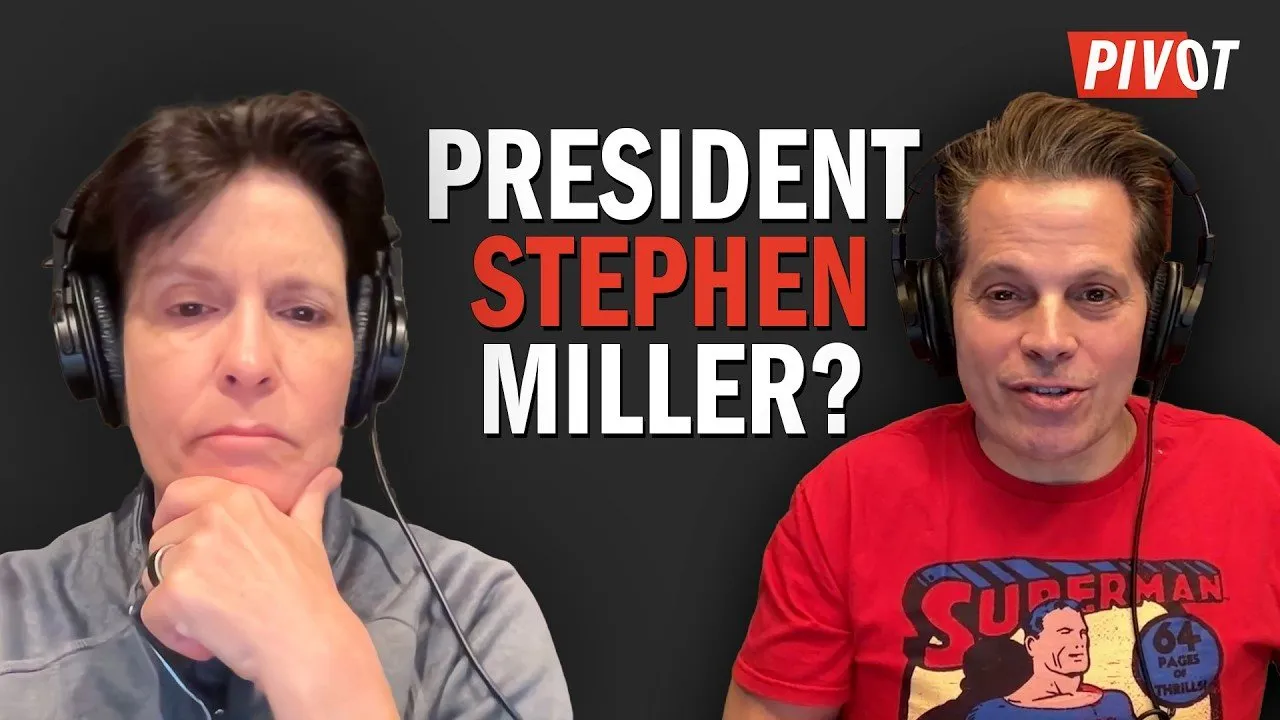
When the President of the United States operates on a managed schedule of only five hours a day, a terrifying question arises: Who is running the country during the other nineteen? In a fiery discussion on Pivot, Kara Swisher and Anthony Scaramucci dissect the current state of the White House, arguing that a dangerous power vacuum has allowed unelected ideologues to seize control of the executive branch.
From the tragic escalation of violence in Minnesota to the "neutering" of TikTok, the symptoms of a chaotic administration are rippling through the economy and the culture. Scaramucci, offering his unique insider perspective, suggests that while corporate America cowers in fear of retribution, the machinery of the state is being piloted by extremists who lack the political instincts to realize when they have gone too far.
Key Takeaways
- The Stephen Miller Theory: With Donald Trump’s health and schedule reportedly in decline, Scaramucci argues that Stephen Miller has effectively become the acting president for policy and immigration enforcement.
- The "Kent State" Moment: The administration’s attempt to stage a culture war victory in Minnesota backfired, resulting in tragedy and a massive shift in public sentiment similar to the 1970 Kent State shootings.
- Corporate Cowardice: Business leaders are failing to coordinate against authoritarian overreach, opting for individual appeasement strategies that history suggests are doomed to fail.
- The Capital Boycott: Instability and the erosion of the rule of law are causing global investors to look away from US markets, threatening the dollar's long-term dominance.
The Minnesota Tragedy: A Culture War Backfired
The recent violence in Minneapolis, involving the shooting of citizens by federal agents, was not an accident of policy—it was a calculated media strategy that went horribly wrong. According to Scaramucci, the administration intended to use Minnesota as a stage to demonstrate a "tough on crime" narrative, specifically targeting a blue state to energize their base. The goal was to dominate a news cycle with imagery of federal agents suppressing alleged fraud and corruption.
However, the execution of this strategy resulted in the death of Alex Preddy and Renee Good, turning a political stunt into a genuine crisis. Scaramucci compares this pivot point to the Kent State shootings, a historical moment where the use of force against citizens caused a sudden and irreversible flip in the political landscape.
They wanted a Fox News day of programming where the day is set from the A block for 12 hours... defending the republic against fraud. They are tone deaf to the overall optics and then they created a Kent State-like moment.
While Trump may lack empathy, he possesses a survivalist’s instinct for public opinion. The footage coming out of Minnesota was visceral enough to panic the White House, forcing them to walk back their aggression. Yet, the incident revealed a deeper issue: the disconnect between the President’s political needs and the ideological zealotry of those executing his orders.
The Power Vacuum: Is Stephen Miller the De Facto President?
Reports regarding Donald Trump's health suggest a President who is physically unwell and managing a rapidly shrinking schedule. Scaramucci notes that if the President is only "present" and managed from 12:00 PM to 5:00 PM, a massive void exists in the executive branch. This vacuum is not remaining empty; it is being filled by Stephen Miller.
The danger, as outlined in the discussion, is that while Trump is driven by narcissism and self-preservation, Miller is driven by ideology. Trump might look at a botched raid and worry about his polling numbers; Miller looks at the same event through the lens of a crusade. This divergence makes the administration unpredictable and dangerous.
If he’s only got five hours a day where he’s present, the other 19 hours are going to Stephen Miller... Miller is writing the policy. Stephen Miller is talking to ICE. Stephen Miller is on the phone with Marco Rubio.
Scaramucci describes Miller as an "evil" force who could not gain Senate confirmation for a minor role in a normal administration, yet is now running roughshod over the republic because of the President's declining capacity. This effectively places the immense powers of the US federal government in the hands of an unelected official with no check on his authority.
The Failure of Corporate Leadership
One of the most critical failures identified in the current crisis is the silence of the American business community. While 60 CEOs in Minnesota finally signed a letter calling for de-escalation, the broader reaction from the Fortune 100 has been one of submission. Executives are terrified of individual retribution—regulatory harassment, DOJ investigations, or loss of federal contracts.
The Silo Effect
Business leaders are operating in silos, asking their boards for advice on how to survive the next 1,000 days of the Trump administration. The standard legal and board advice is to "duck" or negotiate. Scaramucci argues this is a fatal strategic error comparable to Neville Chamberlain’s appeasement of Hitler at Munich. By refusing to coordinate, CEOs allow the administration to pick them off one by one.
If the leaders of the top US law firms and the Fortune 50 coordinated their response, they would possess enough economic and political leverage to check the administration's worst impulses. Instead, the chilling effect is absolute. Even powerful figures like Jamie Dimon face threats of massive personal and corporate lawsuits for voicing relatively standard concerns about central bank independence.
TikTok, Tech, and the Erosion of US Dominance
The conversation also turned to the recent restructuring of TikTok, involving Oracle and Silver Lake. Scaramucci characterizes the deal as the "neutering" of the platform. By severing the algorithm’s connection to US user data and walling off ByteDance, the US government has effectively "spayed" the app. While this addresses immediate national security concerns regarding Chinese intelligence gathering, it likely spells the end of TikTok's era of dominance.
The Innovation Gap
However, the focus on TikTok obscures a larger, more worrying trend. While the US is consumed by cable news cycles and short-term political chaos, China is operating on 10, 20, and 30-year industrial plans. From electric vehicles to artificial intelligence, Chinese innovation is accelerating.
Furthermore, the erratic behavior of the US government is causing a "capital boycott." Sovereign wealth funds and global investors are increasingly hesitant to deploy marginal dollars into the US economy. The unpredictability of the rule of law under the current administration is stripping away the "safe haven" premium that US markets have enjoyed for decades.
Conclusion
The overarching theme of the discussion is one of fragility. The physical fragility of the President has created a constitutional fragility, allowing ideologues to bypass checks and balances. The fragility of corporate courage has allowed this behavior to go unchecked. As Scaramucci notes, the only way to correct course is for civic and business leaders to stop hoping for the storm to pass and start actively coordinating to protect the republic.