Table of Contents
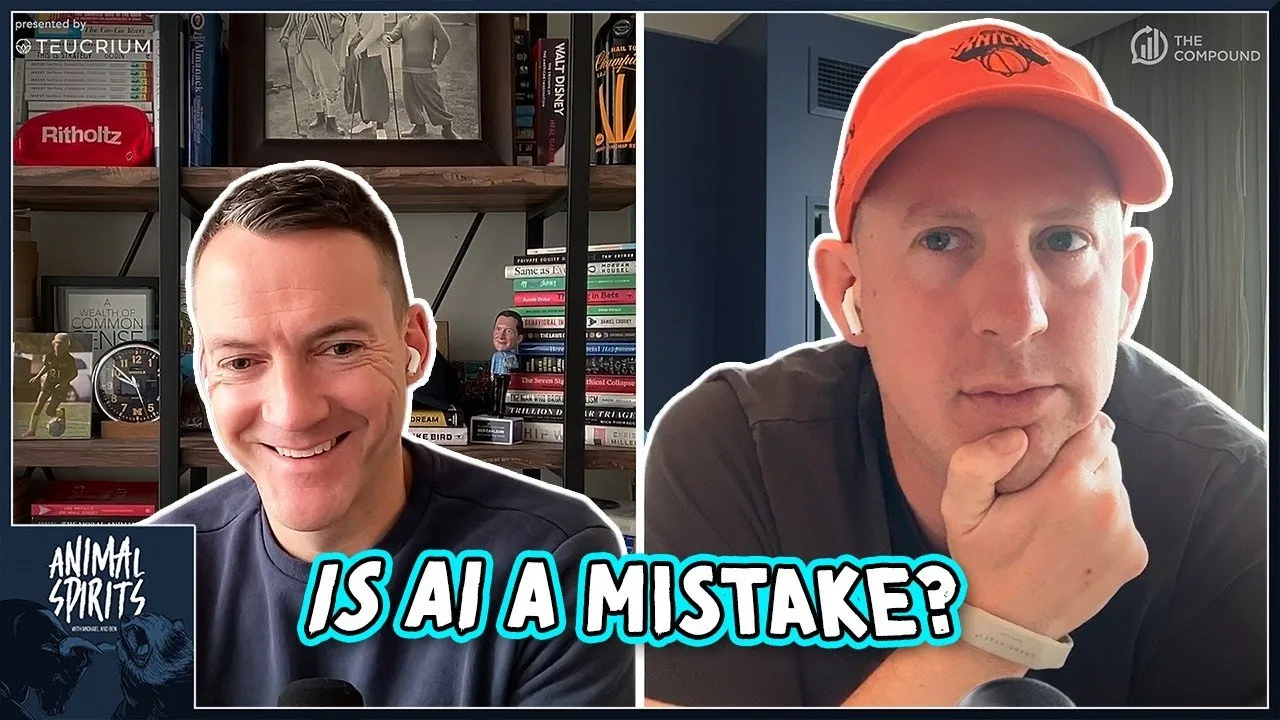
The discourse surrounding artificial intelligence has fractured into two outrageous extremes. On one side, skeptics dismiss the technology as billionaire-hyped vaporware, destined to fade like the metaverse. On the other, tech evangelists warn of a god-like intelligence less than two years away from automating all white-collar labor. The middle ground—where reasonable analysis usually lives—has been completely abandoned.
Recent market volatility, particularly in software stocks, suggests that investors are struggling to price this uncertainty. When a company like Salesforce or ServiceNow takes a significant hit, it isn't necessarily because their current revenue is collapsing. It is because the market is fundamentally questioning the durability of their moats in a world where code is becoming a commodity. To navigate this, we must look past the hysteria of "the end of work" and the denialism of the skeptics to understand how AI is actually reshaping capital allocation, enterprise software, and economic forecasting.
Key Takeaways
- The "Middle Ground" Void: Public discourse is polarized between "AI is a scam" and "AI is the apocalypse," missing the nuanced reality of tool integration and gradual disruption.
- Multiple Compression, Not Revenue Collapse: The crash in SaaS stocks is driven by a fear of future irrelevance rather than current earnings failures; investors are unwilling to pay premium multiples for uncertain 10-year horizons.
- The "Career Risk" Moat: Despite the ease of AI coding, enterprise incumbents remain protected by corporate risk aversion—managers buy software they can defend to their bosses, not necessarily the cheapest or most innovative option.
- The Rise of Prediction Markets: As trust in traditional polling and media experts erodes, prediction markets are emerging as a superior, incentives-based mechanism for forecasting economic and political outcomes.
The SaaS Apocalypse and the Re-Rating of Software
The stock market is currently witnessing a massive case of recency bias and extrapolation. The narrative has shifted rapidly: if AI can write code, then the proprietary software moats of the last decade are evaporating. This fear has led to a brutal re-rating of software-as-a-service (SaaS) companies.
The mechanism here is multiple compression. You do not need revenue to decline for a stock to crash; you simply need the market to decide that a company trading at 15x revenue should now trade at 6x revenue because its long-term durability is in question. If revenue stays flat but the multiple collapses, the stock drops 60%. This is the current reality for many vertical software companies.
The Commoditization of Features
The bear case for software is rooted in the "task completion time horizon." AI creates an environment where coding efficiency doubles rapidly. If a competitor can clone a proprietary feature over a weekend using "vibe coding" (using AI to generate apps without deep technical knowledge), the differentiation between products narrows significantly.
In this scenario, AI acts as a symmetric weapon. It accelerates the clock speed for everyone. However, this argument often ignores the distribution advantage. If an incumbent can ship AI-powered features to millions of existing users overnight, they hold a distinct advantage over a startup that still needs to acquire every single customer from scratch.
The Human Element: Why Incumbents Might Survive
While the technical barrier to entry is lowering, the psychological barrier to exit in enterprise software remains incredibly high. The "SaaS apocalypse" thesis often overlooks the human element of corporate purchasing.
"When you buy software for your company, you're not just buying features. You're buying someone to blame when things go wrong. You don't always pick the cheapest option. You don't always pick the most innovative option. You pick the option that if it fails, you can defend to your boss."
This dynamic—optimizing for career risk rather than unit cost—is what kept IBM dominant for decades. Enterprise buyers want a vendor with a support team they can call at 2:00 AM and a track record of data security. "We went with Salesforce" is a defensible sentence in a boardroom. "We went with an app I generated over the weekend" is a resignation letter.
While valuations may contract to reflect higher competition, the idea that legacy software giants will simply vanish ignores the stickiness of organizational inertia and the value of accountability.
The Economic Disconnect: Productivity vs. Consumption
There is a fundamental contradiction in the most aggressive AI bullishness. Tech leaders, such as Anthropic CEO Dario Amodei, have suggested that AI could drive GDP growth to 10-20%. While mathematically possible through massive productivity gains, this model struggles to account for the demand side of the economy.
Consumer spending drives roughly 70% of the economy. If AI automates a significant percentage of white-collar jobs, pushing unemployment from 4% to 8% or higher, the consumer base required to purchase these goods and services shrinks. Productivity cannot fill the gap left by a collapse in consumer demand. One person's lost job is another company's lost revenue.
The technology sector often operates in a bubble, assuming that efficiency is the only variable that matters. They frequently overlook the unintended consequences of rapid displacement, including the potential for severe inequality and the subsequent regulatory or social backlash.
The Super Cycle of Prediction Markets
Just as AI is challenging the value of traditional software, prediction markets are challenging the authority of traditional experts. Platforms like Polymarket and Kalshi are gaining traction not just for sports betting, but as sources of truth for economic indicators and political outcomes.
The "wisdom of the crowds" thesis posits that a diverse pool of incentivized actors will produce more accurate forecasts than a centralized group of experts. Recent data supports this, showing that prediction markets often forecast corporate earnings and interest rate decisions more accurately than professional analysts.
Incentives Over Opinions
The flaw in traditional punditry is the lack of penalty for being wrong. Professional forecasters often make predictions simply because it is their job to have an opinion, even when the data is ambiguous. In a prediction market, participants only engage when they have high conviction, because their own capital is at risk.
"If you aggregate a diverse pool of incentivized rational actors, the resulting consensus is mathematically likely to be the most accurate proxy for reality available. By assembling these forecasted facts, we are mapping the future with high resolution."
Thomas Peterffy, founder of Interactive Brokers, views this as the synthesis of human imagination and economic incentive. While the sector currently struggles with the optics of sports gambling and "prop bets," the underlying utility—replacing vague expert opinion with calibrated probabilities—represents a significant shift in how we navigate financial uncertainty.
Conclusion: The Grand Rapids Hedge
The current market environment forces investors to price in two mutually exclusive scenarios simultaneously: either AI is a bust and the capex spend will ruin balance sheets, or AI is so powerful it will destroy the business models of the companies building it.
The reality is likely found in the "Grand Rapids Hedge"—a middle-ground approach that rejects both the doomerism and the utopian hype. The economy is dynamic. History shows that labor markets adapt, albeit painfully, to technological shifts. While the "vaporware" argument is demonstrably false—the technology is real and powerful—the timeline for total disruption is likely longer and messier than the tech elite predicts.
Investors should remain wary of companies trading at multiples that demand perfection in an imperfect world, while recognizing that the most enduring moats are often psychological, not technological.