Table of Contents
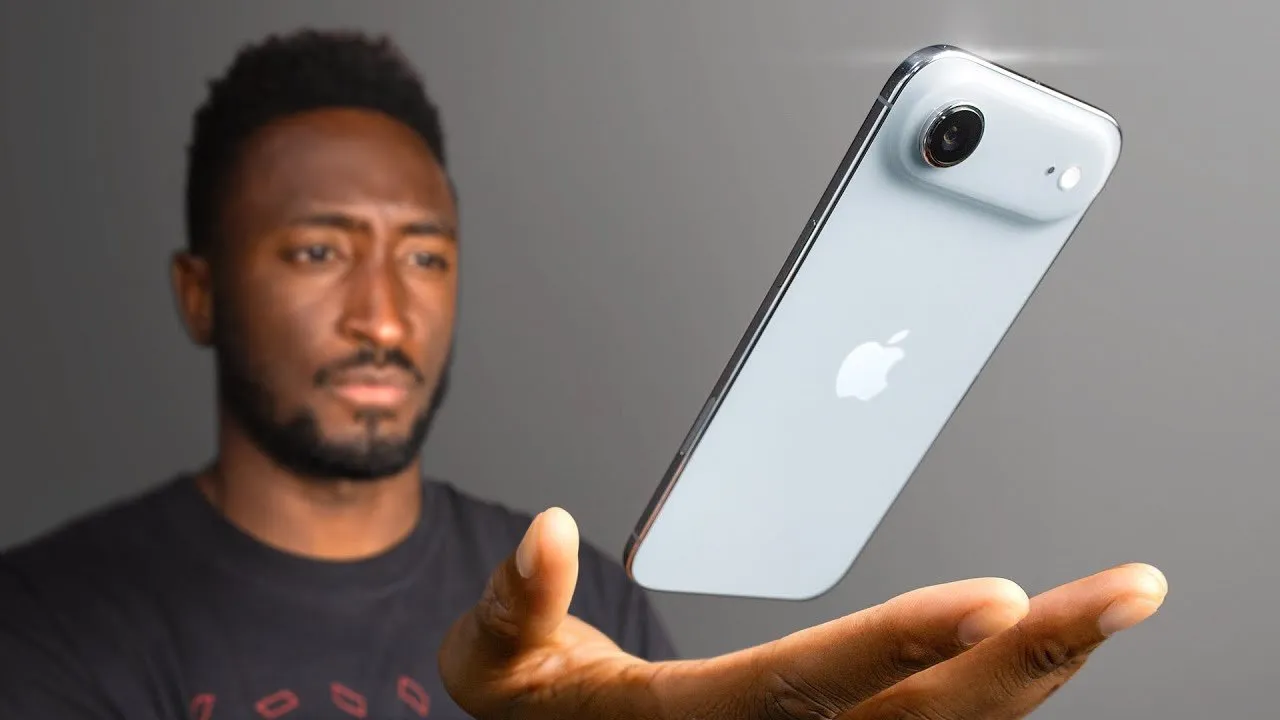
Apple's iPhone Air represents the most dramatic departure from iPhone design philosophy in years, pushing the boundaries of how thin a smartphone can be while maintaining functionality. This ultra-thin device forces users to confront fundamental questions about what they truly need from their phone versus what they think they want.
Key Takeaways
- The iPhone Air is thinner than a pencil and lighter than any iPhone in years, achieved through radical internal component reorganization
- Battery life ranks as the most significant compromise, delivering only 4 hours of screen time with 15% remaining in low power mode
- Despite its thinness, the device passes extreme durability tests and earns a 7/10 repairability score from iFixit
- The single camera system eliminates ultrawide and zoom capabilities that many current iPhone users rely on
- This design likely previews Apple's upcoming foldable iPhone technology, making the Air a testbed for future innovations
Engineering Marvel: How Apple Achieved Ultra-Thin Design
Apple's engineers accomplished something remarkable with the iPhone Air's form factor. The device measures thinner than a number two pencil and surpasses even the iPod touch for slimness. This isn't simply a scaled-down iPhone—it represents a complete rethinking of internal architecture.
Revolutionary Internal Architecture
The key innovation lies in component redistribution. Apple compressed the compute, memory, and logic board into the phone's upper section, creating what they call a "plateau." This design leaves the lower portion primarily for battery storage while maintaining structural integrity.
The exterior features softly rounded edges and a shiny titanium frame that, while fingerprint-prone, delivers exceptional durability. Even the USB-C port required 3D printing to achieve the necessary miniaturization, and all buttons extend nearly to the phone's front and back edges.
New Silicon Foundation
Apple's investment in custom silicon pays dividends here. The new C1X modem chip works alongside the N1 networking chip to handle Wi-Fi 7, Bluetooth 6, and Thread connectivity. Performance matches previous Qualcomm-powered iPhones without apparent coverage or speed compromises, validating Apple's move toward complete silicon independence.
The Compromise Spectrum: What You Lose
Audio System Limitations
The first casualty of extreme thinness is the bottom speaker. The iPhone Air relies solely on the earpiece speaker, creating several practical issues. Volume output decreases significantly, bass response disappears almost entirely, and landscape video viewing becomes frustrating as all audio emanates from one side.
Beauty is pain, after all.
Most users adapt to these audio limitations, but the experience clearly falls short of dual-speaker iPhones. The single speaker becomes particularly problematic when accidentally blocked during landscape use.
Connectivity Trade-offs
Apple eliminated the physical SIM slot globally, making the Air eSIM-only worldwide. This change reportedly recovers approximately 200mAh of battery capacity—crucial space in such a thin device. While most users will only notice this limitation twice (when switching to and from the Air), it creates significant inconvenience for frequent phone swappers and users of devices with poor eSIM support.
The Air also lacks millimeter wave 5G support, though this affects few users practically. Most people globally have never accessed mmWave networks, and even in the US, coverage remains sporadic and situational.
Performance Under Pressure
Thermal Management Challenges
The iPhone Air houses an A19 Pro chip (with one fewer GPU core than Pro models) in a dramatically thinner chassis without advanced cooling solutions. Pro iPhones feature aluminum construction for better thermal conductivity and vapor chambers for heat dissipation—none of which the Air possesses.
Real-world testing reveals noticeable heating, particularly during sustained activities. The area below the camera plateau becomes uncomfortably warm, and the chip clearly throttles under heavy loads. However, the phone never triggered overheating warnings, suggesting Apple's thermal management algorithms work effectively within these constraints.
Camera System Philosophy
The single camera represents Apple's most controversial compromise. Many potential Air buyers currently use iPhones with ultrawide and telephoto lenses, making the transition jarring. The absence of ultrawide capability proves particularly limiting for everyday photography scenarios.
Apple emphasizes their 2x crop processing from the main sensor's 12-megapixel center, but this computational approach cannot match dedicated zoom hardware. Image quality deteriorates rapidly beyond 5x magnification across all shooting conditions.
The camera Apple includes performs excellently—essentially matching the base iPhone 17's capability and ranking among the best single cameras at this price point. The selfie camera receives particular praise for genuine innovation and dramatic improvements over previous generations.
Durability Surprises and Battery Realities
Unexpected Structural Strength
The iPhone Air defies expectations regarding durability. JerryRigEverything's bend tests reveal exceptional structural integrity, with the titanium frame withstanding more stress than human hands can generate. The phone flexes under extreme pressure but returns to its original shape without permanent deformation.
It's literally one of the most impressively durable smartphones of all time.
The ceramic shield front and back glass exceeds typical scratch resistance standards, surviving beyond the usual level six scratches with deeper grooves at level seven benchmark. IP68 water and dust resistance remains intact, and the device earns a 7/10 repairability score from iFixit with dual-entry repair access.
Battery: The Critical Weakness
Battery performance represents the iPhone Air's most significant limitation. The device combines a large, bright 6.5-inch 120Hz OLED display with a battery comparable to the iPhone 11's capacity. While components have improved efficiency—the display throttles to 1Hz and the A19 Pro underclocks effectively—the fundamental math creates problems.
Real-world usage yields approximately four hours of screen time, ending days with 15% charge remaining in low power mode. For a new phone, these numbers raise concerns about performance after three to four years of battery degradation.
Charging speeds lag behind other iPhone 17 models, compounding the battery anxiety. Heavy users find themselves tethered to wireless chargers, undermining the Air's portability advantage.
Strategic Implications and Future Vision
Foldable iPhone Preview
The iPhone Air likely represents more than experimental design—it appears to be foundational work for Apple's anticipated foldable iPhone. Each half of competitive folding phones often measures thinner than the iPhone Air, requiring exactly the component miniaturization and efficiency maximization Apple demonstrates here.
The N1 and C1X chips, internal reorganization techniques, and thermal management solutions developed for the Air directly enable foldable device engineering. This positions the Air as both a standalone product and crucial research platform for Apple's next major form factor innovation.
Product Line Differentiation
The Air's existence allows Apple to make Pro models more decidedly "pro." With the Air handling the thin-and-light category, Pro phones can embrace thickness for larger batteries, advanced cooling systems, and comprehensive camera arrays without compromising the lineup's breadth.
Maybe the best thing about the iPhone Air is actually how much it seems to have freed Apple up to make the Pro phones even more pro.
The Verdict: Form Over Function
The iPhone Air succeeds as a design statement and engineering showcase while struggling as a daily driver for demanding users. Its immediate tactile appeal—the lightness, thinness, and premium materials—creates instant attraction that many will find irresistible.
However, the compromises prove substantial for users accustomed to multi-camera systems and all-day battery life. The Air works best for light users transitioning from older devices rather than power users stepping down from feature-rich phones.
Apple's $100 MagSafe battery accessory highlights the company's approach: create the problem, then sell the solution. Unfortunately, this particular solution delivers only 65% charge due to wireless charging inefficiencies, making it a poor value proposition.
The iPhone Air ultimately represents Apple's willingness to explore radical design directions while laying groundwork for future innovations. Whether it succeeds commercially will determine how aggressively Apple pursues similar form-over-function experiments—and how quickly they bring that rumored foldable iPhone to market.