Table of Contents
Most people live their lives building a well. They spend decades pumping the handle, watching the water rise, yet they rarely pause to drink from it. At the end of their lives, after a lifetime of exertion, they realize they are still thirsty. They spent their existence pumping rather than drinking—which was the entire purpose of the labor in the first place. This metaphor serves as a stark reminder to balance ambition with enjoyment, a central theme in our recent exploration of leadership, decision-making, and life philosophy. From the strategic oratory of Winston Churchill to the ruthlessly efficient business logic of Akon, the lessons from this year focus on optimizing not just for output, but for outcome.
Key Takeaways
- The "Orator" as Leader: True leadership isn't just about strategy; it is about transferring energy and creating a "resistance" narrative that unites a team against a common enemy.
- Timing Matters in Life Optimization: Delayed gratification has an expiration date. Certain experiences, like backpacking through Europe, have a specific utility window that closes with age.
- The "Big Rocks" Theory: If you don't schedule your major life priorities first, the "sand" of daily administrative trivia will fill the jar, leaving no room for what matters.
- Rational Decision Making: Most bad decisions stem from "blended reasons." A strong decision should stand on one decisive factor, not a list of weak pros and cons.
- Value Arbitrage: Sometimes the greatest business wins come from spotting anomalies in the market structure, like Akon capitalizing on the ringtone economy.
The Power of the Orator: Leadership Through Energy Transfer
History suggests that the most effective leaders share a common trait that often supersedes physical stature or conventional good looks: the ability to be an "Orator." In the Roman Empire, emperors were often referred to as orders—individuals who could stand on a rock and direct the attention and energy of the masses.
The study of Winston Churchill offers a masterclass in this specific skill. During the evacuation of Dunkirk, when morale was shattered and the threat of Nazi Germany was existential, Churchill did not merely manage logistics. He transmuted his own fear into public courage. Through his famous speeches, he exerted a relatively small amount of physical energy to completely shift the emotional state of tens of millions of people.
"We will fight on the beaches. We will fight in the trenches. We will fight on the land and we will never ever give up."
This phenomenon—one person leveraging words to ignite the energy of thousands—is the "force multiplier" of leadership. Whether it is a rockstar commanding a stadium of 250,000 or a CEO addressing a startup, the mechanic remains the same. The leader’s job is to define the meaning behind the struggle.
Creating a "Resistance" Narrative
For modern business leaders, motivating employees requires more than financial targets. Revenue growth is rarely an inspiring rally cry for the average employee. Instead, great leaders tie their mission to a resistance movement.
Consider the shift toward digital isolation. A company facilitating in-person connections isn't just selling a membership; they are fighting against a world where humanity is lonely, sad, and speaking only to AI. By framing the company’s mission as a moral stance—"We are part of the resistance against a disconnected future"—leaders can elevate a standard job into a vocation. This shift in narrative can have tangible metrics, such as reducing churn from 40% to near zero by re-emphasizing human connection.
Die With Zero: The utility of Money and Time
The philosophy presented in Bill Perkins’ Die With Zero challenges the traditional "work hard, save everything" mindset. It argues that money is merely stored life energy, and hoarding it beyond its useful window is a tragic mismanagement of resources.
The Principle of Timing
The core argument is that timing matters. Experiences yield different dividends at different ages. A backpacking trip through Europe is a formative, life-altering adventure at age 22. The same trip at age 35, staying in hostels and sleeping on trains, is often miserable. If you delay gratification indefinitely, you miss the specific season in which an experience provides value.
This leads to the realization that while you can always earn more money in the future, you cannot recapture time. Therefore, the fear of squandering life should far outweigh the fear of squandering money.
The Jar of Rocks Analogy
To operationalize this, one must utilize the "Jar of Rocks" visualization for time management. Imagine a jar representing your year, alongside three materials:
- Sand: Daily errands, Zoom calls, emails, and administrative tasks.
- Pebbles: Minor projects and initiatives.
- Big Rocks: Meaningful experiences, family trips, learning new skills.
If you fill the jar with sand first (the daily grind), there is no physical space left for the big rocks. However, if you place the big rocks in the jar first—scheduling your major life priorities before anything else—the sand will naturally fill the cracks and crevices around them. Work acts like a gas; it expands to fill whatever container you give it. To live a meaningful life, you must construct the container with your "big rocks" already inside.
Frameworks for Rational Decision Making
Whether in high-finance investing or personal life, humans are prone to irrationality. We hold losing stocks because of the sunk cost fallacy, or we avoid difficult conversations due to emotional discomfort. Improving judgment requires a systematic approach to bypassing these cognitive biases.
The Investment Logic of Howard Marks
In investing, the decision to sell is often emotional: we sell because a stock is up (greed/fear of losing gains) or because it is down (panic). Legendary investor Howard Marks argues that these are irrelevant data points. The decision to hold or sell should rely on two factors:
- Thesis Validation: Is the original reason you bought this asset still true? If the thesis is broken, the investment is broken.
- Opportunity Cost: Is there a better place for this capital right now?
- Position Sizing: You will be wrong frequently. The goal is to survive your mistakes and leverage your winners. As George Soros noted, it’s not about being right or wrong, but how much money you make when you're right and how much you lose when you're wrong.
The Decision Register
To improve judgment over time, one must track their thinking. A "Decision Register" is a tool to document the state of mind during critical choices. Before finalizing a major decision, answer the following:
- The Tweet Test: Define the decision in 280 characters or less.
- Emotional Check: Are you acting out of extreme fear or extreme greed? If so, pause.
- The One Decisive Reason: Avoid "blended reasons." If you are listing five mediocre reasons to do something (e.g., "it's good networking," "I've never been to that city"), it is likely a bad decision. A good decision usually has one overwhelming reason that makes all others irrelevant.
- The Joust: Pit your strongest argument for the decision against your strongest argument against it. Which one wins?
Strategic Learning and Working Smarter
Innovation often comes from looking at the same information as everyone else but seeing a different utility. This applies to how we consume information and how we spot business opportunities.
Reading to Spark, Not to Store
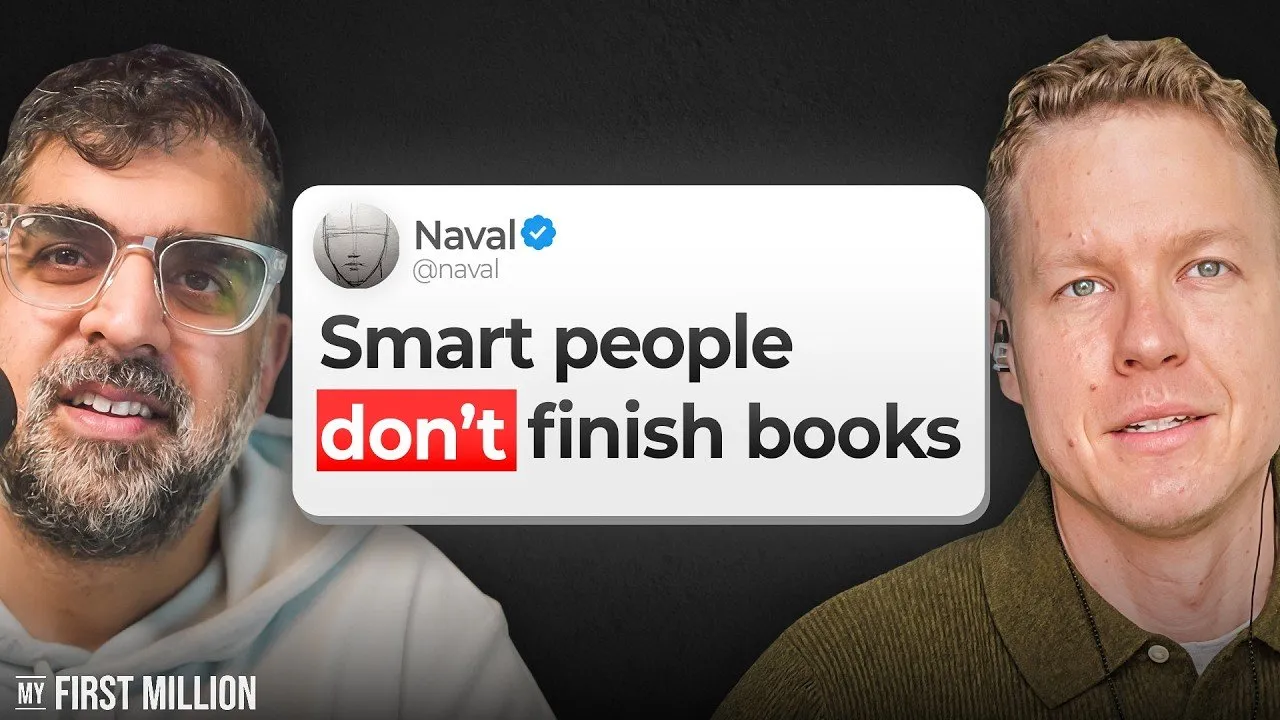
Many ambitious people treat reading as a data extraction exercise, feeling guilty if they don't finish a book or memorize every fact. A healthier approach, championed by naval Ravikant, is to view reading as "rubbing two sticks together." The goal isn't to transfer the book's contents into your brain; the goal is to create a spark. If a book catalyzes a new idea, a new mental model, or a realization, it has served its purpose—regardless of whether you finish it.
The Akon Arbitrage
The concept of "working smarter, not harder" is often a cliché, but artist and entrepreneur Akon provided a definitive example of it in the mid-2000s. At the time, a full song on iTunes sold for $0.99 or $1.99. However, Akon noticed that ringtones—10-second clips of songs—were selling for $4.99.
Furthermore, his record contracts did not account for "ringtones" as a separate revenue stream, meaning he kept a larger percentage of the profit. Realizing this arbitrage, he stopped writing songs for the radio and started writing songs specifically designed to be ringtones. He produced simple, catchy hooks that fit perfectly into a 10-second loop. The result was 11 million ringtones sold and a massive financial windfall, simply by recognizing that the market valued a fragment of the product more than the whole.
Conclusion
Ultimately, the goal of these frameworks—whether it is the Decision Register, the Jar of Rocks, or the Ringtone Arbitrage—is to ensure that the effort we expend yields the life we desire. It is easy to get lost in the mechanics of pumping the well, fascinated by the volume of water we can move. But wisdom lies in remembering to stop, cup your hands, and actually drink.