Table of Contents
Most people categorize movement into rigid boxes: strength training, cardio, flexibility, or sport-specific skills. However, viewing physical activity through these narrow lenses often limits human potential. True movement practice is not merely a workout routine to be completed before dinner; it is a decentralized, open system of self-inquiry.
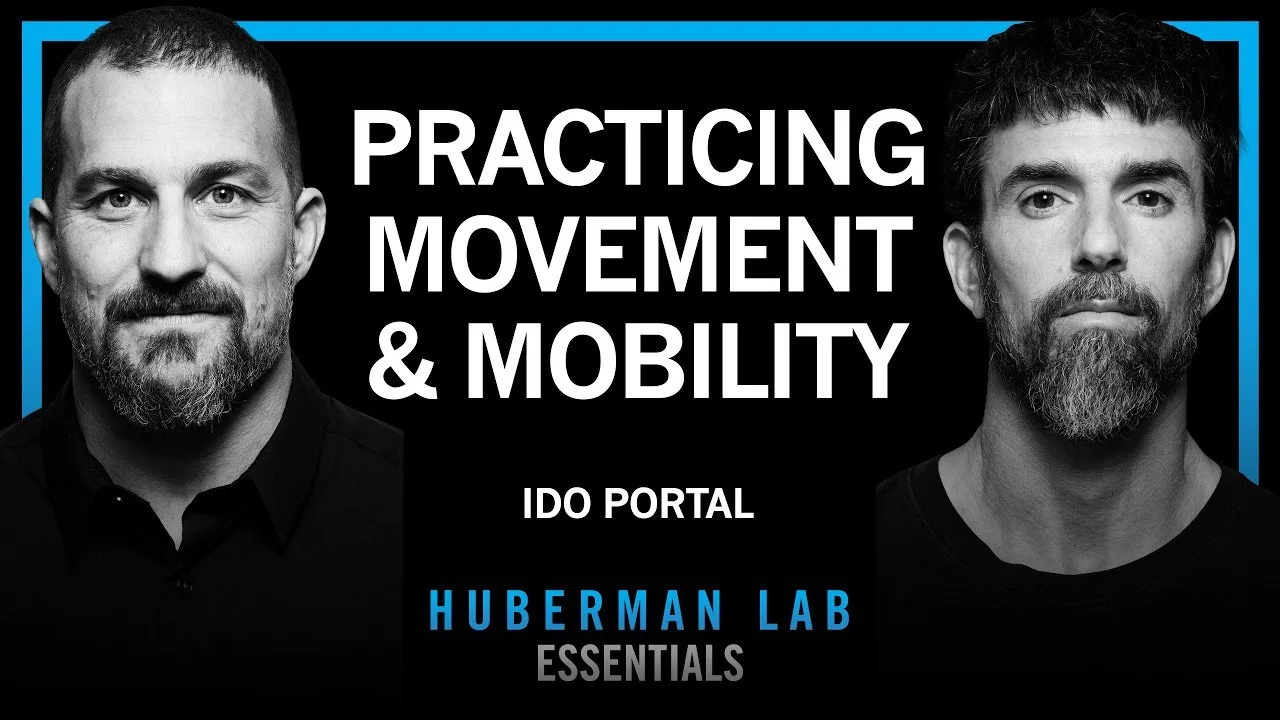
In a profound discussion, Dr. Andrew Huberman sits down with Ido Portal, a world-renowned expert who has redefined the concept of movement culture. Portal is not just an athlete; he is an intellectual of movement who understands the body at multiple levels of granularity. Together, they explore how to transition from mechanical exercise to a fluid, aware, and integrated existence.
Key Takeaways
- Movement is an open system: It serves as a vehicle for self-inquiry, integrating the nervous system, the mechanical body, and the environment.
- Virtuosity requires variability: True mastery lies in the ability to invite chance and improvisation back into a skill after learning the technique.
- Sensory inputs drive motor outputs: The way you use your eyes and ears directly dictates your posture, state of mind, and movement quality.
- Linearity is a modern construct: Biological movement is naturally spiraled and inefficient; strict efficiency in gym culture can stifle natural adaptability.
- Play is essential: Injecting playfulness and "wordlessness" into practice unlocks potential that rigid repetition cannot access.
The Three Layers of Movement Practice
To understand Ido Portal’s approach, one must abandon the idea that fitness is solely about muscle and bone. Drawing inspiration from the late Moshe Feldenkrais, Portal conceptualizes the body through three distinct but interconnected layers:
- The core nervous system.
- The mechanical system (skeleton and muscles).
- The environment.
A robust movement practice requires awareness of all three. It is about recognizing that you are living in motion—your mind is a type of movement, your emotions are in flux, and your physical body is constantly interacting with the world around it. This is what Portal refers to as "wordlessness," a non-verbal experience where the practitioner becomes fully immersed in the dynamic nature of existence.
"The water doesn't stand. This is the beauty of movement. So you can focus for long periods of time and do incredible things with the mind... and it's with skin in the game. That's how movement keeps me very honest and humble."
This awareness can be practiced anywhere. It does not require a commercial gym. Portal shares the example of walking through the crowded streets of Hong Kong, turning a commute into a two-hour session of spatial awareness, avoiding contact, and internal organization. By making ordinary environments dynamic—such as using a rocking chair rather than a static seat—you keep the system fresh and responsive.
From Competence to Virtuosity
There is a distinct hierarchy in how humans acquire and express physical skills. It generally flows from unskilled to skilled, and finally to mastery. However, Portal argues there is a tier beyond mastery: virtuosity.
Mastery often implies a high level of consistency and control within a specific set of parameters—a "sleeve" of technique. Virtuosity occurs when a practitioner becomes so proficient that they can invite variability and error back into the equation. It is the freedom to improvise without losing effectiveness.
When a person focuses entirely on "correct" postures—whether physical, emotional, or mental—they create rigid scaffoldings. They become trapped in a specific way of moving or thinking. The goal of deep practice is to eventually discard the scaffolding. You learn the technique to eventually transcend it, moving toward a "postureless" state where you can adapt to any demand instantaneously.
The Architecture of the Senses
One of the most actionable aspects of Portal’s philosophy is the integration of vision and hearing into movement. Most people assume their limbs dictate their movement, but often, the head and eyes organize the body.
The Visual Aperture
The eyes are the immediate entry point into the state of the nervous system. We have the ability to toggle between two visual modes:
- Focal Vision: Narrow, intense focus. This is associated with high alertness and sympathetic nervous system activation.
- Panoramic Vision: Soft, peripheral awareness. This activates the magnocellular pathway, which is associated with faster reaction times and a calmer state.
In modern culture, we are over-indexed on focal vision due to screens and reading. Portal suggests balancing this by consciously entering panoramic states, similar to how we view nature. We don't look at a specific leaf; we take in the movement of the entire forest.
Auditory Orientation
Similarly, the way we listen changes our physical structure. To capture sound, we intuitively adjust the tilt of our heads to manage interaural time differences (the split-second difference in when sound hits each ear). This subtle adjustment of the head changes the tension in the neck and spine, subsequently organizing the feet and posture. A "movement practice" includes becoming aware of these subtle sensory drivers.
Breaking the Linear Mold
Standard exercise science often treats the body as a machine to be optimized for linear efficiency. The shortest distance between two points is a straight line, and biomechanics often attempts to force the body into this geometry. However, biological movement is rarely linear.
Nature is comprised of coils, spirals, and waves. When we limit ourselves to the rigid lines of a weight machine or the repetitive stride of a treadmill, we may improve specific metrics, but we lose biological adaptability. Portal encourages breaking these patterns to induce neuroplasticity.
"We have all these technical invasions... they invaded our nervous system. And now our walk and our physical practices look linear and efficient... This is biomechanics. It's not mechanics. Nothing there is given. This is no gospel."
Dr. Huberman highlights a practical example of this: performing a bicep curl. Typically done with feet parallel and body rigid, this movement is anatomically "correct" but functionally odd. By simply walking while curling—placing one foot in front of the other or closing the eyes—the practitioner introduces a new layer of complexity. This forces the nervous system to solve new problems, turning a rote exercise into a true movement exploration.
Proximity and Reactivity
A sophisticated practice also addresses the "peripersonal space"—the immediate area surrounding the body. Modern society has created a deficit of touch and proximity, leading to high reactivity when that space is invaded.
Many people suffer from anxiety simply by being close to others. Movement practice offers a safe haven to explore this discomfort. By engaging in contact improvisation or partner drills, individuals can learn to lower their "volume control" on reactivity. The goal is to be in close proximity or physical contact without immediately defaulting to a martial, competitive, or sexualized response. It cultivates a physical intelligence that allows for human connection without fear.
Conclusion: The "N of 1" Experiment
Ultimately, Ido Portal’s message is one of extreme ownership and experimentation. There are no "hacks" or shortcuts. The tools of movement—whether they are heat, cold, light, or physical load—are there for you to test on yourself.
As Dr. Huberman notes, the highest compliment in science is to be an "N of 1"—a unique dataset. You must treat your body as a laboratory. Don't just follow the recipe; understand the ingredients. Whether it is walking with a different cadence, using soft vision, or exploring the floor, the goal is to remain wild, wise, and perpetually evolving.