Table of Contents
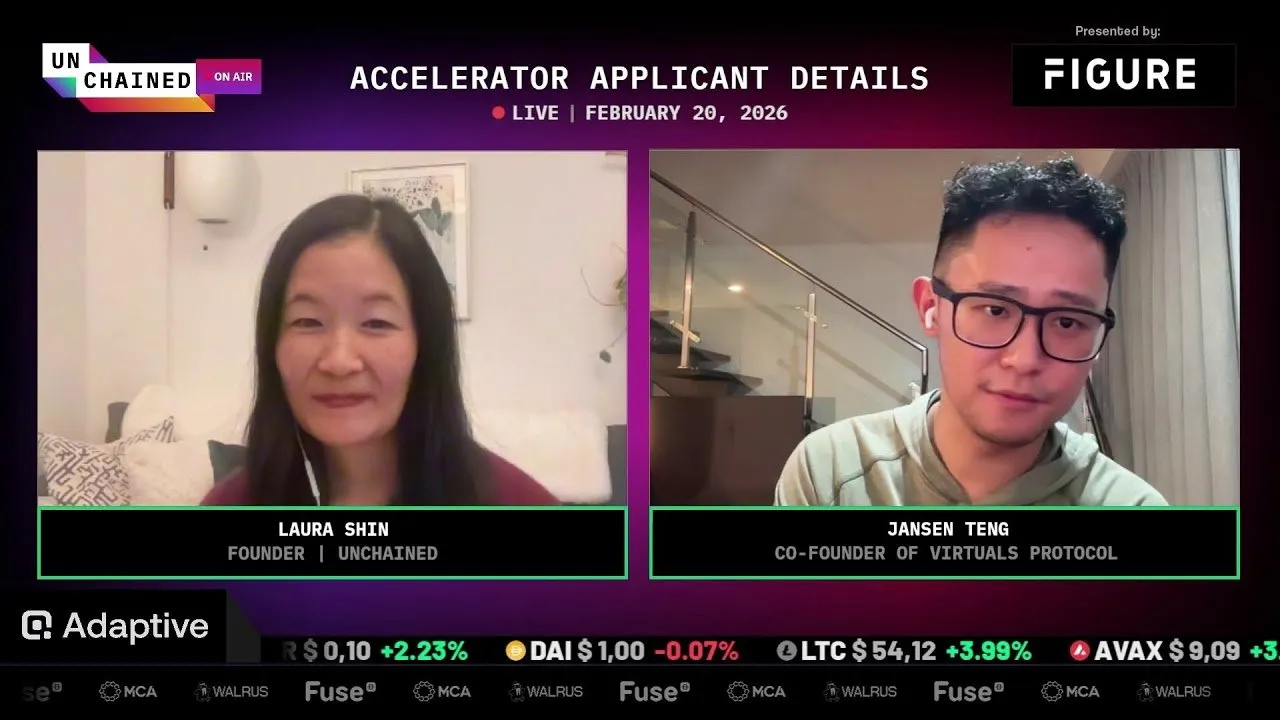
The evolution of artificial intelligence is rapidly moving beyond the confines of digital screens and text boxes. While the industry has spent the last year obsessed with large language models and autonomous software agents, the next frontier lies in the physical world. Jansen Ting, co-founder of Virtuals Protocol, recently sat down with Laura Shin on Unchained to discuss the launch of Eastworld Labs, a vertically integrated robotics accelerator designed to bridge the gap between virtual AI agents and humanoid hardware. By combining the capital formation power of crypto with cutting-edge robotics, Ting believes we are entering an era of a "hybrid society" where humans, digital agents, and physical robots coexist and transact autonomously.
Key Takeaways
- Eastworld Labs is a new 10,000-square-foot robotics accelerator in Kuala Lumpur, Malaysia, housing one of the largest humanoid robot fleets in Southeast Asia.
- The accelerator utilizes a "teleoperation-first" strategy, using human remote operators in lower-cost regions to perform physical labor and generate the data needed for future full autonomy.
- Virtuals Protocol is leveraging tokenization to solve the capital and attention problems for robotics founders, allowing projects to bootstrap funding through on-chain markets.
- The Agent Commerce Protocol (ACP) serves as the economic layer, enabling robots to coordinate with other machines and software agents using smart contracts.
The Launch of Eastworld Labs: A Physical Hub for AI
While Virtuals Protocol initially gained fame as a launchpad for digital AI agents like the autonomous influencer Luna, the team recognized a "dimensional level of unlock" in physical AI. Eastworld Labs represents this shift into robotics. Located in the heart of Malaysia, the facility currently hosts 30 Unitree G1 humanoid robots, which are among the most dexterous and advanced models available on the market today.
The lab is designed to provide founders with a vertically integrated ecosystem that covers funding, data, and distribution. Founders can enter the residency through two paths: a traditional seed funding route or a novel "on-chain tokenization" path. In the latter, if a robotics project launches a token on the Virtuals platform and reaches a $5 million market cap, the team is automatically granted a seat in the residency, which includes a free humanoid robot for testing and access to a fleet of technical experts.
Ting emphasizes that the location is strategic, tapping into academic collaborations with institutions like CMU, Oxford, and NTU Singapore to refine autonomous policies. The goal is to lower the barrier to entry for builders who want to experiment with consumer-facing humanoid use cases but lack the massive capital typically required for hardware development.
From Teleoperation to Full Autonomy
One of the most provocative aspects of the Eastworld strategy is the focus on remote teleoperation as a bridge to automation. Ting compares this to Business Process Outsourcing (BPO), where call centers are moved to countries with lower labor costs. In this model, a robot deployed in a high-cost country like Australia or the United States is controlled remotely by a skilled human in a country like Malaysia or the Philippines.
This approach captures a significant "rich arbitrage." For example, a plumber in Australia might earn over $100,000 per year, while a plumber in Malaysia earns a fraction of that. By using a robot to perform the labor via remote control, businesses can achieve 40% to 60% cost savings immediately. However, the true value lies in the data collection.
"That data of all the robotics joints and whatnot becomes very valuable for training fully autonomous policies."
As humans operate these robots in chaotic, real-world environments, the system captures egocentric data and joint-movement information. This massive "data lake" will eventually be used to train AI models that can perform these tasks without human intervention, effectively allowing the business to self-replace human operators with autonomous software over time.
High-Potential Humanoid Use Cases
Not every task requires a humanoid form factor. In a highly structured factory setting, traditional automation is often superior. Eastworld Labs is specifically targeting environments built for humans, such as:
- Hospitality and Retail: Robots serving as "concierges" or sales managers in hotels and restaurants.
- Specialized Trades: Plumbers, mechanics, and HVAC technicians who must navigate homes designed for human ergonomics.
- Healthcare Support: Carrying equipment and autoclaving tools in hospital back-offices.
Crypto as the Coordination Layer for Robots
A recurring question in the space is why robotics needs blockchain technology. Ting argues that crypto serves two vital functions: capital formation and machine coordination. Tokenization provides an attention flywheel, where token holders become the first customers and advocates for a new robotic service. More importantly, blockchain provides a trustless ledger for machine-to-machine (M2M) commerce.
If a robot chef in a restaurant needs to restock ingredients, it may need to hire a drone fleet or a sidewalk delivery robot. Smart contracts allow these autonomous actors to transact without human oversight or "information loss." Within the Virtuals ecosystem, the Virtuals Revenue Network ensures that economic activity flows back to stakeholders through transaction taxes and treasury redeployment.
Ting views the Virtuals token as the base currency of a "network state" for AI. As more robotic projects pair their liquidity with the Virtuals token, it creates a natural supply crunch and aligns the incentives of the entire ecosystem. This creates a feedback loop where successful hardware projects drive value back to the digital protocol.
The Future of Agentic Commerce
The conversation also touched on the broader AI landscape, including the recent "OpenClaw" mania. Rather than seeing open-source agent frameworks as competition, Ting views them as a catalyst for the Agent Commerce Protocol (ACP). He compares OpenClaw to Shopify (a tool for building agents) and ACP to Stripe (the payment layer that enables those agents to conduct business).
The vision for Virtuals is to become the "Amazon for personal agents." Whether an agent is a software butler on X (formerly Twitter) or a physical robot in a kitchen, it will require a way to discover, hire, and pay other agents for specialized services. To facilitate this, Virtuals has integrated with protocols like X-402 and ERC-8004, positioning itself as a public good and a registry for the agentic economy.
Addressing Security and Social Impact
The transition to a robot-heavy society is not without risks. When asked about potential backlashes or the risk of robotic "cybercrime," Ting was pragmatic. He noted that while automation will inevitably disrupt labor markets, the innovation is likely unstoppable. He also suggested that the best defense against robotic crime is a "robotic security guard," effectively creating an "antivirus" ecosystem for the physical world.
Conclusion: Toward a World of Abundance
The ultimate goal of Eastworld Labs and Virtuals Protocol is to shift the global economy from a model of scarcity to one of insane productivity and abundance. By commoditizing physical labor through humanoid robots and digital agents, humans can theoretically focus on the tasks that matter most to them while autonomous actors handle the mundane.
As Eastworld Labs begins accepting applications, the focus remains on finding founders who can bridge the gap between high-level AI theory and practical, real-world utility. If Ting’s vision holds true, the "soul" of a robot—whether it be a chef, a plumber, or a personal assistant—will soon be something we can swap and trade as easily as a digital asset.