
Table of Contents
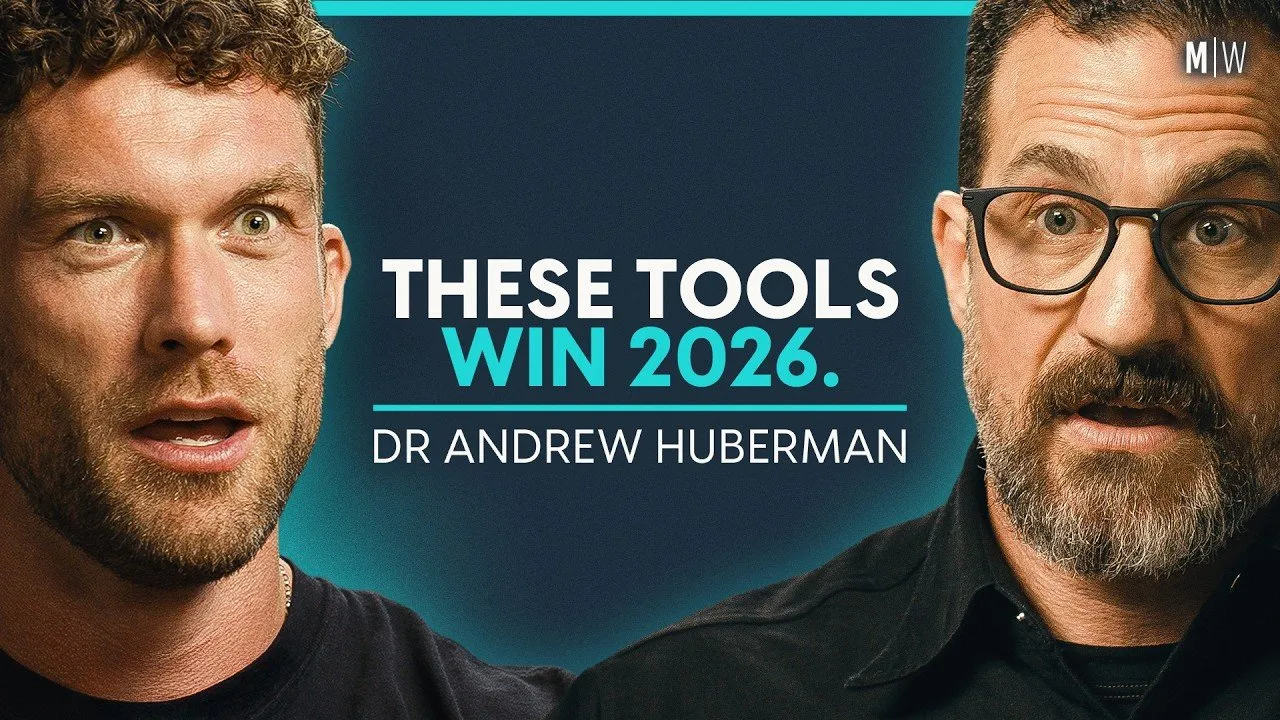
In a rapidly evolving world where attention spans are shrinking and biological stressors are rising, reclaiming control over your physiology is the single most effective strategy for success in the coming years. Dr. Andrew Huberman and Chris Williamson recently sat down for a comprehensive deep dive into the mechanisms of stress, sleep, focus, and the often-overlooked connection between spirituality and neuroscience. This discussion moves beyond basic health advice, offering a blueprint for navigating the biological and psychological challenges of the modern age.
Key Takeaways
- Cortisol is not the enemy: A morning cortisol spike is evolutionarily required for energy and wakefulness; the goal is to front-load stress, not eliminate it.
- The Glymphatic System: Brain waste clearance happens primarily during sleep, and body position (side sleeping or elevated head) significantly impacts this process.
- Focus requires boredom: Deep thinking is the layering of sensory memories; to build new thoughts, you must reduce sensory input (like phones) immediately prior to work.
- The Neuroscience of Surrender: Breaking stubborn bad habits often requires relinquishing "top-down" control to a higher power or concept, a mechanism Huberman notes is supported by addiction recovery data.
- The Next Health Frontiers: While protein and creatine are now mainstream, the next waves of health adoption will likely focus on magnesium for hearing/brain health and specific fiber types for gut inflammation.
Mastering the Cortisol Awakening Response
There is a pervasive misconception that cortisol is purely a "stress hormone" that must be suppressed at all costs. Dr. Huberman argues that this view is biologically inaccurate and counterproductive. Cortisol is an energy mobilizer. The key to regulating your circadian rhythm and energy levels lies not in lowering cortisol globally, but in timing its release correctly.
The Importance of the Morning Spike
To reclaim your brain's natural rhythm, you must optimize the Cortisol Awakening Response (CAR). This is a natural spike in cortisol that occurs within the first hour of waking. It signals to your body that it is time to mobilize glucose and move.
- Light Exposure: Viewing bright light (ideally sunlight, or 10,000 lux artificial light) within the first hour of waking can increase this morning cortisol peak by up to 50%.
- The Domino Effect: This morning spike sets a timer for the release of melatonin 12–14 hours later. If you miss this morning window, your "cortisol curve" flattens, leading to lower energy in the day and higher stress hormones at night.
- Delayed Caffeine: Caffeine blocks adenosine but does not inherently spike cortisol significantly compared to light and movement. Waiting 90 minutes allows the natural cortisol cycle to do its heavy lifting before adding stimulants.
The Danger of "Square Wave" Cortisol
Burnout often manifests as a "square wave" function, where cortisol remains chronically high throughout the day rather than tapering off. This prevents the physiological reset required for deep sleep. The antidote is to treat the first 3–6 hours of the day as "go time" (high stimulation, light, exercise) and the last 2–4 hours as a period of aggressive sensory deprivation (dim lights, low stimulation).
Optimizing Sleep and Glymphatic Clearance
Sleep is not merely a passive state of rest; it is an active period of neurological cleaning. The "glymphatic system" is the brain's waste clearance mechanism, where cerebrospinal fluid (CSF) washes away metabolic toxins, including amyloid plaques associated with Alzheimer's.
Mechanics of Brain Cleaning
This cleaning process is highly mechanical and influenced by gravity and inactivity.
- Inactivity drives clearance: While lymphatic drainage in the body requires movement, glymphatic clearance in the brain requires the body to be still.
- Position matters: Data suggests that sleeping on your side, or with the head slightly elevated, is the optimal position for maximal clearance. Back sleeping with a flat head may be less efficient.
- Visual Indicators: Puffiness around the eyes or a "glassy" look in the iris often indicates poor lymphatic drainage from the previous night.
Nutritional Support for Sleep
For those who struggle to stay asleep (sleep maintenance insomnia), dietary adjustments and supplementation can play a role.
- Starchy Carbohydrates: Huberman notes that very low-carb diets can elevate cortisol. Introducing starchy carbs (oatmeal, rice) in the last meal of the day can suppress cortisol and aid sleep onset.
- Magnesium Threonate or Bisglycinate: These forms of magnesium cross the blood-brain barrier effectively, aiding in relaxation and potentially protecting against hearing loss, which is strongly correlated with cognitive decline.
- Apigenin and Inositol: These compounds can assist in calming the nervous system and improving sleep architecture.
Focus, Boredom, and the Nature of Thought
In a digital age defined by infinite scroll, the ability to think deeply is becoming a superpower. Huberman references the work of Jenny Groh to explain that "thoughts" are essentially the layering of sensory memories in an abstract space.
The Necessity of Boredom
To generate high-quality thoughts, one must limit the intake of new sensory data immediately before attempting to focus.
"Thoughts are really a layering of the senses in abstract thought space."
- The Pre-Work Gap: If you consume social media right before working, your brain is still processing that sensory friction. Huberman advocates for a period of "boring" silence or staring at a wall for minutes before engaging in deep work.
- The Casino Effect: Social media algorithms are designed like slot machines, delivering novelty to keep dopamine circuits engaged. This constant novelty makes the "boring" work of deep thought chemically difficult for the brain to prioritize.
- Transition Activities: Just as athletes have rituals, intellectual athletes need transition periods where they disconnect from the "hive mind" to access their own cognitive resources.
The Cassandra Complex
Chris Williamson introduced the concept of the "Cassandra Complex"—the pain of being right, but early. In health and science, those who identify trends before they are clinically verified (like the importance of the microbiome or sleep hygiene) are often ridiculed before being vindicated. Developing the intellectual courage to trust physiological first principles, even when they contradict the current consensus, is vital for long-term health.
Neuroscience, Faith, and Breaking Habits
One of the most profound sections of the dialogue centered on the limits of willpower. While the anterior mid-cingulate cortex is associated with the "will to live" and tenacity, Huberman suggests that overcoming deep-seated addictions or bad habits often requires a different mechanism entirely.
The Science of Surrender
Huberman, a rigorous materialist scientist, shared his personal evolution toward prayer and the concept of a higher power. He notes that the "top-down" control required to suppress impulses (the prefrontal cortex saying "no") is metabolically expensive and exhaustible.
- Outsourcing Willpower: The efficacy of 12-step programs and spiritual practices may lie in their ability to "outsource" the heavy lifting of willpower to a concept greater than the self.
- Historical Context: Humans evolved with spiritual practices; removing them entirely may leave a biological or psychological gap that makes resilience harder to maintain.
- Practical Application: For stubborn habits where "grinding harder" fails, surrendering the outcome and engaging in prayer or meditation can paradoxically increase the ability to refrain from the behavior.
Future Frontiers in Health and Longevity
Looking toward 2026, the conversation shifted to what is next in the "hype cycle" of health optimization. Vitamin D, Protein, and Creatine have successfully passed through the cycle of skepticism to acceptance. Huberman and Williamson predict the next waves of focus.
Emerging Priorities
- Fiber and the Microbiome: While controversial in some carnivore circles, the nuance of which fibers work for which people will become central. Low-sugar fermented foods (sauerkraut brine, kefir) are emerging as superior to fiber supplements for reducing inflammation.
- Magnesium for Hearing: Low-level hearing loss is a major risk factor for dementia. Magnesium plays a critical role in the fluid of the inner ear, making it a preventative supplement for long-term cognitive health.
- Red Light and Mitochondria: The understanding that mitochondria (originally bacteria) respond to specific light wavelengths will move red light therapy from "biohack" to standard medical advice for cellular energy.
Navigating Chronic Illness and Medical Silos
Williamson shared his harrowing personal journey with "invisible" illnesses, including Lyme disease, mold toxicity, and autoimmune issues. This highlighted a critical flaw in modern medicine: the specialization silo.
The "Inverse Pretty Privilege"
Williamson coined the term "Inverse Pretty Privilege" to describe the difficulty of getting a diagnosis when you look healthy on the outside but are crumbling on the inside. High-performing individuals often mask symptoms with adrenaline and caffeine until they crash.
- The Diagnostic Trap: Specialists look for problems within their specific organ system. A complex, systemic issue like mold toxicity or Lyme often requires a "generalist" approach that connects the dots between systems—a role often filled by functional medicine or patient advocacy.
- Drug Repurposing: Huberman highlighted the work of Dr. David Fajgenbaum, who advocates for using existing, approved drugs for off-label purposes to cure rare diseases. The future of medicine may not be new drugs, but better application of the ones we already have.
Conclusion
Reclaiming your brain in 2026 is not about adding more complexity to your life; it is about respecting the ancient biological machinery that drives you. It requires the discipline to view light in the morning, the courage to be bored in a world of stimulation, and the humility to acknowledge that not all strength comes from sheer force of will. As Huberman concludes, understanding the mechanism gives you the flexibility to adapt the protocol, granting you true agency over your own biology.



)