Table of Contents
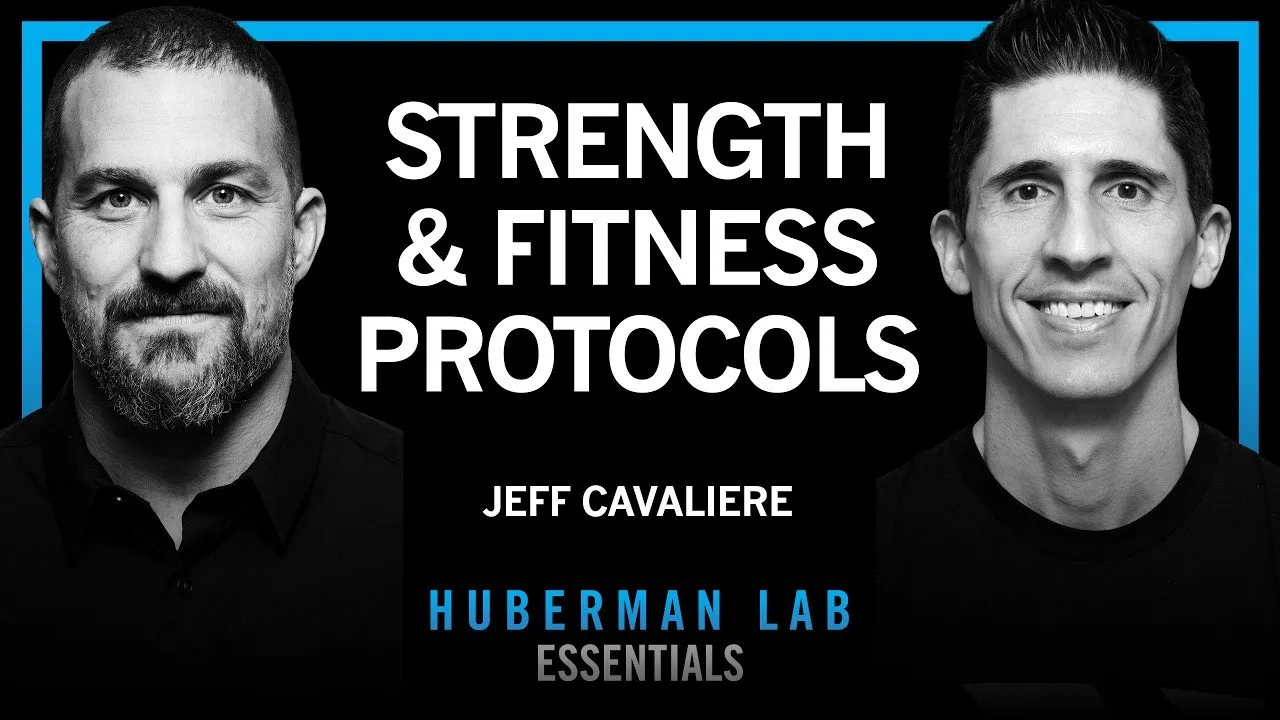
In a compelling discussion on the Huberman Lab Essentials series, renowned neurobiologist Dr. Andrew Huberman and elite strength and conditioning coach Jeff Cavaliere unpack the science-backed principles for optimizing your exercise program. This conversation distills decades of experience and research into actionable strategies for improving mental health, physical health, and athletic performance. From structuring your workouts and understanding muscle mechanics to preventing injuries and adopting sustainable nutrition, Cavaliere shares his signature "train like an athlete" philosophy, emphasizing consistency, intelligent application, and the critical importance of listening to your body.
Key Takeaways
- Balance Strength and Conditioning: Aim for a 60/40 split, dedicating three days to strength training and two to cardiovascular work for a well-rounded program.
- Prioritize Program Adherence: Choose a workout split (e.g., push/pull/legs) that you enjoy and can consistently stick to, as "a split not done is not effective."
- Cultivate Mind-Muscle Connection: Focus on actively contracting the target muscle to the point of a slight cramp, enhancing muscularity and hypertrophy.
- Implement Smart Recovery and Injury Prevention: Monitor muscle soreness and systemic recovery (e.g., grip strength) to guide rest days, and avoid exercises like the upright row that compromise joint health.
- Adopt Sustainable Nutrition: Follow a non-exclusionary approach using the "plate method" (9-20-12 distribution of fibrous carbs, protein, and starchy carbs) to ensure long-term adherence and enjoyment.
Structuring Your Training Week: Strength, Cardio, and Splits
Building an effective exercise program begins with a foundational structure that balances various forms of physical activity. Jeff Cavaliere advocates for a balanced approach, typically leaning towards strength training while ensuring adequate cardiovascular conditioning.
The 60/40 Principle and Workout Duration
For most individuals seeking overall health and performance benefits, Cavaliere suggests a 60/40 split between strength training and cardiovascular conditioning. This could translate to three days of strength work and two days of cardio within a five-day training week, allowing for flexibility in how these days are distributed (e.g., Monday, Wednesday, Friday for strength; Tuesday, Thursday for cardio).
Keeping workouts concise is also crucial, particularly as one ages. Cavaliere emphasizes a core principle:
You can either train long or you can train hard, but you can't do both.
Aiming for sessions under an hour helps maintain intensity and reduces the risk of overtraining or injury, especially since warm-ups become increasingly vital with age.
Choosing the Right Workout Split
The term "split" refers to how you divide muscle groups or movement patterns across your training days. While various splits exist—from full-body workouts to push/pull/legs routines or "bro splits" (one muscle group per day)—Cavaliere's primary governing factor is adherence.
A split not done is not effective.
If a full-body routine feels too fatiguing or time-consuming, a push/pull/legs split might be more suitable. This approach groups similar muscle actions, fostering synergy and a focused training goal for each session. For instance, training all pulling movements on one day allows for concentrated effort and a satisfying feeling of accomplishment. Even traditional "bro splits," which dedicate a day to a single muscle group, can be effective if they increase enjoyment and consistency, though modern science suggests smarter ways to integrate related muscle groups for better recovery and stimulation.
Integrating Cardiovascular Training
Cardiovascular training is a non-negotiable component of a comprehensive fitness program. While a minimum of twice a week is recommended, many individuals will benefit from more. When combining cardio with strength training on the same day, Cavaliere advises placing cardio at the end of the workout. This ensures that the primary strength training session, which relies heavily on intensity, is not compromised by pre-fatigue.
Regarding the type of cardio, Cavaliere often incorporates high-intensity interval training (HIIT) and functional footwork drills (like ladder drills) that blend conditioning with agility and strength. This approach not only makes conditioning more engaging but also offers crossover benefits that straight walking or jogging might not provide. The challenge of learning new movements can be a powerful motivator, almost distracting individuals into effective conditioning.
Mastering the Mind-Muscle Connection
Beyond simply moving weights, truly effective strength training hinges on the ability to connect mentally with the muscle you intend to train. This "mind-muscle connection" is a cornerstone of Cavaliere's philosophy.
The "Cramp Test" and Muscularity
One of Cavaliere's signature tools for developing this connection is what Dr. Huberman terms the "Cavalier test" or "cramp test." This involves actively flexing a muscle to the point of a slight cramp or intense contraction. If you can achieve this sensation, it's a strong indicator that you can effectively stimulate that muscle under load during an exercise.
Cavaliere explains that this stems from a desire to ensure the target muscle is indeed doing the work. By seeking a strong contraction, you enhance what he calls "muscularity" – the resting tone and hardness of the muscle. This improved neurological connection translates to better engagement and ultimately, superior growth and performance. It's about making the muscle "more alive." While some muscles are easier to connect with than others, consistent practice significantly improves this ability.
To achieve muscle hypertrophy and muscularity, one must embrace discomfort. If an exercise doesn't challenge the target muscle in a way that feels intense or slightly uncomfortable, it’s likely not being performed optimally for growth.
Optimizing Recovery and Preventing Injury
Effective training is only half the battle; smart recovery and diligent injury prevention are equally critical for long-term progress and health.
Assessing Local and Systemic Recovery
Recovery occurs at both local (muscle-specific) and systemic (nervous system) levels. Cavaliere notes that different muscles recover at different rates; a bicep might be trained daily, while a larger muscle group might need more rest. Muscle soreness, or DOMS (Delayed Onset Muscle Soreness), serves as a practical local recovery guideline. Training a muscle when it is significantly sore is generally not advisable.
For systemic recovery, grip strength is a powerful, easily measurable indicator. Professional athletes, like those Cavaliere worked with at the Mets, often use grip strength measurements to monitor fatigue. A noticeable drop (e.g., 10% or more) in grip output can signal systemic fatigue, indicating that a rest day might be more beneficial than pushing through a workout.
A simple bathroom scale can be used for a home grip strength test. The inability to make a strong fist when groggy, for example, illustrates how systemic fatigue impacts muscle output. More sophisticated dynamometers offer precise measurements but aren't necessary for general monitoring.
Shoulder Health: The Danger of Upright Rows
The shoulder joint, with its unparalleled mobility, inherently possesses less stability. This trade-off makes it particularly vulnerable to improper mechanics. Cavaliere highlights the upright row as an exercise that significantly compromises shoulder health due to its internally rotated, elevated position.
Everyday life, along with many common exercises, biases internal rotation. The rotator cuff muscles are primarily responsible for external rotation, a function crucial for stabilizing the shoulder and ensuring proper biomechanics during overhead movements. Raising the arm overhead from an internally rotated position increases the likelihood of impingement and stress within the joint. The upright row specifically places the shoulder in this compromised position, mimicking a diagnostic test for impingement (the Hawkins Kennedy test).
Instead of the upright row, Cavaliere suggests the "high pull." This alternative achieves the same benefits for the deltoids and traps without the inherent risk, simply by allowing the hands to go higher than the elbows, thus promoting external rotation. While some argue "I've done this for 30 years without pain," Cavaliere's retort is simple:
I've done this for 30 years and I've never hurt myself. And I always say yet.
The goal is to prevent injury entirely, not just avoid it for a period. This principle extends to the hips, which, like the shoulders, are highly mobile and require balanced training of all surrounding muscles, especially those responsible for external rotation, to maintain long-term health and prevent compensatory movement patterns.
Elbow Pain and Grip Mechanics
Another common gym-related injury, medial epicondylitis (golfer's elbow), often stems from incorrect grip mechanics during pulling exercises. When the weight or bar drifts into the fingertips rather than resting securely in the meat of the palm, undue stress is placed on specific forearm muscles, particularly the flexor digitorum superficialis (FDS).
When you grip a bar… the muscles are not equipped to handle those types of loads.
This distal grip, common in chin-ups or curls, can feel easier because it minimizes forearm engagement, but it overloads muscles ill-equipped for such forces, leading to pain at the medial elbow. The solution is simple: deepen your grip, ensuring the bar is encapsulated by the palm, allowing for greater leverage and distributing the load more effectively. If elbow pain occurs, rest and temporary avoidance of aggravating exercises are crucial, with alternatives like cable curls providing a controlled way to train similar muscles without stressing the injured area.
The Science of Stretching and Flexibility
Stretching plays a distinct role in fitness, divided into two main categories with different purposes and optimal timing.
Active vs. Passive Stretching
Passive stretching aims to increase flexibility and range of motion. This is achieved not by physically lengthening the muscle but by decreasing its resistance to stretch, effectively "taking the brakes off." Due to its effect on the muscle's length-tension relationship, passive stretching is best performed away from workouts or performance events. Doing it directly before can temporarily impair performance by disrupting stored motor patterns (motor engrams), requiring the body to "recalibrate" to the new range of motion.
Cavaliere recommends passive stretching at the end of the day. This timing not only avoids performance impairment but also potentially aids recovery. Muscles tend to "heal shorter" after strenuous activity, tensing up during sleep. Introducing length or decreased resistance to that length during recovery can counteract this shortening and promote better healing, preserving leverage and range of motion.
Muscles prefer to sort of ratchet their way down into that contraction.
Dynamic stretching, conversely, focuses on muscle readiness and exploring the full range of motion in a fluid, active manner. It doesn't aim to increase static flexibility but rather to warm up the body, increase blood flow, and prepare the nervous system for movement. Examples include leg swings, butt kicks, and walking lunges. These movements "touch the ends of those barriers" of range, making subsequent movements feel looser and more ready without disrupting motor patterns. Dynamic warm-ups are excellent pre-workout or pre-performance activities, as they are excitatory and prime the body for action.
Sustainable Nutrition: A Practical Plate Method
Nutrition is often the most challenging aspect of a health and fitness journey. Cavaliere emphasizes a practical, sustainable, and non-exclusionary approach over rigid, dogmatic diets.
The Non-Exclusionary Approach
While various diets (low-carb, high-fat, etc.) can yield results, Cavaliere stresses that for long-term success, nutrition must be sustainable and enjoyable. If an exclusionary diet helps someone gain initial control and achieve a healthier weight, he encourages it, but with the caveat that it must be maintainable forever without negative repercussions.
No plan is going to work if you're eating stuff you don't like.
He advocates for non-exclusionary diets, believing they are the most sustainable approach for a lifetime of healthy eating.
Cavaliere's "Plate Method"
To simplify meal planning without calorie counting, Cavaliere offers his "plate method," which he visualizes like a clock face:
- Fibrous Carbohydrates (Largest Portion): Imagine a line from 9 o'clock to 12 o'clock, and another from 12 o'clock to 20 past. The largest segment (from 9 o'clock clockwise to 20 past, encompassing more than half the plate) is dedicated to green, fibrous vegetables like broccoli, Brussels sprouts, or asparagus. These provide essential micronutrients, fiber, and satiety, helping control insulin response.
- Protein (Next Largest Portion): The next substantial section is for lean protein sources. For active individuals, protein in every meal is crucial. Cavaliere prefers palatable preparations of fish or chicken, often with sauces, to make meals enjoyable without compromising nutritional value.
- Starchy Carbohydrates (Smallest Portion): The remaining, smallest segment of the plate is for starchy carbohydrates. While some diets exclude these, Cavaliere acknowledges the body's craving for them. He opts for healthier options like sweet potatoes, rice, or pasta, but in controlled portions, not in the large quantities typically found in many diets.
This method ensures nutritional balance, satiety, and enjoyment, which are key to reproducibility and consistency.
Pre- and Post-Workout Nutrition
Cavaliere is not dogmatic about specific pre- or post-workout meals, but he underscores the importance of protein intake around training sessions. If protein pre-workout causes digestive issues, it should be consumed post-workout. The "urgency of time" regarding nutrient timing has largely been debunked, allowing for a more responsible and flexible approach to eating. The ultimate goal is to consume nutrition that supports high-level performance without causing discomfort or hindering the workout itself.
For pre-workout "supplements," Cavaliere and Huberman agree that water and caffeine are often sufficient for fueling output. Any pre-workout strategy, whether nutritional or stimulatory, should primarily serve the purpose of enabling optimal performance during training.
The Power of Consistency and Personalization
The overarching theme of Jeff Cavaliere's advice is the profound importance of consistency, coupled with a personalized approach that aligns with individual preferences and circumstances.
Keeping a training journal, for instance, can significantly boost awareness and provide objective goals, making adherence easier than simply "training by feel." While scientific principles offer a logical backbone, the specific application often comes down to what genuinely works for an individual. The fitness journey is not about finding a single "best" method, but rather discovering what you enjoy and can consistently integrate into your life.
The thing that works for you is really the most important thing.
This non-dogmatic perspective is liberating, encouraging exploration of different training styles and nutritional approaches until a sustainable and enjoyable path is found. By demystifying complex concepts and offering practical tools, Cavaliere empowers individuals to take ownership of their health and performance journey.
Conclusion
Jeff Cavaliere's science-based tools for optimizing exercise programs, as discussed with Dr. Andrew Huberman, offer a powerful roadmap for anyone looking to transform their physical health and performance. By embracing a balanced approach to strength and cardio, prioritizing adherence in workout splits, cultivating a strong mind-muscle connection, and rigorously protecting against injury, individuals can build a resilient and effective training regimen. Coupled with a sustainable, non-exclusionary nutrition strategy and a focus on personalized consistency, these principles provide the logical backbone necessary not just to start a fitness journey, but to stay on it for life. The ultimate message is clear: informed, consistent effort, tailored to your body and preferences, is the most potent tool for lasting success.