Table of Contents
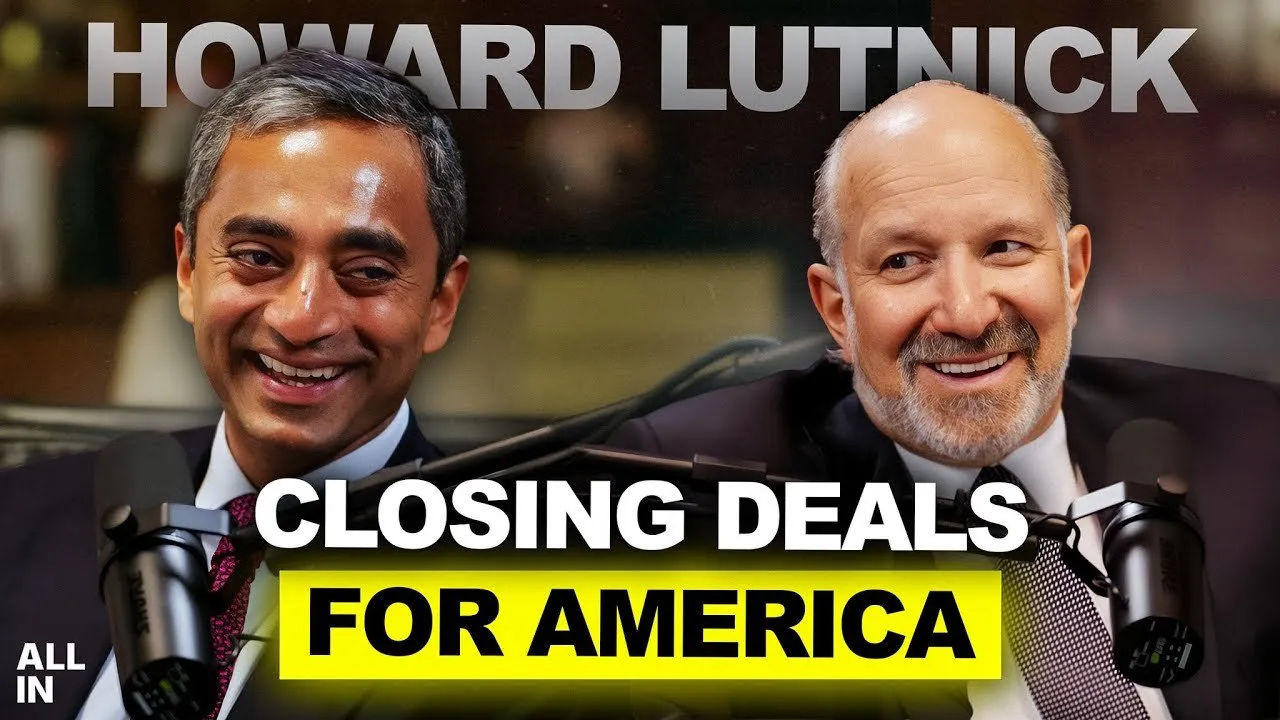
In a recent and revealing discussion on the All-In Podcast, Secretary of Commerce Howard Lutnick offered a deep dive into the economic strategies defining the current administration. Far from the typical bureaucratic approach, Lutnick describes a role defined by aggressive negotiation, a complete reimagining of government efficiency, and a "table setter" dynamic with President Trump. From restructuring the Department of Commerce to leveraging tariffs as geopolitical tools, Lutnick laid out a roadmap that he predicts will lead to unprecedented economic expansion.
The conversation spanned the modernization of government data, the renegotiation of global trade imbalances, and the aggressive repricing of pharmaceuticals. However, the most striking assertion was his forecast for the American economy: a surge to 6% GDP growth by 2026. This post breaks down the mechanics behind that prediction and the structural changes Lutnick is implementing to achieve it.
Key Takeaways
- The 6% GDP Prediction: Lutnick forecasts that a combination of deregulation, on-shoring of manufacturing, and potential Federal Reserve rate cuts will drive US GDP growth to 5-6% by 2026.
- Tariffs as Equity Rebalancing: The administration views the trade deficit not just as a spending gap, but as selling the "equity" of the United States. The goal is to rebalance net ownership assets.
- The "Hammer" Strategy for Pharma: Using the threat of massive tariffs to force pharmaceutical companies to offer "Most Favored Nation" pricing to US government programs.
- Strategic Protectionism in Tech: Renegotiating the CHIPS Act to demand higher investment from foreign entities like TSMC and securing equity stakes (e.g., Intel) and revenue shares (e.g., Nvidia) in exchange for market access.
- Government Modernization: Lutnick has reduced Commerce Department headcount by roughly 20% while moving to put GDP data on the blockchain for transparency and efficiency.
Reimagining the Department of Commerce
Lutnick’s approach to the Department of Commerce is rooted deeply in his background as a high-frequency businessman. Upon taking office, his objective was to transition from an incremental government mindset to an outcome-driven corporate model. He revealed that he quickly reduced the department's headcount from 52,000 to 40,000, arguing that efficiency requires shedding outdated programs—some dating back to the 1970s—that no longer serve modern needs.
His philosophy is one of modernization and transparency. A prime example is the management of GDP data. The Census Bureau and Bureau of Economic Analysis fall under his purview, and Lutnick is moving to automate data collection via APIs and publish GDP figures directly onto the blockchain.
I want to be the cabinet secretary who has the most fun... which means I am outcome driven. If I worked really hard and it failed, it's a fail.
Lutnick describes his role as the "weaver" of a blanket, taking the deep, narrow expertise of career officials and binding them together to execute broad, aggressive policy changes. This restructuring is the foundation upon which his external trade policies are built.
The New Tariff Doctrine: Rebalancing Global Equity
Perhaps the most significant theoretical shift Lutnick articulated is how the administration views trade deficits. He rejects the traditional economic view that a trade deficit is simply a consumer choice. Instead, he frames it as a transfer of national equity.
He uses the analogy of two islands: one that invents and one that produces. If the inventor constantly buys from the producer without selling back, the producer eventually accumulates enough capital to buy the inventor's island. Lutnick notes that in 1985, the US was a net investor in the world by $148 billion. Today, the world owns $26 trillion more of US assets than the US owns abroad.
Negotiating with Allies and Adversaries
The administration uses tariffs not merely as a revenue generator, but as a tool to force investment and rebalance this equation. Lutnick detailed a negotiation with Japan regarding the auto industry. Recognizing that Japan’s market is culturally and economically closed to American cars, the US threatened a 25% tariff.
The resolution was not just about buying more American cars, but about capital investment. Japan agreed to finance $550 billion in US infrastructure projects (such as nuclear plants) using their own low-interest bond markets. The US and Japan will split the cash flows 50/50 until the debt is paid, after which the US retains 90% of the profits. This creative financing allows the US to rebuild infrastructure without raising taxes or increasing the domestic deficit.
Healthcare: The "Hammer" and MFN Pricing
Lutnick also detailed the administration's aggressive stance on pharmaceutical pricing. The core issue identified is that the United States effectively subsidizes global drug R&D, paying top dollar while other nations negotiate significantly lower rates due to socialized medicine price caps.
To address this, the administration pursued "Most Favored Nation" (MFN) status, demanding that drug companies charge the US government the lowest price offered to any other developed nation. To enforce this, Lutnick played the role of the "hammer" alongside health officials.
We said, 'Look, I've got these 232 tariffs. I could smash these companies... I'm the hammer.' So we saved $25–35 billion a year. But more importantly, we made drugs accessible to America at a fair price.
He cites the example of popular GLP-1 drugs like Ozempic and Mounjaro, which are now available via Medicaid and Medicare for roughly $149, a fraction of their commercial price. This was achieved by threatening exorbitant tariffs on the import of these drugs—which are largely manufactured overseas—if companies did not comply with fair pricing.
Tech Sovereignty and The CHIPS Act 2.0
The conversation highlighted a stark pivot in how the US manages its technology sector, particularly regarding semiconductors and Artificial Intelligence. Lutnick criticized the initial rollout of the CHIPS Act under the previous administration as being too focused on "giveaways" and social engineering requirements rather than hard economic output.
Renegotiating with TSMC
Lutnick described renegotiating the deal with TSMC (Taiwan Semiconductor Manufacturing Company). Finding the company in technical breach of contract regarding certain DEI (Diversity, Equity, and Inclusion) requirements that were culturally impractical for a Taiwanese firm, he used this leverage not to cancel the deal, but to expand it. The result was a commitment from TSMC to increase their investment by an additional $100 billion to build more advanced fabrication plants in the US.
The Nvidia and Intel Models
The Secretary also outlined a new model for export controls and government assistance:
- Nvidia: To allow Nvidia to sell high-performance (though slightly restricted) chips to China, the government negotiated a deal where the US Treasury receives a 25% tariff/revenue share on those specific sales.
- Intel: In exchange for government support and grants, the US government effectively took a 10% equity position in the company.
The logic is that if American "national treasures" require state support or diplomatic clearance to operate, the American taxpayer should participate in the upside, helping to offset the national deficit.
The Road to 6% GDP in 2026
The climax of the interview was Lutnick’s economic forecast. He dismissed current growth estimates as conservative and flawed, arguing that they fail to account for the massive wave of industrial construction and manufacturing currently breaking ground.
Lutnick predicts that as these "mega-projects" (fabs, auto plants, data centers) come online, they will drive high-wage employment for skilled technicians—pipefitters, electricians, and welders. He argues this creates "good inflation" or genuine wage growth, rather than monetary inflation.
The timeline he lays out is aggressive:
- Late 2025: Visible growth in the 4% to 5% range as construction projects accelerate.
- 2026: Hitting 5% to 6% GDP growth, catalyzed by a new Federal Reserve Chair who Lutnick expects will cut interest rates.
If they cut rates, you'll see sixes. And what that means is jobs are abundant. Good jobs are abundant. High-paying jobs are abundant.
Conclusion
Howard Lutnick’s tenure at the Commerce Department represents a shift toward a mercantile, transaction-based approach to governance. Whether it is charging admission for access to the US market via the "Trump Card" immigration program or leveraging tariffs to force global capital to fund American nuclear plants, the strategy is consistent: use the immense weight of the American economy to extract better terms.
While critics may argue that protectionism risks global trade wars or higher consumer prices, Lutnick remains steadfast that rebalancing the "national equity" is the only path to sustainable prosperity. If his predictions of 6% growth materialize, it would validate one of the most aggressive economic pivots in modern American history.