Table of Contents
In the digital age, we are often sold the lie that efficiency equals learning. We look for shortcuts, speed-reading hacks, and apps that promise to organize our lives with a single click. However, true understanding is rarely efficient. It requires friction, effort, and time. While digital tools are indispensable for storage and retrieval, the actual process of thinking often requires a more primitive tool: pen and paper.
The notebook remains the backbone of self-education for philosophers, creatives, and high-level thinkers. It provides a level of cognitive engagement—a "mind-muscle connection"—that typing simply cannot replicate. By shifting your workflow to prioritize handwriting during the learning phase and reserving digital tools for archiving, you can build a knowledge management system that is both intellectually rigorous and sustainable.
Key Takeaways
- Friction fosters retention: The physical effort required to handwrite notes slows down information processing, leading to deeper understanding and better memory retention.
- Spatial freedom: Unlike the linear constraints of markdown or word processors, paper allows for non-linear diagrams, arrows, and mind maps that better reflect the messy nature of human thought.
- The hybrid advantage: The most effective system uses paper for "thinking" and "drafting," and digital software (like Obsidian) for "refining" and "archiving."
- Active synthesis: Techniques like mini-essays and predictive subheaders force you to engage with material rather than passively transcribing it.
The Cognitive Science of Friction
There is a prevailing maxim in self-education: the more convenient and quick a process is, the less you actually learn. We see this in the trend of watching educational videos at 3x speed while rapidly tapping out bullet points in a sidebar. While this feels productive, it often results in shallow comprehension. The information evaporates from your mind within hours because there was no "slowness" to anchor the ideas.
Learning is inherently a struggle. It requires friction. When you switch to pen and paper, you introduce a healthy constraint. You cannot write as fast as someone speaks, which forces you to perform a real-time synthesis of the information. You must listen, process, understand, and then summarize the concept in your own words. This effort is the precursor to learning.
The point is not to torture ourselves, but to see that struggle as a precursor to learning. One way you can integrate that is to slow down the flow of ideas.
Scientific evidence supports the superiority of handwriting over typing for retention. The unique intent behind every pen stroke—forming distinct letters, circling key concepts, and physically connecting ideas—engages the brain more deeply than the repetitive, automated motion of typing on a keyboard.
Breaking the Linear Mold
One of the significant downsides of digital note-taking apps, such as Notion or standard word processors, is their rigidity. You are often confined to columns of text, linear blocks, and vertical paragraphs. While efficient for reading, this structure is restrictive for problem-solving.
The Sovereignty of the Page
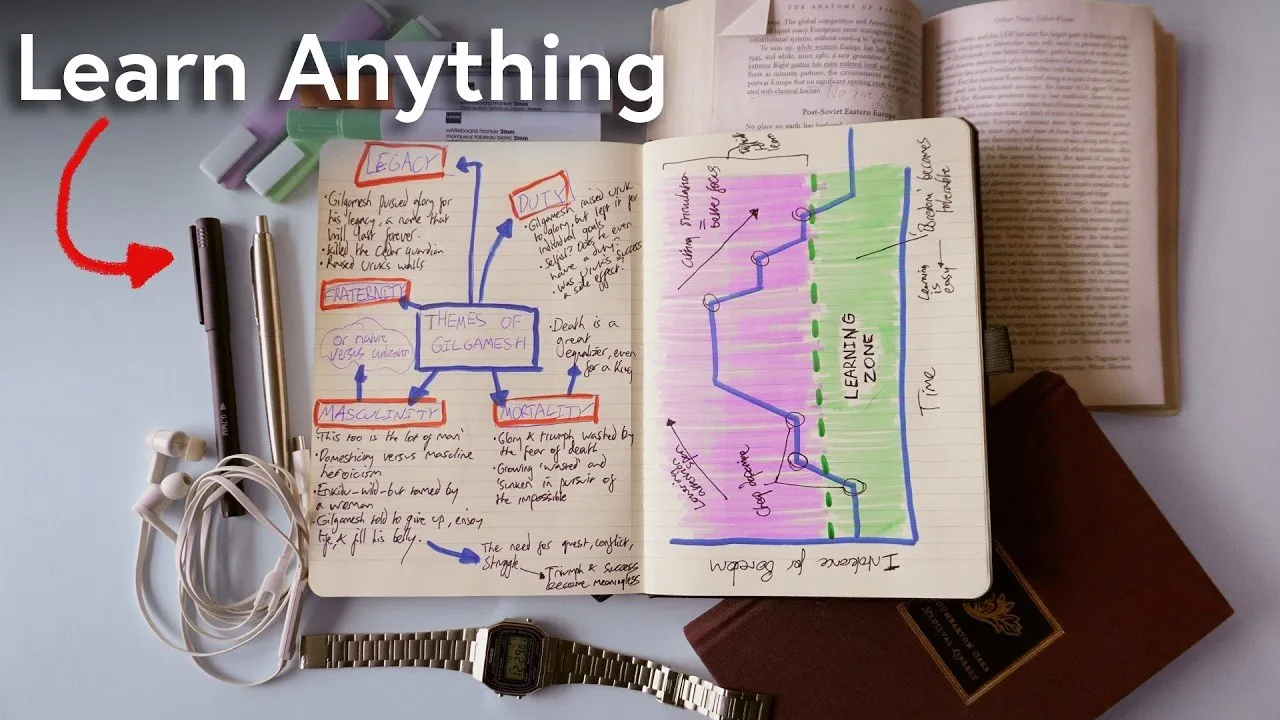
Paper offers total spatial sovereignty. You are free to adapt your note-taking style to the specific requirements of the subject matter. If a concept is hierarchical, you can list it. If it is networked, you can draw a mind map. If it involves a process, you can sketch a flowchart.
This flexibility allows for:
- Mind Maps: Visualizing how disparate ideas connect in a network, rather than a list.
- Diagrams and Doodles: creating visual representations that aid in understanding complex relationships.
- Spatial Grouping: using arrows, boxes, and page divisions to organize thoughts dynamically.
The mind is a very messy place. It's confused, it's busy... and what you're doing here in your notebook is clearing that up. You're thinking out loud.
Your notebook does not need to be a work of art. It is a canvas for your thoughts, not a manuscript for publication. Embracing the messiness of the page allows you to dissect problems, move ideas around, and "fine-tune" your understanding in a way that rigid digital lines prevent.
Practical Analog Methodologies
To think effectively on paper, you need more than just a pen; you need a strategy. Here are several methods to elevate your analog note-taking.
Predictive Sub-headers
When consuming content (reading a book or listening to a lecture), try to mentally categorize the information before it is fully explained. Write down a subheader that captures what you believe is coming next. This acts as a "contents page" for the material.
If the structure is vague, the onus falls on you to define the parts that make up the whole. This is a powerful thinking exercise because it forces you to predict the trajectory of the argument. Under each subheader, use arrows and bullet points to break down the logic or narrative flow.
The Stream of Consciousness (Brain Dump)
Sometimes called a "brain dump," this technique involves writing at the exact pace of your thinking. It is raw and unfiltered. You do not critique the sentence structure or the quality of the ideas; you simply pour the contents of your mind onto the page.
This is particularly useful for:
- Emotional regulation: Walking yourself through a difficult feeling or reaction.
- Idea generation: Digging through the "noise" to find out what you actually believe about a topic.
- Overcoming writer's block: Removing the internal filter to get momentum going.
Mini-Essays and Q&A
Moving beyond bullet points, writing mini-essays is a formal way to test your understanding. These are short pieces of writing dedicated to fleshing out a single point or idea. If you cannot articulate an idea in a cohesive paragraph, you likely do not understand it well enough.
Similarly, the Q&A method involves writing down questions you have about a topic before you start studying. As you learn, you fill in the answers. This turns passive reading into an active hunt for solutions.
The Hybrid Workflow: From Paper to Pixel
Advocating for pen and paper does not require abandoning digital tools. In fact, combining the two creates a system that leverages the strengths of both formats. Paper is superior for thinking and learning, while software like Obsidian is superior for storage and retrieval.
The Transfer Protocol
A common objection to this hybrid approach is redundancy: "Why would I write notes just to type them up later?" However, the act of transferring notes is not administrative busywork; it is a critical part of the learning process.
- Spaced Repetition: Returning to your notes days or weeks later to type them up forces you to review the material, strengthening the neural pathways associated with that knowledge.
- The Filtering Process: You should never copy notes word-for-word. The digital version should be an edited, polished evolution of your rough analog thoughts. You correct mistakes, clarify reasoning, and discard irrelevant data.
- Contextualization: When you input notes into a digital system (like a "second brain"), you can add tags, backlinks, and connections to other topics. This gives your knowledge structure and logic.
Digital notes may be weaker for the actual in-the-moment learning, but there's infinite space. They are infinitely organizable.
By treating your notebook as a temporary workspace—a place for messy drafts and rough ideas—you liberate yourself from the pressure of perfection. The notebook can burn, but the refined ideas survive in your digital archive. This workflow ensures that you benefit from the cognitive struggle of handwriting without losing the long-term utility of a searchable digital database.
Conclusion
Ultimately, the tools you choose should serve your mind, not the other way around. Whether you invest in quality notebooks to romanticize the practice or use a simple biro and scrap paper, the goal remains the same: to slow down and think deeply.
There is no objectively perfect system. You must experiment with different layouts, pens, and digital integrations to find the workflow that reduces friction in your process while maintaining the necessary cognitive friction for learning. Start by picking up a pen, opening a fresh page, and giving your thoughts the space they need to breathe.