Table of Contents
There is a painful irony that many ambitious people live through daily: you feel creative, curious, and eager to understand the world, yet you cannot seem to dig up the motivation to actually sit down and learn. You love the idea of self-education, but the process often feels like a battle against your own brain.
Why does opening a book sometimes feel like torture, even when the topic interests you? The answer lies in how our modern environment shapes our neurochemistry and how we fundamentally misunderstand motivation. To transform learning from a chore into an addiction, we must deconstruct our tolerance for boredom, shift our psychological drivers, and unlearn the rigid habits instilled by formal education.
Key Takeaways
- Reset your boredom threshold: High-dopamine activities (gaming, scrolling) make learning feel artificially tedious; reducing cheap stimulation is a prerequisite for focus.
- Switch power sources: Move from external motivation (deadlines, exams) to internal motivation (curiosity, purpose) to sustain long-term learning.
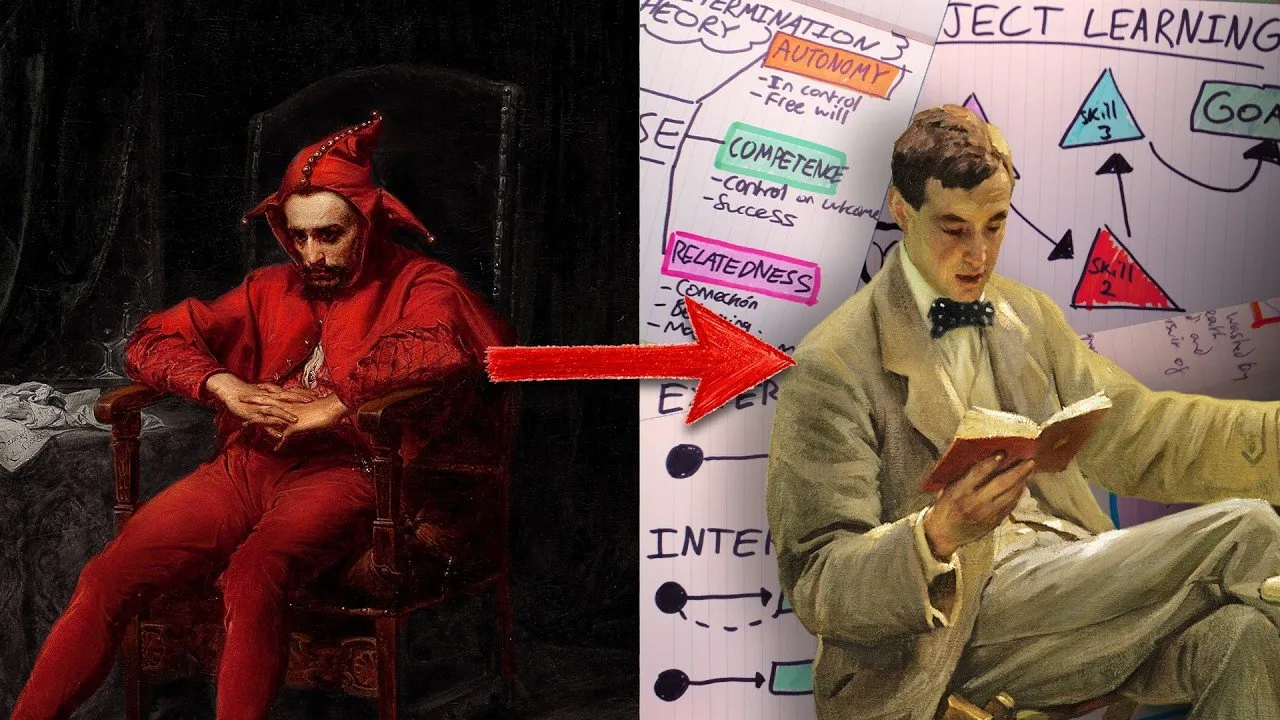
- Apply Self-Determination Theory: Cultivate Autonomy, Competency, and Relatedness to maintain psychological drive.
- Use Project-Based Learning: Reverse-engineer your curriculum by choosing a grand goal and learning only the skills necessary to achieve it.
- Curate digital immersion: Transform social media from a distraction into a tool for discovery and community building.
The Boredom Threshold: Why Learning Feels Impossible
Before addressing study techniques, we must address the biological reality of focus. Critics and educators often note that learning is slow, effortful, and comparatively boring. In a vacuum, this isn't a problem. However, in an environment saturated with hyper-stimulating inputs—video games, fast-paced video content, and infinite scrolling—learning suffers by comparison.
This creates a phenomenon we can call the Boredom Threshold. If your baseline for stimulation is set by "cheap dopamine," your intolerance for boredom rises. Activities that fall below this line of stimulation, such as reading complex texts or practicing a new syntax, feel physically uncomfortable. You become fidgety and restless, not because you lack intelligence, but because you are chemically acclimated to constant input.
The Solution: Dopamine Management
To make learning addictive, you must lower your stimulation baseline. This is a game of relativity. By cutting out sources of instant gratification, you increase your tolerance for low-stimulation activities. When you are comfortable doing nothing, the act of reading or problem-solving suddenly becomes stimulating enough to hold your attention. You don't necessarily need to make learning more exciting; you need to make your other options less overstimulating.
The Psychology of Drive: Corded vs. Cordless Drills
Most of our experience with education is driven by external pressure: exams, degrees, and fear of failure. This is effective but fragile. Once you leave the institutional structure, that pressure vanishes, and many people experience a "doom spiral" of aimlessness.
Think of motivation through the analogy of a power drill:
"External motivation is like a corded drill; you have to be attached to a power source to function. Internal motivation is a cordless drill with a battery—you bring the power with you, and you aren't tied down to anything."
To cultivate this internal battery, we can look to Self-Determination Theory, a psychological framework that identifies three pillars of intrinsic motivation:
1. Autonomy
Autonomy is the feeling that you are the author of your own actions. In self-education, you technically have full freedom, yet many learners still fall into the trap of following trends or algorithms. True autonomy requires introspection: Are you learning this because you genuinely want to, or because an influencer told you it was important? Reclaiming your free will acts as a powerful motivator.
2. Competency
Human beings hate feeling incompetent. We crave the feeling of mastery. However, many self-learners sabotage this by diving into the "deep end" too early—buying dense philosophy tomes or advanced technical manuals to appear intellectual. This leads to frustration and quitting. Competency requires finding the "Goldilocks zone"—a level of difficulty that challenges you without overwhelming you. It means accepting you are a beginner and enjoying the progression rather than posturing.
3. Relatedness
Learning is often a solitary act, which can lead to isolation. Relatedness creates meaning by connecting your knowledge to other people. This could mean finding a community, debating ideas with friends, or applying your skills to a project that helps others. When knowledge exists only in your head, it feels abstract; when it connects you to the world, it feels vital.
Reverse Engineering Purpose with Projects
Purpose is elusive. We often wait for a "grand calling" to strike us before we start learning. A more practical approach is to artificially create purpose through Project-Based Learning.
Instead of studying a subject linearly (Chapter 1 to Chapter 10), define a tangible goal—writing a novel, building an engine, or launching a YouTube channel. Once the goal is set, you learn skills because they are necessary steps to achieve that goal. This shifts the dynamic from "I should learn this" to "I need to learn this to finish my project."
For example, if you want to write a successful novel, you suddenly have a reason to care about grammar, prose structure, and the publishing industry. These dry topics transform into meaningful tools. The project acts as a gravitational force, pulling you through the difficult parts of the learning process.
Unlearning Institutional Habits
Our default approach to learning is inherited from the school system: take linear notes, memorize facts, and finish every book you start. While these methods work for standardized testing, they are often obsolete for self-education.
To love learning, you must be willing to be a "completionist" heretic. If a chapter is boring, skip it. If a book isn't serving you, put it down. In the context of self-education, maintaining momentum is more valuable than comprehensive thoroughness. You might take chaotic notes, watch documentaries instead of reading textbooks, or skim broadly rather than reading deeply.
This flexibility prevents the "grind" mindset. By allowing yourself to follow your curiosity rather than a syllabus, you keep the process dynamic and engaging.
Leveraging Digital Immersion
Social media is often villainized as the enemy of focus, but it can be weaponized for learning through the concepts of Discovery and Community.
When you immerse yourself in a niche—whether it is mechanics, coding, or history—your algorithmic feed shifts. You begin to absorb knowledge through osmosis. Seeing memes, tips, and discussions about your topic daily creates a familiarity that formal study cannot replicate. This "passive learning" keeps the subject top-of-mind and provides a constant stream of micro-motivation.
Furthermore, digital communities provide the "Relatedness" mentioned in Self-Determination Theory. Seeing others struggle with the same concepts or celebrate the same wins validates your journey. By curating your digital environment, you turn a distraction machine into an immersion engine.
Conclusion
Making learning addictive isn't about forcing yourself to study; it's about engineering an environment where learning is the most satisfying option available. By managing your dopamine levels, shifting to project-based goals, and allowing yourself the freedom to learn non-linearly, you can break the cycle of procrastination.
The transition from a passive consumer to an active learner requires structure, but it also requires forgiveness. You don't need to replicate the rigidity of a classroom. You simply need to follow your curiosity, build things that matter to you, and let the process be as chaotic as it needs to be.