Table of Contents
Procrastination is often misunderstood as a lack of willpower, but it is more accurately described as a choice to delay a better future. It is the decision to ignore the potential you could be fulfilling today. Most people believe that to change their lives, they need to overhaul everything at once or summon superhuman levels of discipline. However, the reality of high performance and personal transformation is far less dramatic and far more sustainable. By fixing your inputs—your daily habits—the outputs will fix themselves.
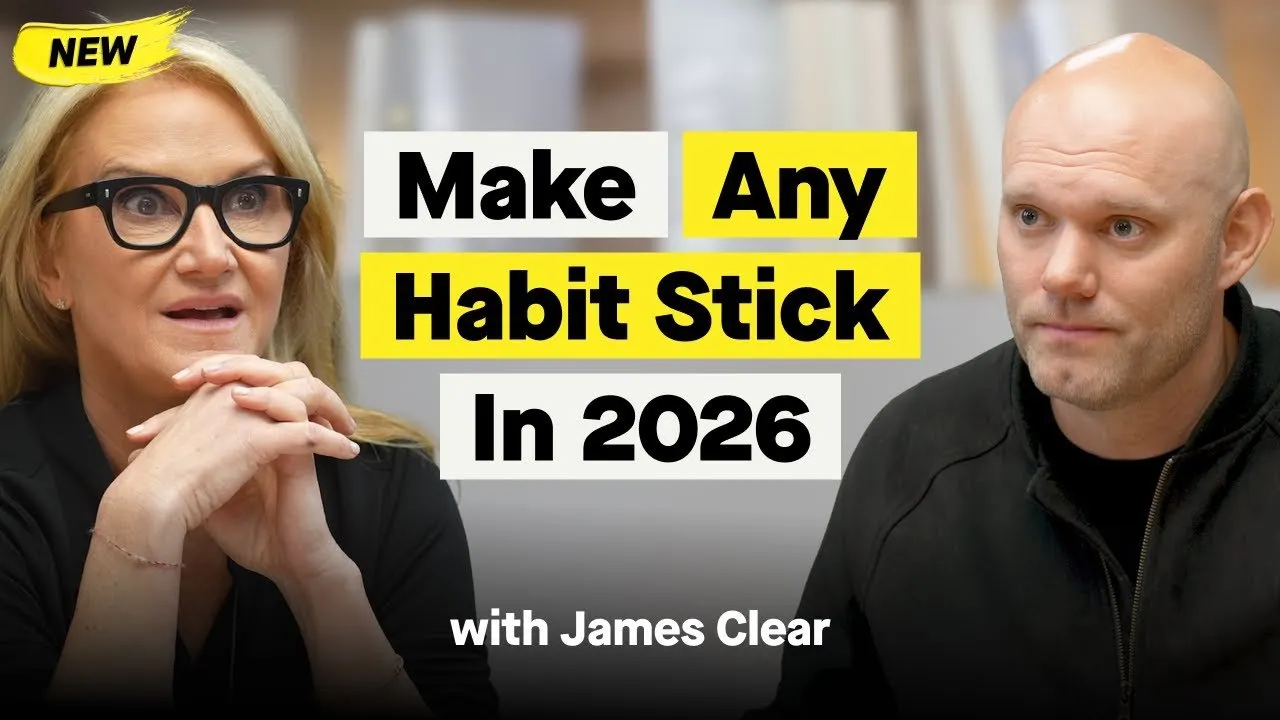
James Clear, author of the global phenomenon Atomic Habits, argues that the secret to winning isn't just about working harder; it is about knowing how to lose, how to bounce back, and how to design a life where doing the right thing is the path of least resistance. Whether you are looking to build a business, get in shape, or simply reduce anxiety, the solution lies in the small, atomic changes you make every day.
Key Takeaways
- The 1% Rule: Improving by just 1% every day results in becoming 37.78 times better by the end of a year.
- Systems Over Goals: Winners and losers often share the same goals; it is the system of daily habits that differentiates the outcome.
- Identity-Based Habits: True behavior change happens when you shift focus from "what I want to achieve" to "who I want to become."
- Action Relieves Anxiety: Taking action reduces fear because it allows you to influence the outcome rather than ruminating on the problem.
- The Two-Minute Rule: Scale down any new habit to two minutes or less to overcome the friction of starting.
The Compound Effect of 1% Improvements
There is a pervasive myth that massive success requires massive action. We convince ourselves that leading a better life requires a quantum leap. However, the math of improvement suggests otherwise. The concept is simple: if you get 1% better each day for one year, the compound effect is profound.
Mathematically, 1.01 to the power of 365 equals 37.78. This means that by focusing on tiny, incremental margins of improvement, you end up nearly 38 times better than where you started. Conversely, if you get 1% worse each day, you drive yourself nearly down to zero.
Time will magnify whatever you feed it. If you have good habits, time becomes your ally. If you have bad habits, time becomes your enemy.
This approach emphasizes trajectory over position. It is easy to get discouraged by your current position—your bank balance, your weight, or your career status. However, these outcomes are "lagging measures" of your habits. Your bank account is a lagging measure of your financial habits; your fitness is a lagging measure of your eating and training habits. If you ignore the current results and focus entirely on the trajectory—getting 1% better today—the results will eventually catch up.
The Airplane Analogy
Imagine a plane taking off from Los Angeles en route to New York City. If the pilot adjusts the nose of the plane just 6 feet at takeoff, the plane will not land in New York; it will land in Washington D.C. A tiny shift in direction, barely noticeable at the start, results in a completely different destination when magnified over time and distance. Your daily habits are that 6-foot shift.
Identity-Based Habits: Changing Who You Are
Most people approach change by focusing on outcomes. They say, "I want to lose 40 pounds" or "I want to write a book." This is an outcome-based approach. To create lasting change, you must invert this process and focus on identity.
Think of behavior change like layers of an onion:
- Outer Layer (Outcomes): What you get (e.g., losing weight).
- Middle Layer (Process): What you do (e.g., going to the gym).
- Core Layer (Identity): Who you believe you are (e.g., "I am an athlete").
The goal is not to run a marathon; the goal is to become a runner. The goal is not to write a book; the goal is to become a writer. When you focus on the outcome, you are chasing a result. When you focus on identity, you are simply acting in alignment with the person you believe yourself to be.
Every Action is a Vote
You do not need to be delusional and tell yourself you are something you are not. Instead, you build this identity through proof. Every time you choose a salad over a burger, you cast a vote for the identity of a healthy person. Every time you write one sentence, you cast a vote for the identity of a writer.
The real reason habits matter is not just because they get you results, but because they can change your beliefs about yourself.
As these "votes" accumulate, the evidence of your new identity becomes undeniable, and the behavior becomes natural. You are no longer "trying" to be healthy; you are simply acting like the person you have become.
Forget Goals, Focus on Systems
We live in a goal-oriented society. We set targets for earnings, fitness, and productivity. While goals are useful for setting direction, they are terrible for making progress. The antidote is to focus on systems.
The distinction is clear:
- The Goal: The result you want to achieve (e.g., winning a championship).
- The System: The process that leads to those results (e.g., how you recruit players and conduct practice).
Consider the Olympics. Presumably, every athlete there has the goal of winning a gold medal. If the winners and the losers have the same goal, then the goal cannot be the differentiator. The difference lies in the systems they follow.
You do not rise to the level of your goals. You fall to the level of your systems.
When you focus too much on the goal, you delay happiness until the milestone is reached. By focusing on the system, you can feel successful every time you execute your habit, regardless of the immediate outcome.
The Four Laws of Behavior Change
Building a habit—or breaking a bad one—follows a neurological feedback loop: Cue, Craving, Response, and Reward. To hack this loop, Clear proposes the Four Laws of Behavior Change.
1. Make it Obvious (The Cue)
Many people think they lack motivation when they actually lack clarity. To build a habit, design your environment so the cues are impossible to miss. If you want to work out, lay your gym clothes out the night before. If you want to drink more water, place filled water bottles on your desk and counters.
The Failure Premortem: Before starting a new habit, ask yourself: "If this fails six months from now, why did it happen?" If you realize you won't go to the gym because it doesn't have a water fountain, buy a water bottle now. Anticipate the friction and remove it.
2. Make it Attractive (The Craving)
Ask yourself: "What would this look like if it were fun?" If you hate running, don't run. Find a form of exercise that feels like play, such as rock climbing or a dance class. The more attractive the habit, the more likely you are to stick with it.
3. Make it Easy (The Response)
Human behavior follows the Law of Least Effort. We naturally gravitate toward options that require the least amount of work. To build a habit, you must decrease the "activation energy" required to start.
If you want to read more, place a book on your pillow. If you want to stop scrolling social media, keep your phone in a different room. The greater the friction, the less likely the habit.
4. Make it Satisfying (The Reward)
What gets rewarded gets repeated. While bad habits often have immediate rewards (stress relief from smoking) and delayed costs (health issues), good habits often have immediate costs (effort at the gym) and delayed rewards (fitness). You must bring the reward forward. Give yourself a small, immediate pleasure immediately after completing the habit to close the feedback loop positively.
Practical Strategies to Lock in Habits
The Two-Minute Rule
The hardest part of any habit is starting. To overcome procrastination, employ the Two-Minute Rule: When you start a new habit, it should take less than two minutes to do.
- "Read 30 books a year" becomes "Read one page."
- "Do yoga for 30 minutes" becomes "Take out my yoga mat."
The goal is to master the art of showing up. A habit must be established before it can be improved. You cannot optimize a habit that doesn't exist.
Habit Stacking
One of the best ways to build a new habit is to identify a current habit you already do each day and stack your new behavior on top of it. The formula is:
"After [CURRENT HABIT], I will [NEW HABIT]."
For example: "After I pour my morning coffee, I will meditate for one minute." This utilizes the strong neural pathways of your existing habits to support new ones.
Never Miss Twice
Perfection is not possible, but consistency is. The difference between peak performers and everyone else is not that they never fail; it is that they get back on track immediately.
If you miss a workout, don't spiral into self-pity. Simply apply the rule: Never miss twice. Missing once is an accident; missing twice is the start of a new, negative habit. The "bad" days—the days you show up when you don't feel like it—are often more valuable than the good days because they prove to you that you are not a fair-weather performer.
Conclusion
Ultimately, your life is a sum of your habits. You have a limited number of hours each day that are truly under your control. By standardizing your habits before you try to optimize them, and by focusing on the trajectory of getting 1% better rather than your current position, you can achieve remarkable results.
Life has different seasons, and your habits may need to adapt to them. Be willing to experiment until you find what works for you. Remember, action relieves anxiety. If you are procrastinating, you are choosing to ignore the results you could be having. Start small, make it easy, and let the compounding effect of time work for you.