
Table of Contents
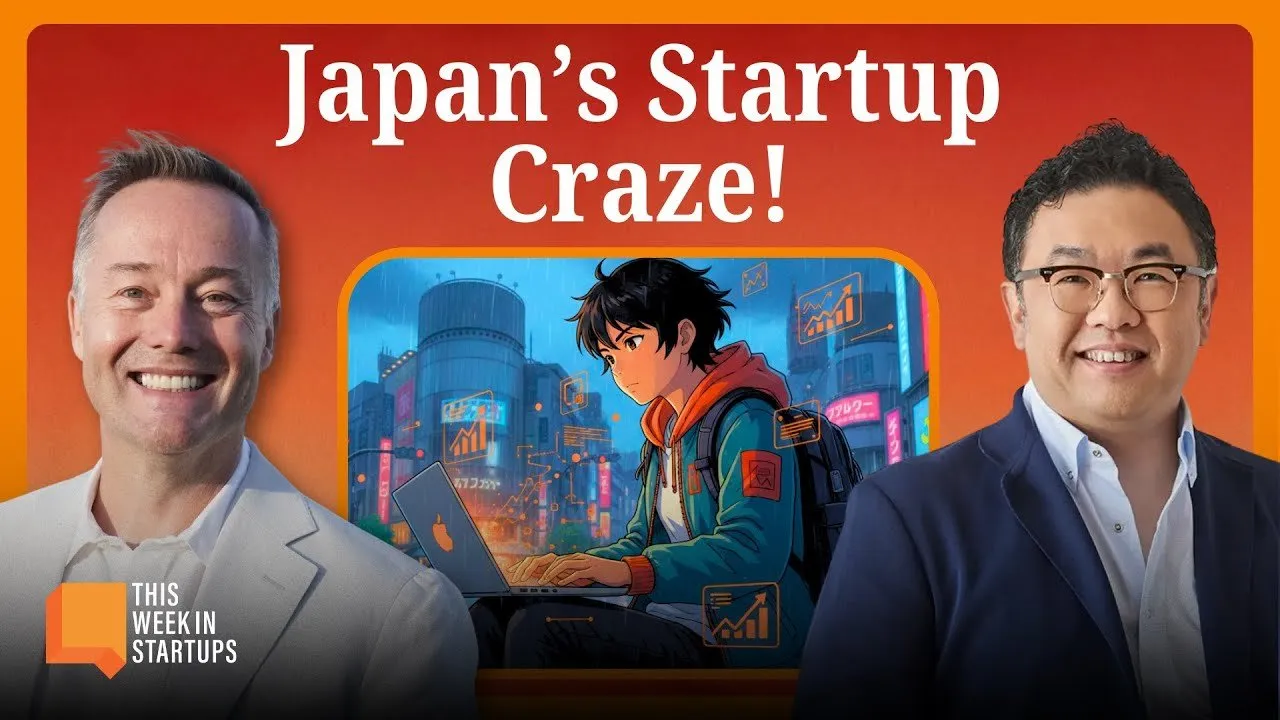
For decades, the global perception of Japanese business culture has been defined by the "salaryman"—a figure synonymous with stability, suits, and lifetime employment at blue-chip corporations. However, a seismic shift is occurring in Tokyo’s economic landscape. During a recent Founder University cohort in Japan, Jason Calacanis sat down with Shin Takamiya of Globis Capital Partners to discuss this transformation.
The conversation revealed that the rigid corporate ladder is no longer the primary aspiration for Japan's top talent. Instead, a vibrant, rebellious, and increasingly "cool" startup ecosystem is emerging. Takamiya, a veteran VC whose firm backed Japan’s first marketplace unicorn, Mercari, offers a masterclass on how founders should navigate this new era, from mastering unit economics to riding the unpredictable wave of artificial intelligence.
Key Takeaways
- The Status Shift: "Startup Founder" has eclipsed traditional prestige roles (like McKinsey consultants) as the most sought-after career path for young Japanese talent.
- Founder Karma: Investors prioritize a founder's deep-rooted "why" over financial motivation; resilience during hard times stems from mission, not money.
- The Investability Venn Diagram: A "great" business is not always an "investable" business. Venture scale requires the overlap of high speed, high margin, and massive scalability.
- The AI "Surfer" Strategy: While the timing of AI dominance is unpredictable, founders must be "in the water" building infrastructure now to catch the wave when it breaks.
- Operationalizing Trust: In Japan’s relationship-heavy market, the connection between founder and investor is less transactional and more focused on long-term character alignment.
The Cultural Renaissance: From Salaryman to Startup Star
The most striking evolution in the Japanese market is the dismantling of the lifetime employment myth. Historically, joining a conglomerate like Sony or Toyota was the endgame. Today, that stability is viewed as a secondary option.
The "Cool" Factor
Shin Takamiya highlights a dramatic reversal in social status. Where risk was once stigmatized, it is now celebrated. The success of Mercari—Japan’s first unicorn to go public—served as a catalyst, proving that tech startups could rival traditional giants.
"The traditional stereotype image of Japanese wearing suits, being what we call salaryman... that's totally gone for young people. Now, high status has shifted to being a founder or even joining startups."
This cultural shift extends beyond employment. "Otaku" culture (anime, manga, gaming), once considered a niche or even derogatory hobby, has evolved into a massive global intellectual property export. This acceptance of alternative cultures parallels the acceptance of alternative career paths, creating a fertile ground for creativity and innovation.
Redefining Failure
Historically, failure in Japan carried a heavy burden of shame. This fear stifled innovation. However, the influx of venture capital—growing from roughly $300 million annually to over $10 billion USD—has provided a safety net that encourages risk. The ecosystem now recognizes that honorable failure is often a precursor to success, provided the founder acts with integrity.
What VCs Actually Look For: Karma and Unit Economics
Takamiya’s investment philosophy at Globis Capital is distinct: they aim to be the "first to last" investor, supporting a company from its seed stage through to its IPO. This long-term commitment requires a specific vetting process that goes beyond spreadsheets.
The "Why" Matters More Than the "What"
In the early stages, product-market fit is often a hypothesis rather than a reality. Therefore, investors bet on the founder's character. Takamiya looks for "karma"—a deep, almost spiritual obligation to solve a specific problem.
If a founder is motivated solely by money or power, they are likely to fold when the startup journey becomes difficult. Conversely, a founder driven by a genuine mission possesses the grit required to pivot and persevere.
Great Business vs. Investable Business
Not every successful company is venture-backable. Takamiya uses the example of a 1,500-year-old Japanese carpentry firm specializing in shrines. It is undeniably a "great" business with longevity and craftsmanship, but it lacks the exponential growth required for venture capital.
To attract VC funding, a startup must sit at the intersection of three factors:
- Scalability: The ability to grow revenue exponentially without a linear increase in costs.
- Speed: The capacity to capture market share rapidly.
- Margin Expansion: Demonstrating that as the business matures, unit economics improve (the "Yum Yum" factor, as Calacanis calls it).
"You want to establish an exponential top line in a growing market... and ensure the cost comes down as you scale up. In the end, your final business model is super beautiful."
Strategic Positioning in the AI Era
Artificial Intelligence represents the most significant technological shift since the internet, but its adoption curve is unpredictable. Takamiya advises founders to treat AI strategy like surfing: you cannot control when the wave comes, but you must be paddling in the water to ride it when it does.
The "Human in the Loop" Bridge
We are currently in a transitional phase. While the technology for full autonomy (in cars or enterprise software) exists, societal trust and legal frameworks often lag behind. The immediate opportunity for startups lies in bridging this gap.
Takamiya points to the "human in the loop" model as a pragmatic approach:
- Client-Facing Safety: Traditional clients (especially risk-averse enterprises) may not trust a fully autonomous AI agent. They need a human account manager or QA specialist to ensure reliability.
- Backend Autonomy: While the client sees a human face, the internal workflow can be heavily automated by AI. This allows the startup to operate with software-like margins while providing service-like assurance.
This strategy allows startups to build the necessary data and infrastructure today, positioning them to switch to fully autonomous high-margin models as soon as the market is ready.
Navigating Investor Psychology
For founders raising capital, understanding the person across the table is crucial. The goal of a first meeting is not to close the deal, but to generate interest. It is a game of finding "investor-product fit."
Rejection is Default
Founders must develop a thick skin. A "no" from an investor often means a lack of alignment rather than a flaw in the business. As Calacanis notes, you only need one lead investor to say yes. If an investor isn't excited, they aren't the right partner for a 10-year journey.
Reciprocal Judgment
The fundraising process is bidirectional. Just as VCs judge founders, founders must evaluate VCs. Takamiya emphasizes that because the relationship can last over a decade, chemistry and trust are paramount. Founders should seek partners who offer candid, objective feedback rather than emotional judgment.
Conclusion
Japan’s startup ecosystem is undergoing a profound modernization, driven by a generation that values creativity and ownership over traditional corporate safety. For international observers and investors, the market offers a unique blend of technological sophistication and deep-rooted dedication to craft.
Whether in Tokyo or Silicon Valley, the fundamentals remain the same: build a scalable engine, stay in the water for the next technological wave, and ensure your motivation is strong enough to survive the inevitable storms of entrepreneurship.




%20%7C%20E2237)