Table of Contents
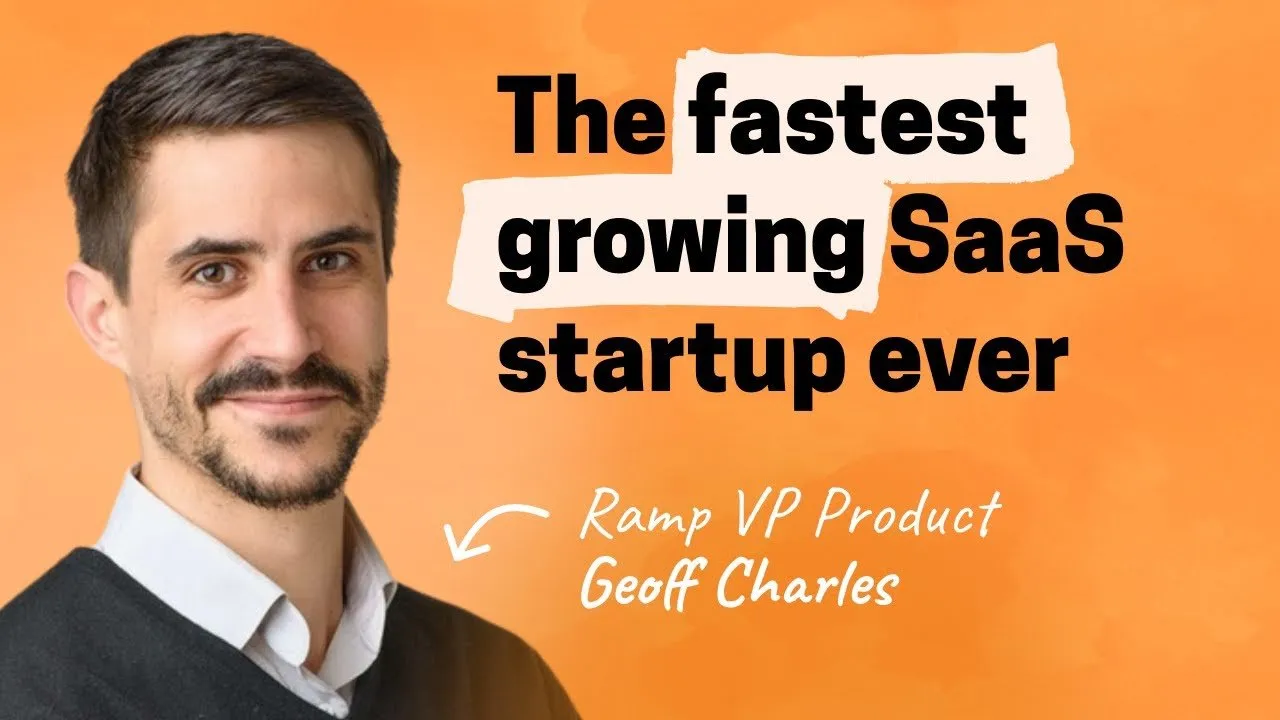
Ramp has earned its reputation as the fastest-growing SaaS business in history, hitting a $100 million annual revenue run rate in under two years. Perhaps even more impressively, they achieved this milestone with a lean R&D department of fewer than 50 people. For many industry observers, the question isn't just what product they built, but how they built it.
The answer, according to VP of Product Geoff Charles, is a singular, obsessive focus on velocity. At Ramp, speed isn't just a metric; it is the defining cultural pillar that dictates hiring, organizational structure, and decision-making. By prioritizing momentum over perfect planning, Ramp has created a unique environment where small teams ship competitors to public companies in a matter of months.
In this analysis of Geoff Charles’s approach to product leadership, we explore the specific operational frameworks that allow Ramp to maintain this blistering pace without succumbing to chaos or burnout.
Key Takeaways
- Velocity is the ultimate leverage: Speed creates a positive feedback loop that de-risks decisions, attracts top-tier talent, and results in higher product quality.
- Single-threaded teams differ from agile squads: To move fast, teams need one clear goal and must be aggressively shielded from distractions, maintenance work, and external chaos.
- Context replaces control: Leaders should debate goals, hypotheses, and data, but leave the specific solutions and roadmaps to the empowered teams closest to the work.
- Planning is a tax on execution: Ramp minimizes quarterly planning and OKRs in favor of a "contract" based on financial goals and product roadmaps, operating with the belief that accuracy in long-term planning is often an illusion.
- Support is a product function: By having Customer Support report directly to Product, Ramp enforces the philosophy that every ticket is a product failure, aligning incentives to fix root causes immediately.
Operationalizing a Culture of Velocity
Many companies claim to value speed, but few operationalize it as aggressively as Ramp. For Charles, velocity is the primary mechanism for de-risking business decisions. If the cost of a decision is low because the team can ship and iterate quickly, the need for agonizing deliberation vanishes. This approach allowed a team of roughly eight engineers to build a competitor to Amex in three months, and subsequently, a competitor to Expensify in the following six months.
The Power of Single-Threaded Teams
The core unit of execution at Ramp is the "single-threaded" team. Unlike traditional cross-functional squads that may juggle maintenance, feature work, and technical debt, a single-threaded team wakes up every morning with exactly one goal.
To make this possible, leadership must aggressively shield these builders from organizational "noise." This involves creating layers of protective tissue around the core product team:
- Rotational Engineering: A dedicated rotation handles bugs and escalations so the core team remains undisturbed.
- Product Operations: This function absorbs the chaos of release management, enablement, and documentation.
- Physical/Digital Isolation: In some cases, teams are physically sequestered in separate rooms or channels to ensure total immersion in their specific mandate.
Quality as a Function of Speed
A common misconception is that high velocity necessitates low quality. However, Ramp’s experience aligns with research from industry experts like Nicole Forsgren: as velocity increases, quality often improves. When the feedback loop between shipping code and fixing issues is tightened, products become more robust.
Ramp operates without a traditional bug backlog. Issues are fixed as they surface. This prevents the accumulation of technical debt that typically slows down legacy organizations.
Strategy: Context Over Control
To scale velocity, leadership must transition from directing action to providing context. Charles describes this as shifting the debate upstream. Instead of micromanaging features or design elements, leaders should focus on aligning teams around the goal, the hypothesis, and the data.
"Whenever things went wrong at Ramp, it was when I was being prescriptive with regards to the solution without actually explaining and aligning upstream on the goal... If you do that, you realize that the solutions actually can come much better from teams that are much closer to the ground."
Once a team is aligned on the strategy, the "contract" between leadership and the product pod is simple: the team owns the roadmap. The leader's role becomes that of a "Repeater in Chief," constantly reinforcing the vision and strategy to ensure the team has the necessary context to make autonomous decisions.
The Anti-Planning Mindset
Ramp takes a contrarian view on traditional corporate planning cycles, such as quarterly OKRs, which often turn into political negotiations that consume valuable time.
"Any second you spend planning is a second you don't spend doing... Accuracy has cost. Make sure that you're only increasing the accuracy of planning for the things that have a high value of that accuracy."
Instead of rigid quarters, Ramp utilizes a bi-annual one-pager outlining company priorities. The "strategy" serves as a contract composed of:
- The Financial Plan: Clear revenue and operational targets.
- The Roadmap: The product deliverables committed to by the teams.
As long as the roadmap supports the financial plan, the team is free to execute without the burden of constant status meetings. Charles notes that he has never scheduled a status meeting; updates should be asynchronous and real-time, leveraging tools rather than conference rooms.
First Principles Thinking in Structure and Talent
Because Ramp spans multiple complex domains—corporate cards, payments, software, and accounting—pattern matching from previous companies is often insufficient. The organization relies heavily on first-principles thinking to solve problems unique to their convergence of industries.
Rethinking Customer Support
One of the most distinct structural decisions at Ramp is having Customer Support report directly to the VP of Product. This reporting line enforces a high standard of accountability.
"Every support ticket is a failure of our product... If the product works perfectly, no one should ever have to contact our support team."
By structurally aligning these teams, Ramp creates a feedback loop where the pain of support volume is felt directly by the engineers and designers capable of fixing it. This has resulted in an exceptionally low contact rate, allowing a lean support team to serve a massive user base.
Hiring for "A-Plus" Talent
The operational model described—high autonomy, low process, high speed—is entirely predicated on the quality of the talent. Charles admits this model breaks down without "A-plus" engineers. At Ramp, an exceptional engineer is defined not just by coding ability, but by:
- Business Curiosity: They ask questions about revenue, market positioning, and customer value, not just technical specifications.
- Proactivity: They jump into sales channels to explain features or fix bugs without being asked or assigned a ticket.
- Desire to Win: They are motivated by market impact and beating competitors, viewing code as a means to a business end.
Avoiding Burnout Through Impact
A culture of "velocity over everything" raises natural concerns about employee burnout. However, Charles argues that burnout is rarely the result of hard work alone. Rather, it stems from working hard on things that do not matter or feeling blocked by bureaucracy.
When teams are empowered, single-threaded, and shielded from administrative thrash, they enter a "flow state." The velocity itself becomes a morale booster. Engineers and PMs see their work in the hands of customers days after conception, creating a loop of gratification that sustains high energy levels.
Conclusion
Ramp’s success suggests that the trade-off between speed and stability is a false dichotomy. By removing the friction of excessive planning, empowering teams with context rather than control, and hiring builders who thrive on autonomy, companies can achieve outlier growth.
For product leaders looking to replicate this velocity, the lesson is clear: stop managing the solution and start managing the environment. Clear the path, set the goal, and trust your team to run.