
Table of Contents
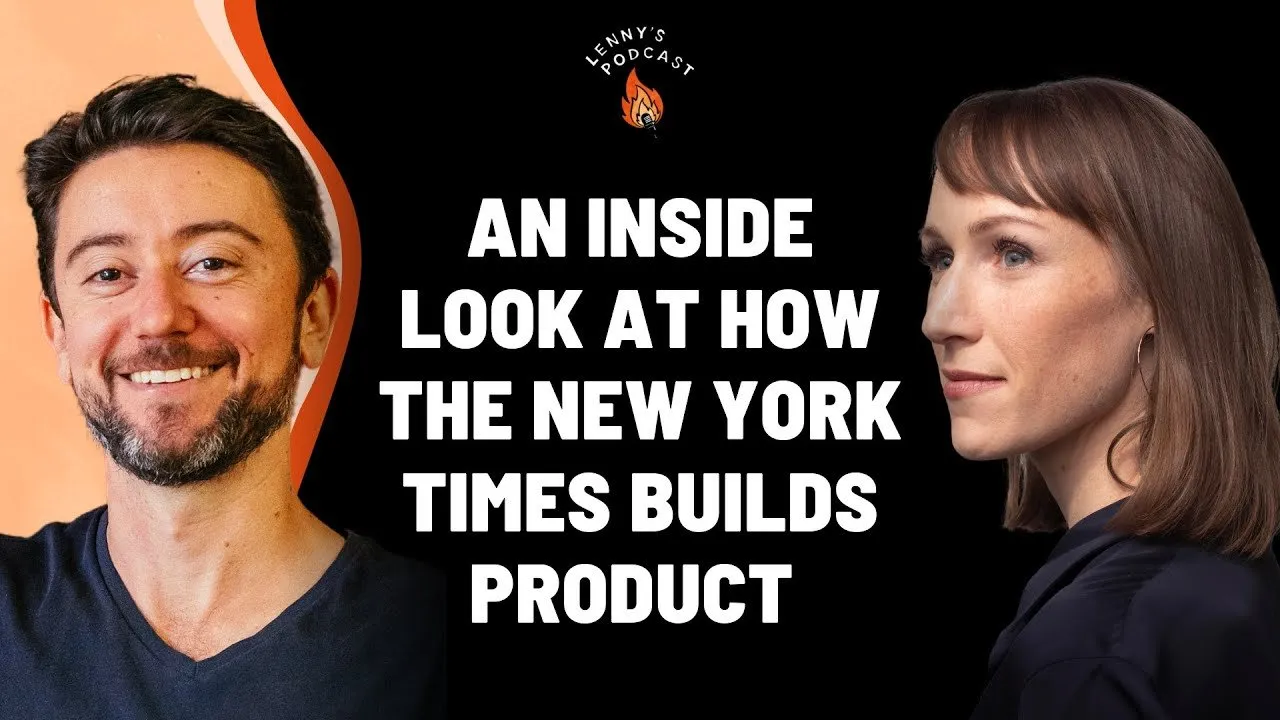
When we think of product management, our minds often drift toward Silicon Valley giants—companies where software is the product and engagement metrics are the north star. But what does product leadership look like at a 170-year-old institution where the primary output is truth, and business goals must remain subservient to a journalistic mission? Alex Hardiman, Chief Product Officer at The New York Times, offers a masterclass in navigating this intersection.
With a career spanning a decade at the Times, a pivotal stint at Facebook during the 2016 election, and leadership roles at The Atlantic, Hardiman possesses a rare perspective on the tension between big tech algorithms and editorial judgment. Her approach to building the "Essential Subscription" reveals how legacy media can successfully pivot to a digital-first powerhouse without losing its soul.
Key Takeaways
- The "Essential Subscription" Strategy: The Times is moving beyond news to become a daily necessity through a bundle that includes Games, Cooking, Audio, Shopping (Wirecutter), and Sports (The Athletic).
- Mission-Driven Metrics: Unlike big tech, where engagement is often the end goal, product metrics at the Times operate in service of the journalistic mission.
- Embedded Editorial Leadership: Cross-functional product teams include editors, ensuring that technology enhances rather than compromises editorial standards.
- The "Solar System" Model: News serves as the sun, providing the gravitational pull and brand authority that allows satellite products like Wordle or Cooking to thrive.
- Wortime Product Management: Crisis moments, such as the onset of COVID-19, require abandoning roadmaps to focus entirely on public service and data accessibility.
The Evolution of the Product Bundle
For a century and a half, the "product" at The New York Times was a printed newspaper—a finite, time-bound package of news, culture, and opinion. Today, the definition of product has expanded to encompass the entire digital user experience. Hardiman describes the current strategy as a move toward a direct-to-consumer relationship, necessitating a shift from being a news provider to a destination.
The company’s ambitious goal is to reach 15 million subscribers by 2027. To achieve this, they are building what Hardiman calls the "Essential Subscription."
The Solar System Metaphor
Hardiman visualizes the product portfolio as a solar system. News is the sun. It is the reason the organization exists, the source of its brand heritage, and the primary driver of trust. It provides the largest funnel for audience acquisition.
Orbiting this sun are "satellite planets"—products that share the same DNA of high-quality reporting and expert curation but serve different life needs:
- Games: Providing mental breaks and daily rituals (e.g., Wordle, Spelling Bee).
- Cooking: Offering utility and inspiration for home cooks.
- Shopping: Delivering trusted recommendations through Wirecutter.
- Sports: Deep coverage via the acquisition of The Athletic.
The product strategy focuses on connecting these disparate experiences into a unified bundle. The objective is to ensure that whether a user enters through a breaking news alert or a game of Wordle, they are introduced to the breadth of value the subscription offers.
Structuring Teams at the Intersection of Tech and News
One of the most distinct aspects of product management at The New York Times is its organizational structure. While the functional divisions of product and design mirror those of tech companies, the execution happens through "Missions."
These cross-functional teams fall into three buckets:
- Consumer Missions: Focused on specific user experiences like News, Audio, or Games.
- Monetization Missions: Focused on subscriber growth and digital advertising.
- Platform Missions: Focused on infrastructure, data platforms, and commerce engines.
The critical differentiator in this structure is the role of the editor. In consumer missions, editors are embedded directly within the product team alongside engineers, designers, and data scientists. This structure ensures that product decisions are informed by editorial judgment from day one, rather than being applied as an afterthought.
"When you're a product manager working at the New York Times... you work across the full stack of the product meaning we own our journalism and our content, we own our distribution, and we own our products. That's really different from working at a big Tech platform."
Algorithms with Editorial Values
Hardiman highlights a fundamental difference between product management in big tech versus media: the inputs used for algorithmic decision-making. At platforms like Facebook, algorithms are largely trained on engagement signals—clicks, shares, and time spent. This often creates a binary environment where content is either "public" or "private," with little distinction regarding quality.
At The New York Times, the product teams build algorithms that scale editorial judgment. For example, when designing the home screen feed, the team starts with expert curation to determine the most important stories. They then layer on machine learning models trained on "editorial importance scores" provided by journalists.
This approach allows the Times to personalize the experience and drive engagement metrics without sacrificing the hierarchy of information that editors believe is vital for the public to know.
Lessons from Acquiring and Integrating Wordle
The acquisition of Wordle in early 2022 serves as a case study in integrating a viral product without destroying its magic. The purchase was driven by the game’s alignment with existing NYT offerings—it was a daily habit rooted in language, similar to the Crossword.
However, the integration process revealed the unique challenges of merging a simple, browser-based game with a complex corporate tech stack. Because the original game stored streaks locally on the user's device, users risked losing their history if they switched devices. The product team prioritized building a backend that connected Wordle to a NYT account, preserving user stats across platforms.
The "Fetus" Incident
Hardiman recounted a specific crisis that highlighted the risks of integration. During the migration of the game’s backend, a pre-programmed word solution—"fetus"—was scheduled to appear the very day news leaked regarding the Supreme Court's potential overturning of Roe v. Wade.
Because the migration was mid-stream, the team could update the word for users on the new version but not for those still playing on the cached, original version. This resulted in different users seeing different words, with some seeing a word that appeared to be a political commentary.
The lesson was transparency. The team had to publicly explain the technical reality of the migration to dispel rumors of editorial interference. It underscored that even "fun" products carry reputational risks in a news environment.
Crisis as a Product Catalyst
The onset of the COVID-19 pandemic illustrated the concept of "wartime product management." In March 2020, the Times faced a scenario where the world needed immediate, accurate information that wasn't readily available from government sources.
Hardiman describes this period as a moment where roadmaps were blown up in favor of immediate public service. The product and engineering teams shifted gears to:
- Build a comprehensive, proprietary database of COVID cases by scraping disparate local data.
- Create localized visualization tools allowing users to check infection rates in their zip codes.
- Remove the paywall for all critical public health information to ensure accessibility.
This pivot demonstrated that in a mission-driven organization, the definition of "impact" extends far beyond revenue. Impact is measured by the ability to help people understand the world during a crisis. Interestingly, this adherence to mission resulted in massive business growth, as half the country visited the Times during the height of the pandemic, reinforcing the trust that converts readers into subscribers.
Conclusion
The New York Times is no longer just a newspaper; it is a sophisticated software company built on a foundation of journalism. For product leaders, it offers a compelling alternative to the Silicon Valley model. It proves that it is possible to build world-class digital products where the primary optimization function isn't just time spent on site, but the depth of understanding gained by the user.
As the Times pushes toward its 2027 goals, its success will depend on continuing to bridge the gap between two distinct cultures: the fast-moving, metric-driven world of tech and the deliberative, value-driven world of reporting.
)